Sans Raison

How does one justify reason without reason? Isn’t this just circular reasoning— circular logic? Can one justify reason without employing reason? Can there be logic without reason?

The Age of Enlightenment is simultaneously the Age of Reason. Reason is the best path forward, and yet one can’t even board the train without a predisposition toward reason at the start.

This reminds me of the troubles the logical positivists encountered by claiming that everything need to be falsifiable, and yet this claim could not be falsified. It’s Hume’s ought problem.

One could employ empiricism, but can one arrive there alogically?

Is there a term for ‘not logical’ without the same baggage as illogical?

  • Alogical
  • Antilogical
  • Contralogical
  • Counterlogical
  • Delogical
  • Dislogical
  • Inlogical
  • Mislogical
  • Nonlogical
  • Oblogical
  • Unlogical

For example, a work of art is not (necessarily) logical, but neither is it illogical; this feels like improper usage. So, what prefix modifier would one employ to communicate ‘not within the sphere of logic’ in shorthand? Or is it just ‘not logical‘. That doesn’t seem quite right either.

Clearly, shambling down some rabbit hole…

What Reason?

Any system built on the presumption of widespread capacity for reason is bound to fail. The ability for most humans to ‘reason’ is clearly abridged and homoeopathic. And this is before one factors in cognitive deficits and biases. This is separate from sense perception limitations.

Nietzsche was right to separate the masters from the herd, but there are those in both classes with these limited capacities, though in different proportions.

People are predictably irrational

In economics, we have to define reason so narrowly just to create support the barebones argument that humans are rational actors—that given a choice, a person will take the option that leaves them relatively better off—, and even with this definition, we meet disappointment because people are predictably irrational, so they make choices that violates this Utilitarian principle. And it only gets worse when the choices require deeper knowledge or insights.

Democracy is destined to fail

This is why democracy is a destined to fail—it requires deeper knowledge or insights. The common denominator is people, most of whom are fed a steady diet of the superiority of humans over other species and lifeforms and who don’t question the self-serving hubris. They don’t even effectively evaluate their place in the system and their lack of contribution to it.

To the masters, who are aware of the limited abilities of the herd to reason, it seems like hunting fish in a barrel. If we convince the herd that they have some control over their destinies, that’s as far as it needs to go, but among the masters, there are subclasses, so people in these factions are also vying for position, so each employs rhetoric to persuade herd factions.

No one is sheltered from the limitations of reason

To the people out reading and writing blogs and such, confirmation bias notwithstanding, they may more likely to be ‘reasonable’ or able to reason, but try as they may, no one is sheltered from the limitations of reason.

More on this later…

Emotion Trumps Reason

“Reason is, and ought only to be, the slave of the passions, and can never pretend to any other office than to serve and obey them,” said David Hume said in his Treatise of Human Nature.

Reason is, and ought only to be, the slave of the passions, and can never pretend to any other office than to serve and obey them.

David Hume, A Treatise of Human Nature

Hume claims that “reason alone can never be a motive to any action of the will,” and that reason alone “can never oppose passion in the direction of the will.”

In the United States, forces on the Left have still not learnt this lesson. They are still trying to fight emotion and irrationality with reason. It’s like trying to coöpt the insane with rationality. It’s not going to happen.

And despite protestations, even the most supposedly logical of us are still motivated by some emotion or passion, as much as we can try to deny it. One can claim to have become an accountant or an engineer or a physicist because it was a calculated, logical thing to do, but in the end, even the brightest of these are driven by passion, by emotion.

As long as we are fighting emotion with reason, the battle is already over before it starts. We need to fight emotion with empathy. This is where the story of the oak and the willow comes in handy. Reason is the oak. Reason is the hare, but emotion is the supple willow of the tenacious tortoise.

Wage this fight and escalating commitment will prevail, as the emotional response will trigger a sort of fight or flight, but your opponent’s reason will form a hard shell to fend off any attacks.

But don’t feel too smug. It’s only your emotions that give you the passion to fight the good fight. Reason has convinced you that this is the logical route.

Emotion-Reason Scaling

I’ve been engaging in an online dialogue on the topic of a scale or continuum of emotion and reason with Landzek through comments on his blog. Since, I am unable of posting images in his comments (AFAIK), I am posting them with commentary here.

He’s got 4 parts of this topic (so far), but, for reference sake, it starts here. Without retreading context you can get on his site, the essence is the notion of a scale, a spectrum between emotion and reason. In part 4, he conveys something I interpret as a time series graphically as image A.

Emotion and reason are a dimension represented on the Y axis, and time is on the X axis.

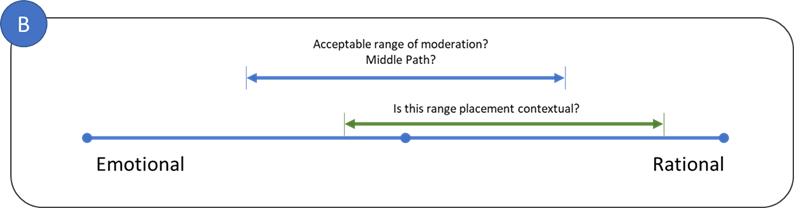
Prior to this, time was not a factor, so I had been constructing this as a simple continuum as shown in image B.

Here, there is only a X axis, running from emotional to rational, representing reason. Ignoring for the time of the index of the scale and not being concerned if the relationship is even-tempered linear or something else.

Secondarily, is there a quality perspective to the placement? My initial questions are embedded on the graph.

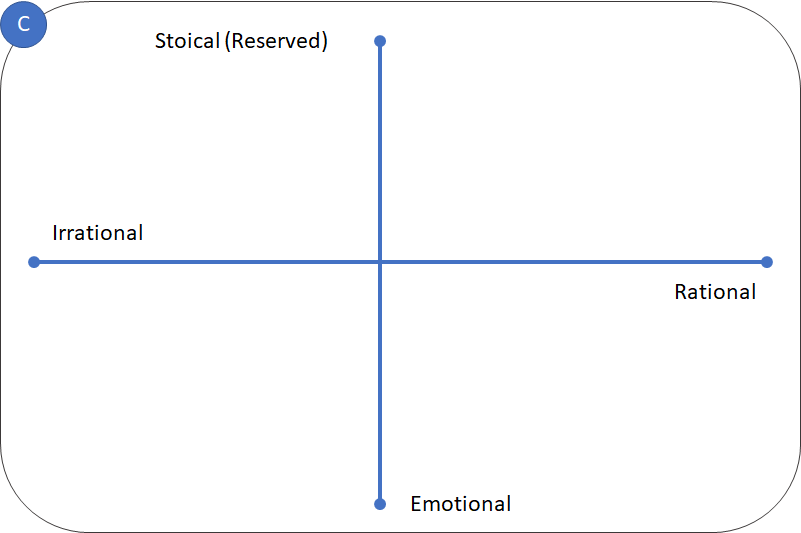
As I don’t feel that the Emotional-Rational scale are opposites, I’ve been thinking through how this scale might work. My first take was along these lines, creating a Cartesian plane.

In this, Irrational and Rational create an X-axis scale and Reserved and Emotional create the Y axis. I’m not sure what the nomenclature opposite of Emotional is, but stoical or reserved are placeholders for now.

Upon further thought, I am not sure irrational is the extreme opposite to rational. I am also not sure what the interplay of rational versus irrational versus non-rational should be, but I created a fourth chart as a basis for discussion.

I am not making a claim that any of these are correct. I am just trying to think this through visually. As I’ve got a day job, I need to get back to, I at least wanted to provide this foundation for conversation.

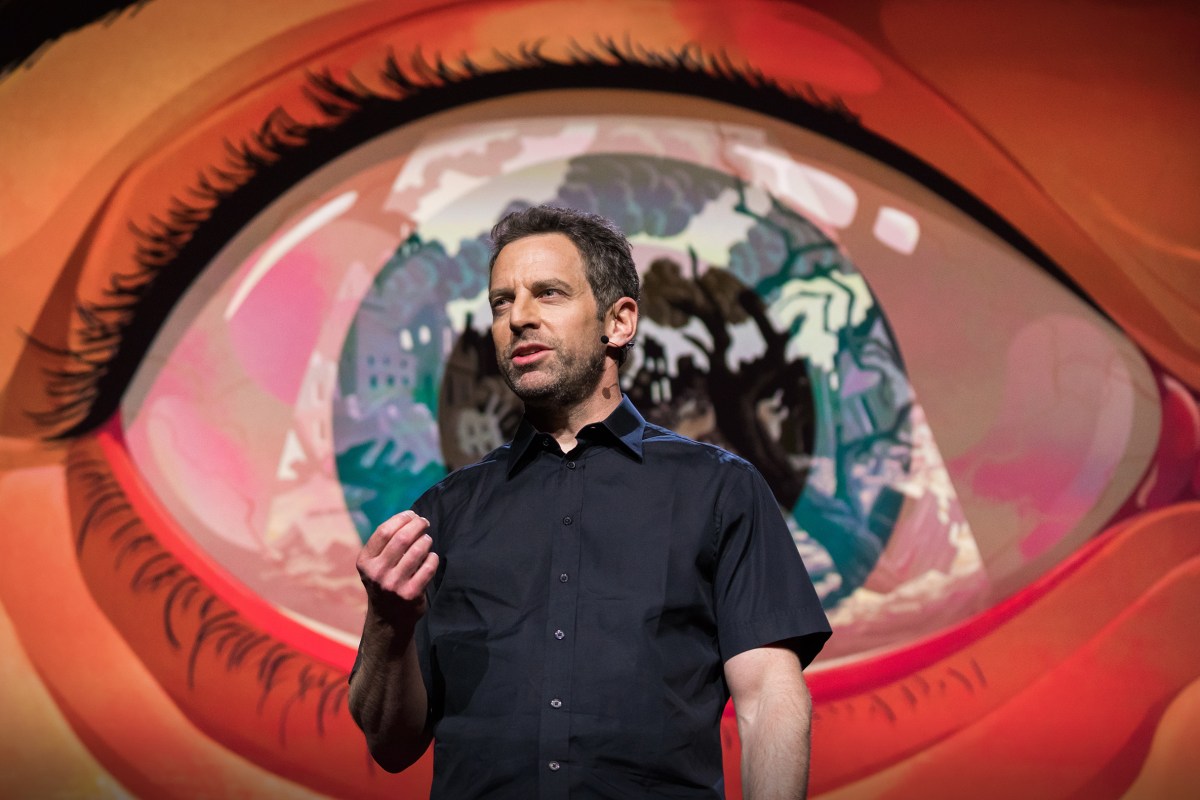
Sam Harris and the Myth of Perfectly Rational Thought