Fiction in the form of film, television, and books has an insidious propaganda effect. This effect is not necessarily conscious or intentional. In practice, it may simply be a meme as a result of prior programming.
I don’t tend to engage with much fiction, though I have in the past. I hadn’t really considered the indoctrination effects at the time. Lately, on account of my significant other, I’ve been consuming fiction via Netflix, Amazon Prime, HBO, Starz, and the like. It’s mostly drivel, in my opinion, but I like to spend time with her, and we can connect discussing plot lines and such over a shared experience.
I find the repetition of facile but culturally prevailing themes such as right and wrong, good and evil, heroes and villains, the power of community and the detriment of the individual, except for the rugged individual, who prevails against all odd.
These shows propagate pop-psychology beliefs and over-simplify complexity to create a digestible narrative, but which is the equivalent of eating refined white bread instead of whole grains.
My point is not that the writers are seeking to influence the masses, it’s just to point out that this is the case. People view this, and use it to calibrate their own believe systems, but it’s a recursive, self-referential model—an echo chamber. I haven’t done any investigation or research into whether people have already made this connection. I will if I get the time.
One might argue that a counter model would not be well-received, and a goal of most fiction is to gain an audience and earn some money, so give the people what they are asking for and don’t make them think about their worldview. Besides, a single film or series is likely to challenge ones prevailing filters anyway. Even if someone were to create an anti-theme, cognitive dissonance may just rationalise it as a statement, so satire rather than objective criticism.
We do have Absurdist authors, like Franz Kafka, Donald Barthelme, or even Kurt Vonnegut, who rather point out absurd situations in life and some possible speculative fictions, but these Post-Modern writers are accepted, though arguably not widely consumed, save for intellectuals and their quasi-counterparts.
If I had more time, I’d document a few examples, but these shows are typically difficult to sit through once casually let alone carefully dissect. Perhaps, I’ll do this for the sake of science.
In my post, The Truth of Truth, I linked to a BBC page outlining Emotivism. I did this even though the leading paragraph reads, as follows:
Emotivism is no longer a view of ethics that has many supporters. Like subjectivism it teaches that there are no objective moral facts, and that therefore ‘murder is wrong’ can’t be objectively true.
BBC Ethics Guide
As I subscribe to Emotivism and its Prescriptivist progeny, I’ll respond from my perspective. Let’s parse the paragraph stepwise:
Emotivism is no longer a view of ethics that has many supporters.
Notice immediately the appeal to popularity. People have been convinced rhetorically that this cannot be true, primarily because they are uncomfortable with the notion. People tend to resort to escalating commitment, digging in their heels and doubling down on their position.
Just because something is popular doesn’t make it incorrect, but neither are unpopular opinions untrue.
Like subjectivism it teaches that there are no objective moral facts…
Indeed, as I’ve discussed at length, there are no moral facts. Morals are human constructs of language and subject to contextual framing. The prevailing meta-narrative is that a moral code is necessary in a society, which is further predicated on the notion that society is necessary. Any moral code is, then, by definition, subject to this underlying meta-narrative.
I can say that I think society and cooperation are necessary for the continuation of our human species, but this is also admittedly and unabashedly self-centred hubris—another unquestioned meta-narrative.
We also have a domain boundary problem. At times, we have altered the boundaries to exclude people from the definition, hyper-focus on people in the definition, or exclude entire other species and kingdoms.
All of these are subjective. So when the inevitable response is, ‘I mean for humans’, we now know the subject.
…‘murder is wrong’ can’t be objectively true.
On the topic of emotion, murder is a heavy hitter. After all, who is going to argue that murder is not wrong, let alone subjective?
Even on the surface it’s obvious that this is a tightly scoped claim, and there a few things going on here:
Murder is a legal subset of killing.
As for the victim—murderee anyone?—, s/he is defined to be human. We cannot murder dogs or roses.
As for the actor—I’m going with murderer here—, this subset is limited to (A) humans, (B) killing not authorised by the State, and (C) unintentional killing.
A human can be declared a non-person or a partial person in order to exempt it from the moral charge. We’ve seen this time and again throughout history, entire classes of people who could be killed with no moral outrage.
A human can be exempted (given a free pass) by maintaining that their killing isn’t murder whilst others are vilified for killing not yet regarded as murder. The rules are subject to change without recourse.
The State declares that killing in some justified circumstance puts a person in some protected realm outside of the scope of murder. These might be military personnel, police officers, executioners, and so on.
Abortion antagonists claim that doctors performing these procedures should be considered to be murders.
Euthanasia opponents claim that doctors performing these procedures are murders.
If one—the subject—does not accept this frame, s/he also doesn’t accept the, let’s say, verdict. Vegan philosopher, Peter Singer claims that all animal life should be protected, that any killing is immoral. Some have claimed that natureitself should have a voice.
And so a statement like ‘murder is wrong’ is nothing more than a prescriptive emotional statement:
I feel that murder is bad (emotions with justification defended by protective layers of reason), and you should too.
Just Saying
Not an ounce of objectivity to be found, excepting, of course, for the objection I have to the counter-claim.
I’ll save you a click to the BBC page. These paragraphs are as silly as the first.
Emotivism has become unpopular with philosophers because the theory that led the Emotivists to think that moral statements were meaningless has fallen from favour.
Less technically, if expressing moral judgements is really no more than expressing one’s personal opinion there doesn’t seem any useful basis for arguing about moral judgements.
In practical terms, Emotivism falls down because it isn’t very satisfying. Even (most) philosophers think moral statements are more than just expressions of feeling.
And it’s perfectly possible to imagine an ethical debate in which neither party has an emotion to express.
Non-philosophers also think there is more to ethics than just the expression of an attitude or an attempt to influence behaviour. They want a better explanation and foundation for shared standards of morality than Emotivism can provide.
Please note that this content has been subsumed into the originating article: The Truth about Truth.
This is a response to this comment by Landzek from The Philosophical Hack regarding the notion of intended truth in communication, the fourth amendment in a series of posts extending the concept commenced in The Truth about Truth.
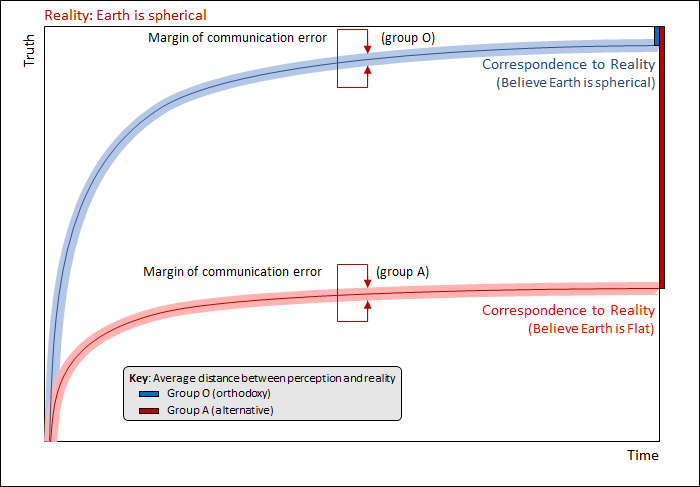
Extending the simple asymptotic function from the first amend, we might see (in Graph 4a) a slight variation in interpretation due to the insufficiencies of language—providing us with a close enough for the government approximation to some shared perception. People in this group will tend to agree on some perception, say, that the earth is spherical.* The average distance from perception to reality is the same for all in-group members, give or take some small variance that I’ll dismiss as an insignificant rounding error.
Graph 4a: Correspondence of Truth to Reality (Simplified in-group concurrence)
Graph 4b, however, illustrates two opposing perceptions of reality. In this example, I show proponents of orthodoxy (group O), who claim the earth to be roughly spherical, arbitrarily closer to reality than proponents of an alternative theory (group A), who claim that the earth is flat.
Each in-group has some variance from the mean notion, but ex-group members are orders of magnitude apart, as measured by the blue and red bars to the right of the chart. If we assume some binary condition that the earth is either spherical or flat with no other options, one of these might be considered to be right whilst the other would be wrong. We can establish this situation relative to the ex-groups, but, still, neither of these is comparable to Reality™ .
Graph 4b: Correspondence of Truth to Reality (Simplified ex-group concurrence)
The intent of each group may be to promote the perspective of the group—each claiming to be closer to the truth than the other. It is easy to imagine a situation where both claimants are equally distant from the truth:
Imagine two groups, each making opposing claims:
Tarot is superior to Astrology in predicting the future.
Astrology is superior to Tarot in predicting the future.
I’ll go out on a limb here and create a reality where the future is not predictable by either measure, irrespective of what each in-group believes.
* I understand that the earth being an oblate spheroid is primarily an analytical distinction, so is tautologically true, but I am using a simplification of a commonly accepted fact.
Please note that this content has been subsumed into the originating article: The Truth about Truth.
THIRD: Rhetoric is a primary driver to fashion our sense of how close or distant we are from reality. Rhetoric shapes and focuses the frame.
War Is Peace, Freedom Is Slavery, and Ignorance Is Strength
— 1984, George Orwell
I’ve already commented at length about the primacy of rhetoric. To recap for the purpose of this disquisition, the only meaningful arbiter of truth is rhetoric—the ability to persuade the larger populace to accept something as true.
Here, I’d expect someone to counter with, ‘Just because people are convinced that something is true doesn’t make it so’, and they’d be right. However, as we cannot access the underlying reality accept through our admittedly fallible senses, who’s to argue?
Moreover—going off on a tangent—, we know that other lifeforms—let’s stick with the animal kingdom—have different senses than humans, and some humans perceive things differently to the normie (if I may adopt a spectrum term) .
Sharks have electroreception (re: The Ampullae of Lorenzini), which allows them to perceive small changes in electrical fields as well as what’s termed a lateral line ( mechanoreceptor function), which allows them to recognise changes in environmental pressure. Other known sensory adaptations are echolocation in bats and dolphins and chemoreceptors (notably in insects and snails).
We are probably also aware that different animals have differing degrees of sense acuity compared to humans. Dogs hear frequencies above the human threshold and have better olfactory discrimination. Birds of prey have superior vision. Women typically have a broader colour vocabulary.
And then there’s synesthesia, a condition in which one sense is simultaneously perceived as if by one or more additional senses. A person with synesthesia may perceive sound as colour (chromesthesia) or perhaps taste.
Given concepts of normality, we presume we are synesthesia are normal and these other people are somehow not, but for all we know, we normies are evolutionary dead ends, soon to be displaced by synesthesiacs. (Is that even a word? It is now.)
But I digress.
Perception is reality. If one can convince you of something, e.g. Donald Trump is a good president, then it’s ostensibly true to you. If one can convince an entire population that something is true, e.g. the plot of Orwell’s 1984, or The Matrix, then who’s to say otherwise.
Please note that this content has been subsumed into the originating article: The Truth about Truth.
SECOND: We have no idea if any changes to our perception move us closer to or further from Reality.
Rather than being asymptotic, perhaps the relationship to is polynomial (or the result of some stochastic function). See the graph above. As we move into the future (in red) and look back, we may perceive that we’ve reversed against some notion of progress. Common wisdom is that progress is directly, positively related to time. But is it?
In my last post, I reference how Einstein progressed and refined Newtonian physics, but in the future, this could be shown to be wrong. In our minds, what had seemed like progress may in retrospect turn out to have been a false assertion.* Moreover, we’ll dutifully accept this updated notion of truth if the rhetoric is sufficient to fit our concept of evidence, especially given humans’ propensity for pareidolia.
Taking our understanding of gravity as the fabric of space-time, we still have no idea what’s going on or how it operates, but this doesn’t prevent us from accepting it as a black box and making pragmatic predictions from there. So, for all intents and purposes, the ‘truth’ mechanism is less important than the functional relationship, just as I can tell time on a watch I have no idea how it operates.
I am no true Sceptic, but neither do I accept the prevailing meta-narrative whole cloth. Unfortunately, I am in no better position than the next to discern proximity to the underlying structure of reality.
* I am not versed well enough in the history of science, but I’d be interested to know which, if any, scientific advances have been a step ‘backward’, that a belief had overtaken a prior belief only to have reverted to the former.
I am aware of the slow march of science and the ignorance of possibly valid assertions simply because the rhetoric was not strong enough or the PR just wasn’t adequate. An example might be the debate of theoretical Democracy versus Communism: which is better than the other. Of course, there are too many dimensions to consider, and the adoption or exclusion of one dimension over another might be enough to tilt the outcome.
In the real world—see what I did there—, the US spend billions upon billions of dollars to interfere with Communism—and I am not taking a position whether it would have succeeded or failed on its own terms—, just to be able to knock down the strawman some century later though propagandising and disinformation campaigns.
Please note that this content has been subsumed into the originating article: The Truth about Truth.
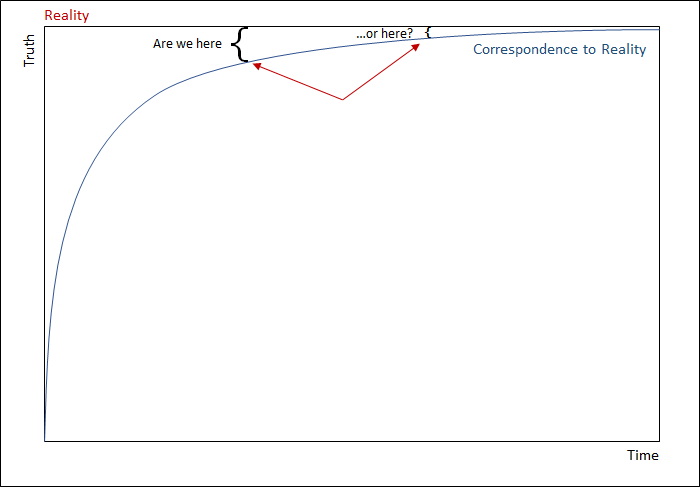
We have no idea how close or far we are from Reality on the Y (Truth) axis.
Graph: Correspondence of Truth to Reality (Asymptotic Curve)
Assuming for the time being that there is an approachable truth, we have no reference to understand how close to reality we might be. In practice, we seem to operate on a basis of always being within some level of statistical significance of where Truth = Reality, and when new information is introduced, we say, “Hooray for Science!” Aren’t we glad that science is self-correcting. And Empiricism has its own issues.
Historically, we’ve had ‘wrong’ correspondence between Truth and Reality, but then we got it ‘right’—until we didn’t.
We may all know how Einstein progressed and refined Newtonian physics. What Einstein did is to create a new narrative—a synchronous shift of paradigm and rhetoric—, which has been accepted into a new orthodoxy. In our mind, this feels like progress. How close are we to the real truth?
Taking our understanding of gravity or of the fabric of space-time, we still have no idea what’s going on or how it operates, but this doesn’t prevent us from accepting it as a black box and making pragmatic predictions from there. So, for all intents and purposes, the ‘truth’ mechanism is less important than the functional relationship, just as I can tell time on a watch I have no idea how it operates.
The notion of Truth is not as cut-and-dry as it might appear at first glance. As a non-cognitivist, I don’t believe in the notion of objective Truth, so I am not entirely sure why it matters enough to me to continue to talk about it. I suppose I’m an Emotivist and Prescriptivist, if these terms capture the essence of my feelings. The Emotivism is what attracts me to an issue whilst Prescriptivism is why I feel the urge to transmit my beliefs. I’ll also suppose, if I adopt an evolutionary survival framework, that people do this to enhance probability of survival by minimising otherness. It also identifies me to those with a similar perspective. The inherent risk is that this attempt at community-building also broadcasts my potential—and let’s be real here, actual—otherness.
In practice, I’d venture that most people simply take the notion of truth for granted, and given an inquiry would defend it with an ‘of course it’s true‘ response with no need for additional justification. But as with human language more generally, Truth is an approximation of a notion. I like to categorise it as Archetypal.
The issue with Truth and other virtues (and pretty much everything else not analytically tautological), is that people don’t seem to believe that they operate asymptotically. They believe there is a truth, it’s objective and accessible, with enough inquiry, can be discovered.
I am self-aware that employing the language of maths and science is a problem adopted for many in philosophy, as they attempt to legitimatise a position by explaining it relative to the currently adopted metanarrative framework. I also know that by adopting this frame, I (or anyone in a similar position) am (is) twisted into convoluted knots. This is how science had been forced into retrograde motion models to explain a geocentric model of the universe, but when the paradigm was shifted to a heliocentric model, these off behaviours fell by the wayside. I suppose a superior approach would be to redefine the language and deposition the frame, but that’s easier said than done.
Graph: Correspondence of Truth to Reality (Asymptotic Curve)
The common assumption is that, over time, scientific inquiry will lead us closer to the truth. Correspondence theory supports the notion that more observations and perspectives will lead to a closer approximation, and eventually tools at our disposal will lead to more granular definitions, until we reach a point that and differences in the tangency to reality will be insignificant, a veritable rounding error. But there are several problems with these assumptions.
We have no idea how close or far we are from Reality on the Y-axis, representing Truth.
Graph: Correspondence of Truth to Reality (Asymptotic Curve)
Assuming for the time being that there is an approachable truth, we have no reference to understand how close to reality we might be. In practice, we seem to operate on a basis of always being within some level of statistical significance of where Truth = Reality, and when new information is introduced, we say, “Hooray for Science!” Aren’t we glad that science is self-correcting. Empiricism has its own issues.
Historically, we’ve had ‘wrong’ correspondence between Truth and Reality, but then we got it ‘right’—until we didn’t. Rinse and repeat.
We may all be familiar with the story of how Einstein progressed and refined Newtonian physics. What Einstein did is to create a new narrative—a synchronous shift of paradigm and rhetoric—, which has been accepted into a revised orthodoxy. In our mind, this feels like progress. But how close are we to the real truth?
Taking our understanding of gravity as the fabric of space-time, we still have no idea what’s going on or how it operates, but this doesn’t prevent us from accepting it as a black box and making pragmatic predictions from there. So, for all intents and purposes, the ‘truth’ mechanism is less important than the functional relationship, just as I can tell time on a watch I have no idea how it operates.
We have no idea if any changes to our perception move us closer to or further from Reality.
Rather than being asymptotic, perhaps the relationship to is polynomial (or the result of some stochastic function). See the graph above. As we move into the future (in red) and look back, we may perceive that we’ve reversed against some notion of progress. Common wisdom is that progress is directly, positively related to time. But is it?
In my first amendment, I reference how Einstein progressed and refined Newtonian physics, but in the future, this could be shown to be wrong. In our minds, what had seemed like progress may in retrospect turn out to have been a false assertion.* Moreover, we’ll dutifully accept this updated notion of truth if the rhetoric is sufficient to fit our concept of evidence, especially given humans’ propensity for pareidolia.
I am no true Sceptic, but neither do I accept the prevailing meta-narrative whole cloth. Unfortunately, I am in no better position than the next person to discern proximity to the underlying structure of reality.
Rhetoric is a primary driver to fashion our sense of how close or distant we are from reality. Rhetoric shapes and focuses the frame.
War Is Peace, Freedom Is Slavery, and Ignorance Is Strength
— 1984, George Orwell
I’ve already commented at length about the primacy of rhetoric. To recap for the purpose of this disquisition, the only meaningful arbiter of truth is rhetoric—the ability to persuade the larger populace to accept something as true.
Here, I’d expect someone to counter with, ‘Just because people are convinced that something is true doesn’t make it so’, and they’d be right. However, as we cannot access the underlying reality accept through our admittedly fallible senses, who’s to argue?
Moreover—departing on a tangent—, we know that other lifeforms—let’s stick with the animal kingdom—have different senses than humans, and some humans perceive things differently to the normie (if I may adopt a spectrum term) .
Sharks have electroreception (re: The Ampullae of Lorenzini), which allows them to perceive small changes in electrical fields as well as what’s termed a lateral line ( mechanoreceptor function), which allows them to recognise changes in environmental pressure. Other known sensory adaptations are echolocation in bats and dolphins and chemoreceptors (notably in insects and snails).
We are probably also aware that different animals have differing degrees of sense acuity compared to humans. Dogs hear frequencies above the human threshold and have better olfactory discrimination. Birds of prey have superior vision. Women typically have a broader colour vocabulary.
And then there’s synesthesia, a condition in which one sense is simultaneously perceived as if by one or more additional senses. A person with synesthesia may perceive sound as colour (chromesthesia) or perhaps taste.
Given concepts of normality, we presume we are synesthesia are normal and these other people are somehow not, but for all we know, we normies are evolutionary dead ends, soon to be displaced by synesthesiacs. (Is that even a word? It is now.)
But I digress.
Perception is reality. If one can convince you of something, e.g. Donald Trump is a good president, then it’s ostensibly true to you. If one can convince an entire population that something is true, e.g. the plot of Orwell’s 1984, or The Matrix, then who’s to say otherwise.
Intent in communicating perception does not get one closer to some corresponding reality. It merely converges perception.
This fourth entry is a response to this comment by Landzek from The Philosophical Hack regarding the notion of intended truth in communication.
Extending the simple asymptotic function from the first section, we might see (in Graph 4a) a slight variation in interpretation due to the insufficiencies of language—providing us with a close enough for the government approximation to some shared perception. People in this group will tend to agree on some perception, say, that the earth is spherical.** The average distance from perception to reality is the same for all in-group members, give or take some small variance that I’ll dismiss as an insignificant rounding error.
Graph 4a: Correspondence of Truth to Reality (Simplified in-group concurrence)
Graph 4b, however, illustrates two opposing perceptions of reality. In this example, I show proponents of orthodoxy (group O), who claim the earth to be roughly spherical, arbitrarily closer to reality than proponents of an alternative theory (group A), who claim that the earth is flat.
Each in-group has some variance from the mean notion, but ex-group members are orders of magnitude apart, as measured by the blue and red bars to the right of the chart. If we assume some binary condition that the earth is either spherical or flat with no other options, one of these might be considered to be right whilst the other would be wrong. We can establish this situation relative to the ex-groups, but, still, neither of these is comparable to Reality™ .
Graph 4b: Correspondence of Truth to Reality (Simplified ex-group concurrence)
The intent of each group may be to promote the perspective of the group—each claiming to be closer to the truth than the other. It is easy to imagine a situation where both claimants are equally distant from the truth:
Imagine two groups, each making opposing claims:
Tarot is superior to Astrology in predicting the future.
Astrology is superior to Tarot in predicting the future.
I’ll go out on a limb here and create a reality where the future is not predictable by either measure, irrespective of what each in-group believes.
* I am not versed well enough in the history of science, but I’d be interested to know which, if any, scientific advances have been a step ‘backward’, that a belief had overtaken a prior belief only to have reverted to the former.
I am aware of the slow march of science and the ignorance of possibly valid assertions simply because the rhetoric was not strong enough or the PR just wasn’t adequate. An example might be the debate of theoretical Democracy versus Communism: which is better than the other. Of course, there are too many dimensions to consider, and the adoption or exclusion of one dimension over another might be enough to tilt the outcome.
In the real world—see what I did there—, the US spend billions upon billions of dollars to interfere with Communism—and I am not taking a position whether it would have succeeded or failed on its own terms—, just to be able to knock down the strawman some century later though propagandising and disinformation campaigns.
** I understand that the earth being an oblate spheroid is primarily an analytical distinction, so is tautologically true, but I am using a simplification of a commonly accepted fact.
DISCLAIMER: In order to keep generating new content (or even content) on this blog, I will occasionally adopt a new approach of publishing unfinished thoughts instead of waiting to complete the thought. This means, I may be editing pages in place to correct my position and alter narrative flow, of not the narrative itself.
EDIT: I’ve included my amendments in line above, though I’ve retained links to the original content.
The US government are a crime syndicate, a veritable mafioso family. The current Don, quite literally, Donald Trump, The Don, is a conman at all levels. Some forget that conman is short for confidence man. About a quarter of the eligible voters had confidence in him–or at the least had more confidence in him than in his rival.
The US don’t have a vote of no confidence, but the impeachment process may serve as a worst case proxy. Watching the news, much f the political theatre and grandstanding revolves around the issue of character. It all sounds so tidy. A particular legal defence tactic is to impugn character. He’s got character; she doesn’t. One can’t trust that bloke even though he’s in a position presumably predicated on this character thing.
Character is a quaint notion, remnant of specious Virtue Ethics. The warring families–let’s call them Republicans and Democrats–attempt to secure the moral high ground by making a claim on the impeccability of their character pedigree. But what is character?
Character is another weasel word mired in cultural relativism. Essentially, it’s an asymptotic function wherein a person approaches some archetypal ‘good life’, as in eudaimonia. In the end, it suffers the fate of a no true Scotsman logical fallacy.
One topic I hear often, and most often from Libertarians, is that people ‘own’ their body. These people espouse body autonomy and self rule. In fact, this is a starting point and they extend it out to some imaginary boundary of limited government.
This sentiment is captured by pithy statements like
Your right to extend your fist ends at my nose.
Some guy
This all sounds well and good, yet there is no objective case that defends body self-ownership. Taking this position is simply latching onto normative, emotional rhetoric.
Personally, I like the idea that I should have some control over decisions leading to what happens to my body, but save for the idea content, I am under no delusion that this is self-evident or otherwise guaranteed. By extension, there is no reason in particular why sovereignty can be defended except through mutual contract and the tacit (and sometimes explicit) violence and the threat thereof, as I’ve commented on before.











 Philosophics