I’ve been engaging in a bit of friendly dialogue countering a claim citing the demise of atheism with a mate (Neal Mack) at a blog named The scientific case against evolution, but I’ve decided to pose some points here so I can leverage some of my expended energy on my own content.
Although I don’t believe in the supernatural or metaphysical, I’ve got no dog in the race as to how others believe. Where I draw the line, though, is where religious doctrine seeps into the realm of political philosophy, jurisprudence, and governance because then it’s not about a ‘personal relationship’ with God. It’s about imposing that God upon me.
Parent scolding child
As the sayings go, if you feel abortion is wrong, then don’t have one; if you don’t approve of gay marriage, then don’t marry a same-sex partner; if you don’t believe that two (or more) adults should be able to engage in safe, sane, and consentual sexual acts, then don’t participate; if you don’t believe that a woman should be able to earn money from sex, then don’t pay her any; and on and on and on and on…
if you don’t approve of gay marriage, then don’t marry a same-sex partner
But don’t impose your sense of morality on me. Keep it to yourself. If it were up to me, I would prefer that there be no religion and no superstition outside of the domain of fiction. But a key reason that these things even work in fiction is the sense that they could be or might be true. It fits into the evolutionary psychology the got humans to where we are instead of withering and dying on the evolutionary vine. But give us time. Homo sapiens sapiens is a relatively young species, and they appear on course to extinguish themselves relatively soon anyway, making all of this moot. Perhaps a more fitting name would have been Homo hubris.
I’ll keep this post short, as I’ve got nothing new to add, and it’s getting late. If you’ve read my other posts, you’ll know that I am a non-cognitivist, and I don’t believe in any objective truth. I also understand—and as Nietzsche pointed out—the difficulty in forming a cohesive society without this orientation and supporting meta-narrative. Yet, this is not my problem.
TRIGGER WARNING: This post is about sex and prostitution and includes words and images not necessarily appropriate for the self-righteous.
If this describes you, avert your eyes.
The Holy Water, It Burns
I stumbled across another blog site advocating the Nordic (anti-prostitution) Model, which in a nutshell makes it illegal to buy but not ‘sell’ sex.
On the positive side, the advocates of this model pretty much all adhere to the same talking points. On the negative side, there are only weak strawman arguments , moralising, and anecdotes. Any studies referenced are limited in scope and with dubious rigour.
In this case, I (again) pointed out that the core of the argument was one against Capitalism, and (again) the response was that it is (somehow) more than this—because, well, things…moral things.
Interestingly, the site is named Your Social Construct Is Showing, but it seems her complaint is not about social constructs in general; rather, she doesn’t appear to like any social construct she doesn’t agree with—and without recognising the irony in claiming to understand the constructed nature of society whilst also claiming that her construction is somehow better—because, well, things…just things. She’s got some subcultural metanarrative running through her head, and, by God, it’s got to be the only valid one.
I’ve written on this before, but the primary argument is that sex work is not work—otherwise, they wouldn’t have to label it as work. It sort of employs the same logic that oral sex is not sex for the same reason—because reasons.
The next angle is to conflate prostitution with sex trafficking, just hoping no one will notice the redirection. Then they try to muddy the waters with other issues such as exploited, underage subjects as if there is some parallel between these cohorts and women who choose this line of work.
Example of an advertisement by a sex worker
So, to be fair and not fight strawmen like Cammy, I’ll comment on a Logos blog she posted in a response to me. She seemed to be impressed with it. After a rambling preamble, the post gets to its points:
Worker safety: Sex Work does not comply with OSHA rules.
Sexual Harassment: ‘unwelcome sexual conduct that is a term or condition of employment’
Civil Rights: Slavery used to be illegal, and now it isn’t. Prostitution is like slavery.
Without devoting more than a passing moment to remind the reader that workplace safety and sexual harassment rules are social constructs that vary by place and time. OSHA is relevant in the United States of America and nowhere else. Let’s address these in turn:
The Logos post cites various OSHA rules and attempts to rationalise how sex work would be non-compliant.
1
Worker Safety
Mouth pipetting/suctioning of blood or other potentially infectious materials is prohibited
The author (attributed as Lori Watson) points out that ‘this doesn’t say is permitted with protective gear. It says prohibited.’ The line of argumentation here is seemingly that semen is a potentially infectious material and so is prohibited. What she fails to note is that suctioning is not the purpose of oral sex, and with a condom, no suctioning could happen anyway.
Gloves shall be worn when it can be reasonably anticipated that the employee may have hand contact with blood, other potentially infectious materials…
If the punter is wearing a condom, it cannot be reasonably anticipated that the employee would be in contact with [semen].
Masks, Eye Protection, and Face Shields. Masks in combination with eye protection devices, such as goggles or glasses with solid side shields, or chin-length face shields, shall be worn whenever splashes, spray, spatter, or droplets of blood or other potentially infectious materials may be generated…
Again: Condoms obviate this need.
Gowns, Aprons, and Other Protective Body Clothing. Appropriate protective clothing such as, but not limited to, gowns, aprons, lab coats, clinic jackets, or similar outer garments shall be worn in occupational exposure situations. The type and characteristics will depend upon the task and degree of exposure anticipated.
Ditto: Condoms
In the event of exposure, OHSA requires: “The source individual’s blood shall be tested as soon as feasible…
OK
This part of the post closes with a comment that many [note: weasel word] punters do not prefer condoms.
2
Sexual HARASSMENT
Since the definition and expressed purpose of prostitution is ultimately an exchange of sexual services for remuneration, it seems that a person waives this protection. There is much precedence of this occurrence.
Case in point. In the United States, citizens are protected by the Constitution and its Amendments. These documents contain inalienable rights (as established by the Declaration of Independence), yet these rights are abridged (waived) in many instances—military service being the most notable, where members do not have the right to free speech, peaceable assembly, to carry a weapon (except as specifically allowed), due process, and on and on.
3
Civil Rights
The response here is a deluxe word salad, so I’ll break it down slowly.
If sexual autonomy is to mean anything, it has to mean the right to refuse sex with anyone, at any time, for any reason.
Indeed. And the woman can refuse service and refund the fee. If I am a fast food worker, I can forego my wages and my job if I no longer wish to do it. Try to do that in the military. Indentured servitude, you ask? Why, yes. I do believe you’d be correct.
[As] a regulated commercial exchange, the “providers” are cannot be legally free to refuse clients in protected classes on grounds of their membership in the protected class.
Indeed. If I were a lawyer and refused to service a member of a protected class, I would likely be disbarred. This said, the sex worker could choose another profession. In my experience, many sex workers exclude various classes of people they do not prefer to service.
Below are some images I found whilst performing a Google search. Notice that the provider advertises her boundaries and limitations.
This one makes it clear that she does not provide unprotected services or anal sex and does not accept African-American (AA) customers under 35 years of age.
No BB – No Greek – No AA
This ad makes it clear that she only practices safe sex (No BB (bareback), including no BB oral sex) and will not provide Girl Friend Experience (GFE).
No BBBJ
Again, this provider does not service African American men of any age and does not require protection for oral sex, but she only services from her own location.
BBBJ Friendly – No AA
So at the end of all this, I stand by my original position that there is no argument to have beyond ‘boo hoo. I don’t like prostitution and neither should you. I can’t come up with a cogent argument, so I’ll shout into an echo chamber where my friends and allies will cheer me on, but critical thinking need not apply because reasons and things…lots of them.
John Lennon wrote this song in 1968 and released it as a solo artist, post-Beatles breakup, but he clearly was no post-modern. He embraced truth. He searched for it. To many, he had found it; following Heidegger’s logic, Lennon was authentic; not living the life someone else designed for him; living up to his potential.
This is quaint. I’d always loved John. He was my favourite Beatle. Paul was always too saccharine for me. I liked George, but his mysticism went off the rails. And Ringo—well, Ringo was Ringo. What’s not to like about the guy?—as long as you’re not talking about his prowess as a drummer.
I watched a YouTube video, and felt compelled to write a response—one I’ve recast and embellished here.
What is Postmodernism – Armored Skeptic
To a postmodernist, there is no objective truth. End of story. There is no further discussion. To postmodernists, a claim that there is some objective truth is parallel to hearing a proponent of religion who claims there is a God just because s/he says so. Truth is like God: it doesn’t exist. Period. End of story. And so like the religious who will ramble on for days about their God, so the modernist do the same.
Like the notion of God, Truth is a construct of human language, and they’re both fictions. People often confuse facts with truth. Facts are descriptive attributes about things or ideas whereas truth is about some inviolable, absolute notion. But facts are analytic or tautological: the car is red. Sure, we’ve constructed a term ‘car’ and a term ‘red’. If a thing exists that is both a car and red, then the statement is factually correct, but there is nothing true about it. It provides no additional information than ‘all bachelors are unmarried’.
The problem with truth is that we are attempting to make some universal claim, so let me pick an easy one: Thou shalt not kill: killing is bad. As an emotivist (post-modern philosopher AJ Ayer’s term), this translates to ‘Boo, murder’ or ‘I don’t like murder’, but there is no truth component to be found. Moreover, when it is brought to my attention that I abide with killing very frequently—by means of eating meat or vegetables—, I can attempt to limit the scope: Thou shalt not kill people. Of course, there are all sorts of escape clauses from this, whether wars, police action, capital punishment, euthanasia, abortion, and what have you. Each of these is differently good or bad subject to the observer. Why? Because there is no objective truth behind the claim. It was fabricated in the same manner Gods, governments, and other human institutions were fabricated.
So, the claim is that there is no basis for the status quo, which clearly jeopardises the standing of the status quo, so they pull a yellow card and argue that you are not allowed to argue without accepting their notion of truth. Otherwise, how can they win the argument? This is akin to arguing when you are stranded in the desert without fuel in your vehicle that there has to be fuel or else you can’t progress. And so the status quo has no fuel, and so it whines that the postmodernists just aren’t fair. In fact, they are accused of speaking nonsense, which sounds a lot like what the church claimed about heretics all those years ago. Only now, the modernists are the church holding onto a past that never was.
Finally, grouping all of these different postmodern disciplines together is like lumping all atheists together—they may have little in common save for the disbelief in God and gods, but their rationale and path may be orders of magnitude apart.
One particular criticism of non-cognitivism is that it is not intuitive (as if this is the arbiter of truth). Much of statistics is not intuitive. The behaviour of quarks and other quantum events are counter-intuitive. This is a poor argument, especially given the limitations of intuition—whatever that might be.
In his book Moral Realism, Kevin Delapp advances his belief ‘that as a descriptive thesis, noncognitivism appears exceptionally counterintuitive’. He advances with argumentum ad numeram(or ad populum—take your pick): Most speakers of most languages do not mean by “killing innocents is wrong” merely that they don’t approve of it, or even that they are simply endorsing a norm, no matter how universal in form. Rather they say, namely that killing innocents is literally wrong.’ Moreover, what people think they mean and what they mean may diverge widely. But these are petty arguments.
“Killing innocents is wrong.”
Let’s unpack the example Delapp uses. Let’s even move forward by accepting common idiomatic notions of these terms. The problem is one of scope. Keeping away from any metaphysical complications but considering a cosmic scope, how is this wrong?
Ignoring that people die routinely of natural and otherwise ‘unnatural’ causes—however these might even be classified—, the absence of some particular human or all humans or all life forms would have a nil effect on planetary motion, the birth and death or stars, or of the creation of other universes. An analogue might be similar to killing a single bacterium in your body, an event that happens countless times daily yet you don’t even notice.
The reason that this is considered wrong relates to hubris, the self-importance humans bestow themselves. It would be amazing for another lifeform with the capacity for language—a shared human language—to impose its parallel morality on earth-dwelling mortals…with the twist that they envision themselves as superior lifeforms. Of course, in the work, the earthlings would justify eliminating this hostile species—and vice versa. Yet neither would be right. As we do on earth now, we’d rely on our divine intuition and know that our vantage was the true one and these usurpers would need to be shown the error of their ways.
In any case, the only reason this logic is justified is by some argument of self-preservation, as if the universe somehow cares about this. Of course, the religious attribute the special place occupied by humans to be justified because we are God’s special children—but these are short-bus children indeed.
Returning to recast the original statement, ‘killing innocents is wrong’, we end up with something less than universal and quite contextual more along the lines of ‘killing [human] innocents is wrong [to me as a human with simple cognitive assessment skills and who has been socially indoctrinated to believe that humans are the most important lifeform in the entire universe or any possible multiverse]. Here wrong means ‘not conducive to the furthering of humanity‘, which is miles away from some claim with a deeper foundation, integrally woven into the fabric of space-time itself.
And when these people counter with, ‘would you want me to kill you’ (smugly clever, indeed), taking this to be some logical checkmate as opposed to the “I know you are but what am I” juvenile retort. Weak tea, indeed.
If everything is just “rhetoric” or “power” or “language,” there is no real way to judge anything.
Somehow, I happened across a blog post, Postmodernisms: What does *that* mean? Of course, this is right up my street, I skimmed a couple other posts on the site and followed some links to establish some contextual frame.
My by-now standard (read: autonomic) reaction to this line of questioning is that this is a correct assessment of the conditional statement.
If everything is just X, Y, or Z, there is no real way to judge anything.
Before evaluating the entirety of the content, let’s look at the lexical choices, in particular:
everything: Realising that this is hyperbole. I am going to assume that the author did not mean that everything is X, Y, or Z. I believe he means everything within some imagined yet undefined domain. I’ll guess that this domain relates to some moral or social sphere. Anything employs the same hyperbole, so I’ll ignore it.
just: This rhetorically modifies X, Y, and Z, in order to diminish them for the reader, to make them appear petty.
real: I believe the term he was looking for is objective or perhaps ontological. Otherwise, we’ll need to discern what he considers to be real versus not real.
Also, notice the use of or as a conjunction. This seems odd, as the listed items do not have equal weight or effect. Rhetoric does not exist without language, and power really feels out of place, Michel Foucault’s law of the instrument complicity notwithstanding. To him, power was his litmus.
Constructionism
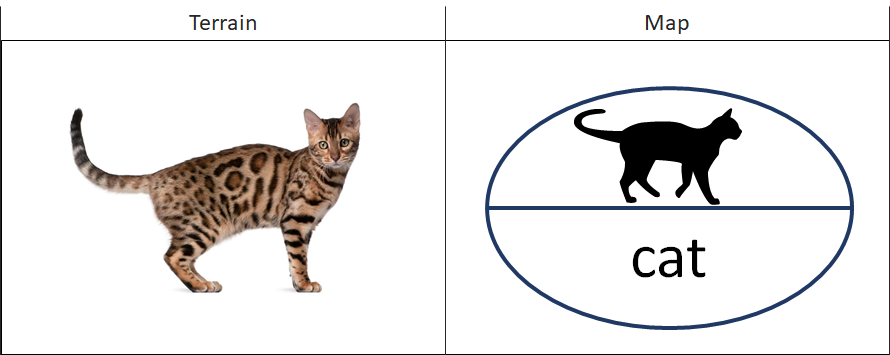
Firstly, all social perception is the result of the construct of human language. Of course, there is the physical world that exists independently of humans and perception—perhaps this is the real world where real judgments occur. Let’s label this real world the terrain. The earth and the larger universe would exist absent of humans. In fact, it had for aeons and will persist for many aeons beyond the last semblance of humanity. Humans are also real, if ephemeral, on a grander scale.
If this independent, objective, real world is the terrain, language is the map. We use language to communicate and make sense of the terrain, but it is only a representation based on our imperfect sense faculties.
Image: Symbolic language mapping of terrain
So when one makes a claim that everything [sic] is, say, language, they are making a claim similar to that of Saussure. Saussure was a structuralist. In fact, post-structuralism (or its expanded form labelled post-modernism) was a reaction against structuralists. Within the context of this post, Saussure believed that if one could fully qualify the structure of language, one could achieve a one-to-one fidelity relationship of the map to the terrain.
Post-structuralists pointed out all of the reasons why this was a fool’s errand. Like a geographical map, it is only a representation of the underlying terrain. Language serves the purpose of communication including expression and phatic aspects. One form of communication is rhetoric, which is a form employed for the purpose of persuasion. One possibility of this persuasion is to gain and retain power—or to at least win the upper hand in your argument. I suppose this is where the original statement starts to coalesce: rhetoric, power, and language.
All models are wrong, but some are useful.My point, then, is that our language map is always disconnected from the terrain. Moreover, it can be a pretty low fidelity map indeed. So when one says that everything is language, they are making a claim that we can not acquire this real knowledge. We can make sensory observations and construct narratives about it.
If you’ve ever taken a basic communications class, you’ve probably experienced the telephone game. Perception works in a similar manner. There are many things of which we have little or no experience save for conveyance through language. But as with the telephone game, fidelity can be lost. This is less likely to be a problem when interfacing with the so-called real world of rock and trees and of lions and tigers and bears.
Image: Symbolic language mapping of nebulous concept
It is more likely to become a problem when dealing with non-ontic concepts, these ‘things’ that would not exist without humans or, more critically, without language. These artificial (in contrast to real) concepts are things like goodness, justice, democracy, liberty, sovereignty, nations, and on and on, ad nauseum. Humans have constructed narratives about all of these, but if the last human were to die tomorrow, these concepts would die, too. Whether some new lifeform would eventually evolve to develop language and further develop these concepts is debatable.
Judging
All of this aside, let’s look at the perceived intent of this statement, which is the same sentiment behind Nietzsche’s ‘God is dead’ quip.
As has been discussed, the Enlightenment replaced God with Nature and Nietzsche realised that if this worldview were universally adopted, the tyrannic role that God and gods had played could not be leveraged to maintain control or power, much in the same way that the divine rights or kings had withered and died. God played a vital role in this narrative. Nature, particularly human nature, was a weak substitute. This said, moral and natural realists, quickly (and relatively successfully) filled the void with cognitive filler, a perfect pairing for budding Enlightenment thinkers.
Given that even if there were some objective morality (terrain), there is no reason to believe that a human could gain access to it. Previously, priests and pharaohs claimed to possess this ability, but this vector was no longer extant or accessible. Even if a person did have this power through some miracle of some sort or another (or another or another), what reason (other than convincing rhetoric) would one have to believe him (or her—but let’s be honest; it’s pretty much all hims).
Without access to this objective morality, we are left with creating some subjective morality. I fully admit that trying to gain consensus and compliance to a known-to-be constructed moral code would be akin to herding cats. It is no doubt that society would operate more efficiently if all constituents follow the same code.
If wouldn’t matter if this society adopted, say, monogamy over polygamy, so long as everyone accepted this as the rules of engagement. Cultural subjectivism would provide a moral framework for this situation, We have many examples of social arrangements where this is the mode of operation.
Sports are an example. There are rules. Players agree on the rules, protocols, and procedures, and they operate within this socially constructed framework. There is no objective sportsball deity on high that conveyed the commandments, and yet it works.
Locke and Rousseau each wrote about social contracts. Granted, they believed in a supernatural Nature with a capital N, but they still felt that people could operate as a society based on some sort compact or accord.
This missing element would be power because those in power could not use some higher power to justify their actions especially in regard to retributive justice and so on.
Commentary
What I still don’t understand after all these years is how this logic works. It is eerily similar to Pascale’s Wager.
If notSOME CONDITION, then not DESIRED OUTCOME therefore FABRICATE SOME CONDITION
If not[belief in God], then not [eternity of bliss in Heaven; instead eternal suffering in Hell, so double down] therefore [convince yourself of or feign belief in God]
If not [objective means of judgment], then not [real judgment] therefore [delude yourself into the belief that an objective means of judgment exists]
Emotivism and the rest are categorised under the non-cognitivist branch whilst ethical subjectivism falls into the cognitivist bucket. Intuitively, humans appear to have an innate bias toward accepting cognitivism, much in the same way as they seem to be wired to believe in supernatural concepts and see images of Jesus in toast. Whether these are vestiges of some successful evolutionary strategy is beside the point, but the problem it creates is that, in contrast, non-cognitivism is perceived as counterintuitive.
In its essence, cognitivism can be distilled down to the belief that moral statements are truth-apt, which is to say that they can be evaluated as true or false. Because of the current created by intuitionists, I lead with my fallback position, which is one of ethical subjectivism or more likely error theory.
Heads I win; Tails you lose
Although for reasons I’ll articulate later, entering a conversation assuming truth-aptness, the conversation can at least focus on the compositionality and universality components because whether I believe that moral statements cannot be evaluated as true or false, the default cognitive position of the general population is that they can be. This is not to say that I identify as a quasi-realist, which is to believe that there is no truth-aptness but to behave (pretend) that they do.
Image: Deciding the truth-aptness of a moral claim
God Is Dead
In his critique of Enlightenment beliefs, Nietzsche declared that ‘God is dead’ as he understood the implications of a society absent a justification for not only believing that morality claims are truth-apt but that they are true, divinated from some metaphysical, supernatural, and universal power. In practice, the Enlightenment replaced God with a rather animated and interactive concept of Nature, hence were born all sorts of natural rights. You may get a sense of some déjà vu, as humans, not being particularly creative, just reappropriated and rebranded the same tropes Theists use prior to that. They just performed a search-and-replace of God with Nature in a manner similar to the Christian appropriation of pagan holidays.
Image: God is dead
Non-cognitivism has generally fallen out of favour primarily because it was sort of painted into a corner by the Frege-Geach (embedding) problem, but this issue is only intractable if you accept the given frame.
I should probably just link out to a different source to explain the Frege-Geach problem because I feel it’s a red herring, which only presents a problem if you accept the frame established by the Structuralist
The problem here is that language is a complex, socially constructed communication system. Even if we accept Chomsky’s theory of the innate ability to parse language, the syntax, lexicon, and grammar are still arbitrary human constructs. I can’t likely repeat this point often enough: humans have a poor track record of creating and comprehending complex systems, examples of which are the various half-cocked socio-political, economic, jurisprudent, and philosophical systems. Hubris is evidently a successful evolutionary selection factor, as it persists everywhere and certainly in people of power.
The logical positivists ran into a similar problem when they proposed the verification principle that asserted that a statement is only truth-apt if it is either an ANALYTICAL statement or a SYNTHETIC statement, and yet this assertion with neither analytical nor synthetic, so it itself does not meet the verification principle. It’s simply a normative prescription.
Fundamentally, this quandary underscores the deficiencies of the constructed language system more than anything else, what I am developing with a working title of Insufficiency Theory. A tangent to this theory is my concept that the only moral truth (and many social truths) are simply rhetorical victories—situations where one agent employing rhetorical devices has convinced others as the truth of some condition.
Intermission
A problem with writing an unstructured stream of consciousness is that you look up and realise your post is getting pretty lengthy, and there is a lot more depth than you expected. Due to this, I am going to unpack this over several posts over several days.
Disclaimer
DISCLAIMER: I am not a professionally-trained philosopher, linguist, psychologist, or gynaecologist for that matter. I had considered studying Linguistics at uni as well as Philosophy, but I opted instead to study Economics and Finance, as these appeared to be more pragmatic. As relates to philosophy and language, I am an autodidact. This said, this particular area is new to me, so I am certain that I am missing key elements and may have large gaps in my understanding. In some cases, I’ve read more excerpts and others’ perspective on these people and their work than their actual work product. I am trying to catch up, but that leads me to a place fraught with selection and affirmation bias—though I do try to comprehend counter arguments as well. Moreover, I am painfully well aware of the Dunning-Kruger effect, and I am trying to allow for enough time to elapse to move further along this curve.
Apparently, there was a part 0 and a part 2. I didn’t realise that, so I skipped video 1. My bad, as this is one I was particularly interested in.
In this video, Elly’s premise is to focus on the right to buy sex instead of the right to sell it. Pausing for a moment, I’d like to point out that sex is neither bought nor sold; rather access is rented or leased, in a manner similar to renting a streamed movie on Amazon or Netflix. You retain no rights to ownership or future access. You don’t get to keep it when your time is up. Rather than adopt new nomenclature, I’ll continue with the convention in place.
Rather than asking is there a right to sell sex, ask is there a right to buy it, AND ask is there a right to profit off of selling someone else for sex.
Ignoring whether a right can even exist ontologically, I’ll go along and pretend that a right can exist. We’ve been down this street before, but I am commenting in real time, and I am not yet even a minute in. Essentially, she suggests asking two questions:
Is there a right to buy sex?
Is there a right to profit off of selling someone else for sex?
Clearly, these two questions are related. The right to buy sex begs the question from whom, so even though the focus is redirected from the seller to the buyer, there cannot be a buyer without a seller. In practice, the seller is a critical piece of the equation. For example, I may have a right to buy an automobile, but you only have the right to sell it if it is your property; you can’t rightfully sell me your neighbour’s car.
Separately, is there a right to profit from selling sex [as a first party transaction] in the first place, and for selling someone else for sex [as a second party transaction] in the second place?
[SPOILER ALERT] » This video does not yield the anwers to these questions.
The next order of business is to use these talking points…
Discuss what motivates men to by prostituted women.
Discuss how they view and treat them rather than discuss statistics.
…followed by this assertion.
“There is plenty of evidence that men are motivated to buy prostituted women because prostitution at its core means the availability of sexual access with little to no boundaries to young, attractive women anywhere at any time for affordable prices.”
This is where I go off the rails and critique poor methodology and poor rhetorical form. Let’s unpack this:
There is plenty of evidence that…
First, plenty is a weasel word. It carries no rhetorical weight unless it is followed with, well, plenty of evidence. How much is plenty? Is there plenty of counter-evidence? Is the evidence more prevalent than the counter evidence or vice versa.
Second, what is the source of this unspecified, uncited, and unattributed evidence. Elly references links; perhaps they are the evidence she is references. What is the quality of this evidence?
Not to offend, but this wouldn’t even pass as a Wikipedia comment.
…men are motivated to buy prostituted women because…
Apart from the inability to actually know someone’s motivation, I am interested in seeing where this leads.
Elly uses the noun phrase prostituted women. As she employs the adjective form prostituted, I am led to wonder what the motivation was for this word choice.
My initial thought is that she is modifying the noun women because wants to differntiate buying women from buying prostituted woman, but I don’t think this is quite right.
My next thought is that her motivation to convey that these women have no agency or volition; they are passive objects who are prostituted against their will.
My third, or perhaps it was my first, thought is why not emply the plural noun prostitutes. She has already established context that her focus is women, so I am left feeling there is a deeper subtext. Perhaps I am reading too much in.
…prostitution at its core means the availability of sexual access with little to no boundaries to young, attractive women anywhere at any time for affordable prices.
This is some definition. I’ll need to unpack this one slowly:
This definition get to the heart of the matter from the perspective of the punter.
Prostitution is the availability of sexual access… Yup. Nailed it.
…with little to no boundaries… Wait, what? Where did this come from? Is there some subclass of prostitutes to which this applies? Surely does not define all prostitutes? Does this define most prostitute? As I understand it—at least the escorts of Backpage of days gone by, a victim of FOSTA—, escorts to have boundaries. Moreover, some boundaries can be expanded by an up-charge. Even reading the negative reviews on the Invisible Men Project, it is apparent that many of the complaints were that the woman refused one service or another, which is to say to enforce a boundary. This appears to be counterevidentiary.
…to young… I wonder how we are defining young. I wonder what the average age of a prostitute is. A quick Google search of ‘prostitution’ yeilds a recent arrest of 7 women. I am not saying this is a valid random sample or size, but their ages range from 27 to 55 with an average age of just under 40-years old. I suppose to a 70-year-old, these are young. Let’s move on…
…attractive women… Attractiveness is relative, but let’s just say there’s no accounting for taste. Without comment, I’ll leave it to you to decide the attraction level of these same arrested women.
…anywhere… This is a bold assertion.
…at any time… This is an another bold assertion. I am certain there is support for this claim somewhere.
…at affordable prices. Finally, the end of this parsing party. Affordabilty is another relative term. Who’s the punter and what’s the cost? I’m noticing that first guy perportedly spent £340 for 45 minutes. That’s about $450 US for the peeps reading on this side of the pond, and I am just going to go out on a limb and suggest that is beyond the affordability range of most Americans by several hundred dollars.
At the end of the day, I am left with the impression that the purpose of this definition is to incite and inflame not to objectively define anything. In the court system, this is what one would call leading the witness. As such it would be inadmissible. I concur.
Her next course of action is to determine ‘If your opponents are aware of widespread social stigma in society against prostituted people, which causes risks or disadvantages during interactions with law enforcement or social services, ask them if Johns are somehow magically exempt from this’.
Resulting from my previous search, it seems buyers not exempt. In fact, 6 of the 8 people arrested were men ‘charged with patronizing a prostitute’.
Again, an unsubstantiated claim was countered in less than a minute. It feels to me that the tactic is to throw so much word salad at the opponent that they simply can process the mis- and dis-information, and without recourse to Google, they may be overwhelmed and convert having never researched any of the false claims. Donald Trump relies heavily on this technique.
If they are unable to see the misogyny in the words and actions of punters, introduce them to punter forums…where prostitutes are rated like products.
The claim of misogyny is one of intent. It is not a claim that the words are offensive. It is a claim that the intent behind the words is fueled by some inherent hatred of women. I’m sorry but this is unadulterated psychobabble.
I did read the negative reviews on the punter forums, and to be honest at the expense of being accused of mansplaining, these don’t read much differently to bad service reviews on on Yelp or Google. And, yes, the woman are rated—albeit like services not like products: like my stylist butchered my hair; my gardner killed my dog; whatever. Linguistically, this is akin to code switching. They are employing the vernacular of the forum.
Do some of these men hate women? Sure. Who knows? Do they hate all women? Do all men who frequent prostitutes hate women? Do they hate all women or just prostitutes? Do they hate their mothers? Is their hatred of prostitutes simply a hidden hatred of their mother manifest in hatred of women? Do they hate other categories of people? Do they kick cats and beat dogs? Of course they do, and then they go home and beat their wives and children and speak poorly about their aunts and mothers.
Of course, this line of reasoning is just as inane as the line that inspired it.
She mentions men who freely admit to abusing and raping women.
Wait, what? I didn’t see that. I must have been distracted by the snuff films.
I can tell this is just turning into a rant. If there is one thing I can’t stand—and there is more than one thing I can’t stand—is sloppy academics. The rules of engagement for defending a position with integrity are simple. If the goal is to win at any expense, then, as the saying goes, all is fair in love and war. But I am not sure what the prize is here. I am not one to have much faith in the intellectual capacity of most humans, but even I am pretty sure that the majority of people can see right through this subterfuge.
Shake it off, Bry. Just shake it off. Push through it. No pain no gain.
Presumed motivators for men to pay for prostitutes are because…
A. Men want to have sex with no responsibilities with maximum control and no required effort of actually impressing and winning over the other person, and because other men are willing to provide it by pimping out others for their own lucrative profit.
Wow. Another unfounded, ungrounded assertion. Just some claim pulled from thin air. Also, I am pretty sure I heard her say A, as if to enummerate some list, but I never heard any subsequent letters.
Men want to have sex…
So far, so good…
…with no responsibilities…
I’ll presume she means with no additional strings attached. I am not sure what other responsibilities we could be talking about.
…with maximum control…
I am pretty sure we’ve already trodden this teritory. Perhaps he feels he has (or even has) more control over a prostitute than over some alternative woman. Perhaps he wife or partner won’t allow him to do something or another, but I have a feeling that this maximum control claim is a bit more hyperbole than reality justifies.
…and no required effort of actually impressing and winning over the other person…
I am fast-forwarding a bit because this feels like reading it will be like watching paint dry or grass grow. By what Romantic construct is this a thing? Someone’s watched too many Disney films. And this is a game, and the person who pays to avoid effort is a cheater? He jumped the queue. Hmmm. When I say it like that, it does seem awfully juvenile.
…and because other men are willing to provide it by pimping out others for their own lucrative profit.
Let’s just tag some barely relevent rationale on because we can.
And let’s pepper our speech with superlatives so the hyperbole doesn’t feel lonely.
Prostitution exists because of the demand not because of a subset of women who are nymphomaniacs.
I have to admit that I loved this last line.
Also [prostitution does] not [exist] because of poverty. Poverty is a supporting factor.
Rachel wins the strawman argument contest of the year. Who is asserting that poverty is the sole arbiter of prostitution? Apparently, some unnamed source in Parliament.
Prostitution exists for one reason: male demand —Rachel Moran
This logic exhibits a fundamental lack of understanding of the basic rules of transactional economics and equilibrium in context with supply and demand.
Not to be a dick about it, but I can demand a Ferrari until the cows come home, but this will not conjure a Ferrari. Believe me, I’ve been waiting for those cows to come home for ages. Also, the supply of Ferraris does me no good either because the transction price is too high; therefore, I cannot afford a Ferrari.
Rachel however is correct—In your face Jean Baptiste Say!—when she recognises that supply does not create its own demand. Sorry believers in Conservative economics dogma. But I digress.
Even if this nymphomaniac offered her services for free, there could be no transaction without demand, so the monetary exchange is a secondary factor.
Don’t sugarcoat the violence that punters and pimps commit.
Also, don’t differentiate violence that happens on the job, such as a dope dealer or a loan shark that would have occurred, perhaps even sooner, whether or not she was a prostitute. Let’s just pretend that these are related to her line of work because it helps to inflate number to make our position more sellable.
When a prostituted woman is raped or killed, the most likely rapist and/or killer is a pimp or a John. That makes prostitution the only so-called occupation which [sic] changes the most likely perpetrator of severe bodily harm from a partner or relative to your customer or employer.
And this is relavent how? Perhaps we should make associating with partners and relatives illegal. It seems that they are the biggest concern.
Why is this a so-called occupation? Is this not a job or line of work?
Lastly, make it very clear that this dynamic and this level of violence does not magically change under legalised prostitution.
OK.
The set of men buying and selling women doesn’t really change.
I disagree. Where prostitution is illegal, the good men are going to exit the system, and only bad men will remain. Of course, if you define all men who frequent prostitutes as misogynists, then I suppose you’ve created a situation where all men are bad, and so I stand corrected.
Let’s see how that renders as a categorical syllogism:
– All men who frequent prostitutes are bad.
– Joe is a man who frequents prostitutes.
∴ Joe is bad.
I see how it works. I stand corrected. All punters are evil. Burn them.
Under legalisation, too, men retain their disgust for the prostituted and their disrespect for their boundaries.
Here we go again with the broadbrushing.
Ample evidence are the punter forums of Germany, the Netherlands, and New Zealand. This contempt and the sever mistreatment does not change unless there is effective widespread social intervention that teaches children for elementary school onwards that prostituted women and men are just as human and deserving of respect as anyone else and that all sexual interaction requires enthusiastic consent, which means that it cannot be bought.
Prostituted women and men are just as human and deserving of respect as anyone else…which is why we should deprive them of their livelihoods. Nothing says “I respect you” more than kicking the chair out from under you. That’s my creed.
Not merely consent but enthusiastic consent. Not only do I have to work, I have to do so enthusiastically.
Abolitionists have an issue not with the prostitutes but in the system they are caught in and the men who operate and benefit from it.
I think I am approaching the end of this clip.
The systems they are caught up in is Capitalism and a market economy, a system that presumes to be able to put a price on anything.
A cynic is…a man who knows the price of everything, and the value of nothing. — Oscar Wilde
Hatred of a system does not equate to hatred of a person in that system.
I agree, and so…
Humans have a piss poor track record in understanding complex systems, whether weather, poitical, sociological, economic, or otherwise. The issue here is that you can hate the system and love the person, but if you disrupt the system intentionally or otherwise, the wide ranging effect may prove disaterous.
Punters love the system but hate the women. Abolistionists care about the women.
Where is all this categorical hatred coming from?
Lastly, Elly mentions that she is working on a video piece to summarise the important stats and info on who punters are, what they do, and why they do it.
And here is where I will challenge your integrity. Who here would believe—especially insomuch as by her own admission that she recommends hiding inconvenietly opposing facts—any reporting would contain an accounting of unbiased and unabridged data, metrics, or summaries or that proper methodological rigour would be applied for the study.
On the topic of studies, in the description of the video on the page, there are links, which I’ve copied here for comment.
This is a PDF of speaking notes or a transcript of Rachel’s presentation in London, based on her experience as a sex-trade survivor. Rachel’s is a sad story, but it is her story.
Yet again, a list of cherry-picked perhaps 180 quotes from some Canadian forum. This is contemptuous. I only read about a dozen and a half of them. In order to be even somewhat useful (instead of being polemic) would be to see all of the reviews, and to see what percentage of people wrote these reviews. You can’t convince me that there are no doting reviews. These are exempted because they dilute the disingenuous shock value of only negative reviews. Even a simple word cloud would be more useful than this hatchet job. (I feel like finding one of these forums and cherry-picking the rest of the story just out of spite.)
This is a full forum of resources. I have not done anything more than scan the initial page where I landed. I may return for more context. If you seek additional information, visit. I think it goes without saying that the information here is slanted, much like watching Fox News in an attempt to understand American Liberal politics.
How Porn Creates the John: Porn, Trafficking and the Social Construction of Masculinity (Youtube video from a lecture given in December 2012)
Being on the topic of social constructivism, this one should be right up my street. I haven’t watched even a moment of this video, so am probably commenting prematurely, but it is interesting to me how some people accept the concept of social constructivism when it relates to a different perspective, but rarely do they accept their own perspectives as social constructions. This is a cognitive bias.
I am not so sure I have the interest in commenting on the rest of the series. To be honest, Elly has other series as well. I’d like to take a look, but I’m afraid I’ll have a similar reaction that the position and content haven’t been well thought out. Perhaps a strong editor would help, a disinterested party who would maintain (or otherwise elevate) the integrity of the content and who would provide needed rigour.
In the end, Elly’s message would be stronger and more cogent, and she could shed the chaff whilst retaining the substance.
DISCLAIMER: This post is a veritable rant. It promises to go off script or at least be oblique to the recent themes I’ve adopted. It is also a bit late, missing the heels of the FOSTA debacle in the United States.
Prostitution is immoral. It exploits women. It exists in a world of violence. It objectifies and creates a rape culture. It is a vector for transmission of diseases. These are the main arguments against it, yet many of these are arguments against Capitalism itself.
In fact, most arguments of prostitution are criticisms of capitalism or conflated claims to some tangential activity. The most popular conflation is with sex trafficking, ‘modern-day slavery and involves the use of force, fraud, or coercion to obtain some type of labor or commercial sex act‘.
Prostitution is a category of sex work, which includes dominatrixes in the BDSM space, porn actors (and actresses if you expect archaic sexist jargon), phone sex operators, cam models. Nude modelling is somehow tasteful and not readily included in the collection.
The World Health Organisation (WHO) defines sex workers [PDF] as ‘women, men and transgendered people who receive money or goods in exchange for sexual services, and who consciously define those activities as income-generating even if they do not consider sex work as their occupation‘. I won’t comment on why they feel the final dependent clause is relevant to the definition. Perhaps it’s in the realm of the aspiring actors or screenwriters who wait tables but don’t consider themselves to be waitstaff.
Returning to the main arguments in turn:
Prostitution is immoral. As a subjectivist, this is a difficult argument to win. Although morality is a human social construct, many people believe otherwise, and even those who don’t ascribe to the notion of an objective morality still adopt and abide by the fabricated moral codes generated by the worldview of, say, Christians or Muslims or some other sect who claim to have direct insight into such codes.
Nothing is immoral that society doesn’t declare to be immoral.
Nothing is immoral that society doesn’t declare to be immoral. In the United States, the institution of slavery—what I call hyper-capitalism or a capitalist’s wet dream—was deemed moral by most. Eventually, the morality was hotly debated, and now, it is considered to be immoral. Time changes everything. In some circles, slavery is still considered to be moral. In other circles, it has morphed into wage-slavery and because money is exchanged within a frame of a labour market, it escapes the definition.
Excepting for local norms, prostitution is not inherently more immoral than banking or retail sales.
Prostitution exploits women. Excepting that there are male prostitutes and sex workers, it is commonly believed that these people are (somehow) less likely to be exploited, so I’ll keep this focused on women. First, it is important to separate prostitution from human sex trafficking. This is not the topic, and it’s a problem with specificity. If you feel that sex trafficking is immoral and should be illegal, that’s fine; but don’t throw out the baby with the bath water. Focus on the actual problem. <sarcasm>If you want to prevent all women from being exploited, lock them all up in monasteries. Problem solved. </sarcasm>
Prostitution is not inherently more immoral than banking
If one wants to discuss exploitation, let’s discuss a system designed such that a person needs to earn money to survive. Period. Full stop. If you buy into the capitalist worldview, then, that in order to survive a person chooses to be a marketing executive, a customer service representative, a janitor, or a prostitute, is none of your concern.
I have heard many arguments put forth that these women should get ‘real jobs’, jobs that pay minimum wage (or less) and have no other benefits, jobs where it would take a week or more to earn what they could in a day or less. That’s not even rational.
Prostitution exists in a world of violence. Despite trends, the world is still a violent place. Part of the higher probability of violence in the realm of prostitution exists because these women are marginalised by moralists. Even where prostitution is legal, it is still often viewed as immoral. They have little recourse to the legal system. They can’t organise. They are forced underground. Sunlight is the best disinfectant. Don’t force these women into alleys and underground.
In the US, recent FOSTA and SESTA hysteria have disarmed women from the tools they used to navigate their environment. They could share intelligence related to which men to avoid for one reason or another. Other tools have cropped up to facilitate this cooperation, but these tools benefit from network effects. The more people having access to the information clearinghouse, the better.
Prostitution objectifies women. I’ll concede this point straight away but not without noting that many things objectify women: the beauty industry, the entertainment industry, the marketing industry in general. If as a society we can resolve objectification and prostitution is the last holdout, I’m onboard, right there with you. But there is no need to make prostitution the poster child for eliminating objectification.
Prostitution creates a rape culture. To be fair, I have no metrics on this, and I am going to pass, but not without saying that it seems to be an implausible claim. And I have read counterclaims anyway.
Prostitution is a vector for the transmission of diseases. Indeed. And driving is a vector for traffic accidents. Of course, given higher frequencies of an activity, one would expect a greater number of outcomes—even with the same probability, the additional exposure may result in hitting this undesirable lottery. And the variety of partners with unknown sexual histories is problematic.
However, a mitigating factor is education—and not simply moralistic lip service. Women need to understand the risks and understand how to diminish it. Yet again, being marginalised does not necessarily allow a woman to be empowered. A client can insist on unprotected sex. If he forces his hand, no one is going to believe that a prostitute can be raped. As with sex trafficking, rape is its own subject and is only part of a larger conversation.
I was winding down, but I found a related quote I wanted to address:
Geena Leigh was in prostitution for 19 years from the age of 18. In her submission to an Australian inquiry into the regulation of brothels, she said prostitution: “has this way of stealing all the dreams, goals and beautiful essence out of a woman. During my years in it, I didn’t meet one woman who enjoyed what she was doing. Everyone was trying to get out.”
Evidently, lack of enjoyment in one’s employment is not limited to prostitutes. The is the problem with fundamental attribution bias. A recent Gallup poll cited that 85% of people hate their jobs. Maybe Gallup only interviewed prostitutes, or perhaps the 15% who liked their jobs were the only ones who weren’t sex workers.
Well, there went my morning…
For those wondering (and who’ve gotten this far), the impetus for this post was some other blog posts I happened upon in WordPress’ Reader.
Prostitution (A post from another one-track blog. If only I could remain as on-track.)
Prostitution is a sin but are these prostitutes the real sinners? To be completely honest, this was one of my favourite titles, but for the reasons I’ve mentioned above, the content doesn’t quite live up to the promise as it devolved into human sex trafficking and rape, each of which can exist without prostitution. Besides, it’s not that prostitution is a sin. In the Bible, Proverbs 23:27 states: ‘For a prostitute is a deep pit; an adulteress is a narrow well‘, but it is important to note that the term prostitute comes from the Hebrew, זוֹנָ֑ה, which simply means a fornicator. So the offence is not that a woman accepts money in exchange for sex; it’s that she has sex with someone for whom she is not chattel, who is not her husband. As an atheist, I’ve read the bible more and deeper than most Christians. If more Christians would actually read the bible, there would be fewer Christians.
Why “Sex Work” Is Not Work Another non sequitur of a post where the content doesn’t deliver what the title promises. The conversation quickly devolves into cherry-picked, edge case examples of tangential issues unrelated to prostitution itself.
There are no accidents, or so claimed Carl Jung in his work on synchronicity, positing that events may be connected causally or by meaning. Some people see this as the work of some karmic force whilst others use it to suggest that a person is being passive-aggressive.
Karma
In the karmic sense, this means that there is no escaping fate, and, as with Santa Claus, he is constantly watching you, like some personified panopticon. See the short post on karma, too.
I’m not sure if the bible story of Judas and Jesus is really a karmic anecdote, but under this paradigm, everything is a no-fault situation. Judas was fated to betray Jesus. And despite this lack of responsibility, Judas still committed suicide once he realised what he had done and despite it not being an accident.
Passive-Aggression
In the passive-aggressive sense, it is to say the event A may be caused by something in person B’s unconscious mind—and not by some collective consciousness or a Universal Overseer. So, secretly, if Person B accidentally backed into your parked car, it may not be by some conscious volition; rather, it’s because or some deep-seated anger or other ill-will harboured and directed for you.
The problem is that if you accept that there are no accidents, then you—intentionally or otherwise—parked your car in a place where it would necessarily be hit by someone—by anyone. It just happened to be this other person for whom there are also no accidents. So, both parties are blameless. But people love to blame, and they like to defer responsibility.
Verdict
The bottom line is that both of these concepts are a bit sketchy. In a world of no free will, the karma situation might be plausible, but this wreaks havoc on moral-ethical systems. I discuss that in most post on karma.





![Quarks[1]](https://philosophics.blog/wp-content/uploads/2018/07/quarks1.png)


![quote-all-models-are-wrong-but-some-are-useful-george-e-p-box-53-42-27[1]](https://philosophics.blog/wp-content/uploads/2018/07/quote-all-models-are-wrong-but-some-are-useful-george-e-p-box-53-42-271.jpg)

![John+Locke+-+Jean+Jacques+Rousseau[1]](https://philosophics.blog/wp-content/uploads/2018/07/johnlocke-jeanjacquesrousseau1.jpg)
![jessica-brooke-real-lesbian-wedding-orlando-florida-alternative-life-photography-design-first-kiss[1]](https://philosophics.blog/wp-content/uploads/2018/07/jessica-brooke-real-lesbian-wedding-orlando-florida-alternative-life-photography-design-first-kiss1.jpg)


![dunning-kruger-graph[1]](https://philosophics.blog/wp-content/uploads/2018/07/dunning-kruger-graph1.gif)




![745_600_10964maybelline-color-elixir-gloss-sohelee1[1]](https://philosophics.blog/wp-content/uploads/2018/07/745_600_10964maybelline-color-elixir-gloss-sohelee11.jpg)

 Philosophics