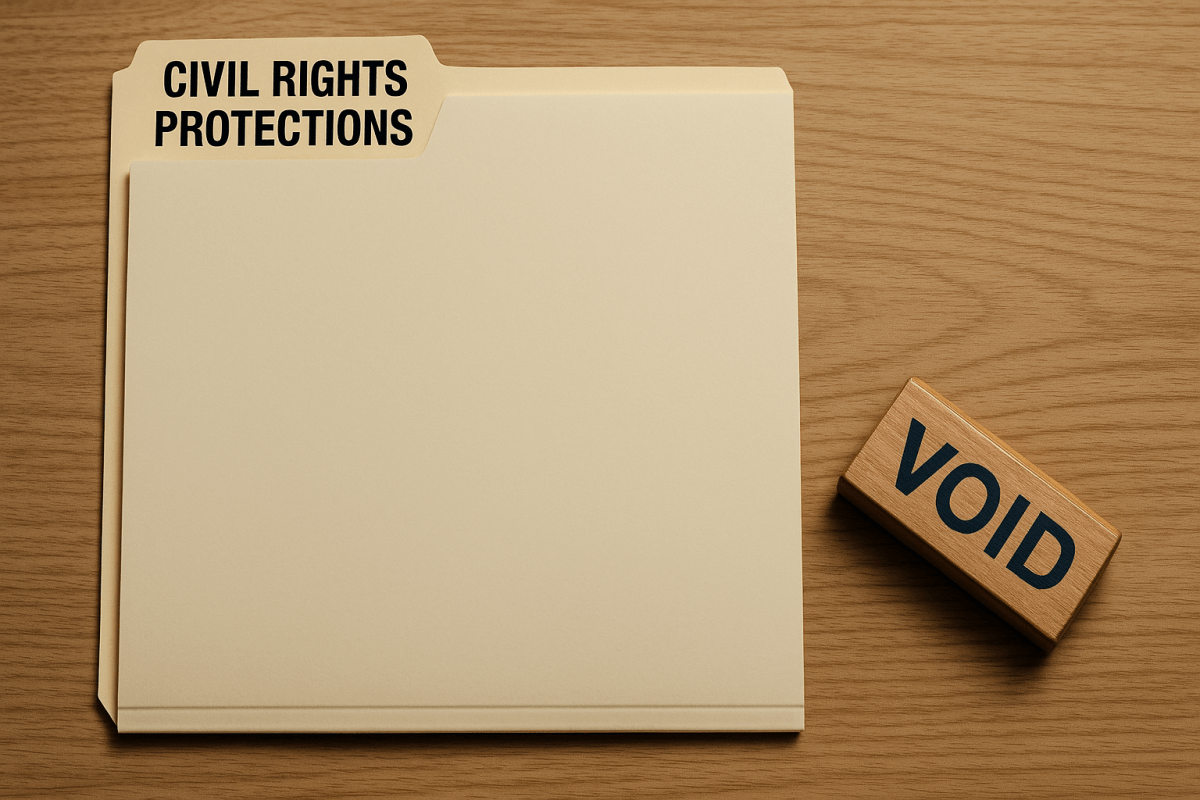
“All that is necessary for evil to triumph is for a few words to go missing from the bylaws.” — not Edmund Burke, but it ought to be.
The Trump administration—America’s reigning monarch of meaningless bombast—has done it again. This time, with an executive order so linguistically cunning it deserves a Pulitzer for Subtextual Menace.
Issued on 30 January 2025, the decree known as “Defending Women from Gender Ideology Extremism” (because, of course, it couldn’t just be called Let’s Erase Legal Protections for People We Don’t Like) removed “political affiliation” and “marital status” from the list of protected classes within certain federal frameworks.
And the result? According to documents unearthed by The Guardian, VA doctors can now legally refuse treatment to patients based on their politics or marital status. You know, because being a Democrat apparently makes you too much of a pre-existing condition.
Naturally, the VA and White House are insisting this means absolutely nothing. “Don’t worry,” they coo. “No one’s actually doing it.” Ah yes, the old Schrödinger’s Protections defence—simultaneously removed and unchanged, invalid but somehow still effective.
But here’s the point—and where it ties to the Language Insufficiency Hypothesis I’ve been peddling like a raving madman at the crossroads of post-structuralism and bureaucratic despair: language isn’t just failing to communicate meaning—it’s being weaponised to obscure it.
The Erosion of Meaning Through Omission
This isn’t the blunt-force idiocy of Orwell’s Newspeak. This is something more elegant—more insidious. This is legislative lacunae. It’s what happens when not saying something says everything.
The words “political affiliation” and “marital status” weren’t replaced. They weren’t clarified. They were simply deleted. Erased like a bad tweet, like a conscience, like a veteran with the wrong bumper sticker.
This is language subtraction as a tool of governance.
We’re not criminalising dissent. We’re just making it legally ignorable.
We’re not discriminating against the unmarried. We’re just no longer required to treat them the same.
It’s the bureaucratic cousin of the dog-whistle: not quite audible in court, but perfectly clear to the base.
The Slippery Slope is Now a Slip-n-Slide
This is how you rewrite civil rights without the fuss of saying so. You just… remove the language that once held the dam in place. Then, when the flood comes, you feign surprise:
“Oh, dear. Who could have guessed that removing protections would result in people being unprotected?”
(Everyone. Everyone could have guessed.)
This is not a bug in the legal language. It’s the feature. The silence is the speech act. The absence is the argument.
This is what I mean by language insufficiency: not merely that our words fail to convey truth, but that their very structure is liable to be gamed—exploited by those who understand that ambiguity is power.
Beyond Intentionality: The Weaponised Void
In philosophy of language, we often debate intentionality—what the speaker meant to say. But here we’re in darker waters. This isn’t about intention. It’s about calculated omission.
The executive order doesn’t declare war on Democrats or single mothers. It simply pulls the thread and lets the tapestry unravel itself.
It’s an act of rhetorical cowardice disguised as administrative efficiency.
This is the Trumpian genius: use language like a stage magician uses sleeves. Distract with one hand, disappear with the other.
Final Diagnosis: Policy by Redaction
We now inhabit a political climate where what is not said carries more legal force than what is. Where bylaw gaps become policy gateways, and where civil rights die not with a bang, but with an elision.
So no, the VA hasn’t yet denied a Democrat a blood transfusion. But the table has been set. The menu revised. The waitstaff told they may now “use discretion.”
Language doesn’t merely fail us. It is being made to fail strategically.
Welcome to the new America: where rights aren’t removed—they’re left out of the memo.
Yet again, ChatGPT renders an odd image. Can’t be bothered to amend it.
 Philosophics