On Mediation, or: Why I Let an AI Write My Last Post

…and this one. A clarification that is also a demonstration. If anything, the Americanisms should give it away.

The Preamble as Method

A previous post—the one with Foucault, Arendt, Sontag, Fish, Mill, and Girard all lined up like theoretical ammunition—was drafted entirely by ChatGPT after a conversation about the Dershowitz piece before it. I fed it my argument about moral contamination and asked it to expand the thesis with additional thinkers. It obliged. I posted it unedited.

I mention this not as confession but as method. If my core claim is that truth equals rhetoric—that there is no unmediated access to reality, only constructed positions negotiated through language, power, and interpretation—then having an AI mediate my argument while I mediate its output is not a bug. It’s a feature.

The question is never “who really wrote this” but “what work does this text do, and under what conditions?”

This is a non-foundationalist position. There is no neutral ground from which to assess claims. There is no Logic floating above rhetoric, no Reason untouched by affect, no Truth prior to its articulation. What we have are competing rhetorical constructions, each shaped by interests, histories, and power arrangements, each claiming—to varying degrees of honesty—to represent something beyond themselves.

The game is not to transcend this condition. The game is to stop pretending we ever could.

What I’m Actually Arguing

Let me be direct about what those two posts were defending, since the theoretical apparatus apparently obscured more than it clarified.

I am not arguing that:

  • Age of consent laws should be abolished
  • The French intellectuals were right to sign those petitions
  • Association with Epstein is irrelevant
  • Analysis automatically immunizes anyone from moral judgment

I am arguing that:

  1. Liberal discourse routinely launders emotional and political commitments as self-evident logic, then treats anyone who exposes this process as morally suspect.
  2. Legal thresholds are negotiated rhetorical compromises, not mathematical truths. They reflect harm minimization, cultural anxiety, enforcement pragmatics, and historical contingency. To analyze their construction is not to advocate their abolition.
  3. The “moral contamination reflex” treats inquiry as confession—not because the inquiry threatens truth, but because it threatens the claim that certain positions are simply Logic Itself rather than one rhetorical construction among others.
  4. Guilt by association is both a logical fallacy and sometimes a reasonable heuristic. The trick is admitting which one you’re doing at any given moment, rather than claiming your heuristic is deductive proof.

These claims are rhetorical positions. They are not transcendent truths. But neither are the positions they critique.

The Hypocrisy I’m Diagnosing

When someone argues that a 16-year-old capable of choosing abortion should be capable of choosing sex, they are making a rhetorical move. The argument has gaps—abortion concerns bodily autonomy in ways that sex with others does not; capacity for one decision doesn’t automatically transfer to capacity for another; power dynamics matter.

Fine. Point those out. Explain why the analogy fails.

But what actually happens is different. The argument is not refuted. The arguer is diagnosed. Making the argument becomes evidence of desire. Analyzing it becomes evidence of endorsement. Logic is treated as circumstantial proof of guilt.

This is not because the argument is uniquely dangerous. It’s because it threatens a stabilizing fiction: that our current legal thresholds are both pragmatically necessary and philosophically coherent. They are the former. They are not the latter. And the moral panic that greets anyone who points this out is not about protecting children. It’s about protecting the claim that our compromises are something more than compromises.

The same pattern plays out with Epstein associations. Some people knew him socially or professionally in contexts that had nothing to do with his crimes. Some people continued relationships after credible allegations emerged. Some people were directly complicit. These are different categories.

But the discourse collapses them. Everyone in the address book becomes suspect. Association becomes evidence. And anyone who suggests “we should distinguish between these cases” is immediately accused of defending predators.

This is not logic. This is moral theatre. And the fury it provokes when exposed is not righteous. It’s defensive.

The Difference Between Rhetoric and Relativism

Saying “truth equals rhetoric” sounds like relativism. It sounds like I’m claiming all positions are equal, nothing matters, anything goes.

I’m not.

I’m claiming that all positions are constructed through rhetoric, but that doesn’t make them equal. It means we should argue about them on the terms they actually operate—consequences, values, power, effects—rather than pretending one side has Logic and the other side has Emotion.

Some rhetorical constructions are more defensible than others. Age of consent laws, as constructed compromises aimed at harm reduction, are defensible. That doesn’t mean they’re philosophically coherent or that analyzing their incoherence is an attack on children.

Maintaining professional relationships with powerful people who were later revealed to be criminals does not make you guilty of their crimes. But it might raise questions about judgment, complicity, or willful blindness—questions that should be asked specifically, not universally.

The difference is this: I’m not claiming my position is Logic. I’m claiming it’s a rhetorical construction I find more defensible than the alternatives, for reasons I’m willing to argue about.

What I’m criticizing is the move where liberal discourse presents its rhetorical positions as self-evident moral truths, then treats dissent as pathology.

Why the Theoretical Version Failed

The expanded post tried to universalize the pattern—to show that this reflex appears across domains, across thinkers, across history. It succeeded at that. What it failed to do was stay grounded enough for readers to assess whether the pattern I was describing was real or whether I was constructing a persecution narrative.

The problem was strategic evasiveness. By staying abstract, the piece avoided being testable. It gestured at examples without committing to them. It borrowed authority from Foucault and Arendt without doing the work of showing how their critiques apply to the specific cases I had in mind.

This created a gap between what the essay claimed to be doing (defending analysis against moral panic) and what it was actually doing (defending specific controversial figures using theory as cover).

That gap is what critics correctly identified as bad faith.

What I Should Have Said

Here’s the honest version:

The Dershowitz argument is bad. The abortion-sex analogy doesn’t hold. But “the argument is bad” and “making the argument is evidence of pedophilia” are not the same claim. One is logical critique. The other is moral contamination. We should be able to distinguish them.

The 1977 French petitions were misjudged. Calling for the abolition of age of consent laws in that context, with those specific cases, was not wise. But signing a petition is not the same as committing the acts in question, and treating mid-century French intellectual culture as self-evidently monstrous erases the specific debates they were having about law, psychiatry, and state power. We can think they were wrong without treating the question itself as unspeakable.

Epstein’s network matters. Some associations are meaningful. Power enabled his abuse, and understanding how requires looking at who knew what and when. But not every name in a flight log or party photo is evidence of complicity, and the current discourse often treats them as such. We should distinguish between innocent contact, poor judgment, and active enablement—not flatten everything into “guilt by proximity.”

These are all messy positions. They require distinctions, context, and willingness to live in discomfort. That’s harder than moral certainty. But it’s also more honest.

The Meta-Point About AI Generation

The fact that the previous post was AI-generated does something interesting to all of this.

It was rhetorically effective. It marshaled the right theoretical authorities. It structured the argument coherently. It sounded like philosophy. And it was assembled by a pattern-matching system with no beliefs, no commitments, no stakes.

This should tell us something about the nature of rhetoric itself. The text worked—or didn’t—based on what it did, not where it came from. Authenticity is not truth. Authorship is not authority. What matters is whether the construction holds, and under what conditions.

I could have hidden the AI involvement. Many would. The disclosure feels like it undermines the argument’s authority—if a machine wrote it, does it count?

But that reaction itself proves the point. We want arguments to come from authenticated sources, from proper authority, from legitimate speakers. We want to know who’s talking so we can decide whether to trust them. This is not Logic. This is rhetoric all the way down.

The AI wrote a version of my argument that was cleaner and more theoretically sophisticated than I would have produced alone. It was also more evasive, more abstract, less committed. Those aren’t bugs in the process. They’re features of how the system generates text—maximizing coherence, minimizing controversy, staying in safe abstraction.

That I chose to post it anyway, knowing these limitations, is itself a rhetorical move. It says: “I’m willing to use mediated tools to construct my position, and I’m not pretending otherwise.”

What This Leaves Us With

I started with a claim about moral contamination—that liberal discourse treats certain kinds of inquiry as self-incriminating. I then demonstrated this by making precisely the kind of inquiry that provokes that reflex, using examples I knew would be read as defensive rather than analytical.

The responses proved the thesis. Analysis was read as confession. Theory was read as cover. Even asking whether a distinction exists between argument and endorsement was taken as evidence that no such distinction can be maintained.

But here’s what I didn’t make clear enough: I’m not claiming to be above this dynamic. I’m in it too. I have commitments, interests, and positions I’m defending. The difference is I’m naming them as such, rather than claiming they’re simply What Logic Demands.

Truth equals rhetoric. We’re all doing motivated reasoning. The question is not “who has transcended their motivations” but “whose motivations, toward what ends, with what consequences?”

I think the moral contamination reflex produces bad discourse—not because it’s emotional, but because it claims not to be. I think guilt by association is overused—not because association never matters, but because we’ve stopped distinguishing between different kinds of association. I think legal thresholds should be analyzable—not because they should be abolished, but because unexamined laws are dangerous even when well-intentioned.

These are rhetorical positions. I’m arguing for them. I’m not pretending they’re Logic Itself.

If you disagree, argue back. But argue with what I’m actually saying, not with what analysis supposedly reveals about my secret desires.

That’s all I’m asking for. And apparently, it’s too much.

Moral Responsibility

Can we be held morally responsible for our actions? Yes, says Daniel Dennett. No, says Gregg Caruso. Reader, you decide

Aeon Article, 4 October 2018

Caruso: [Dan,] you have famously argued that freedom evolves and that humans, alone among the animals, have evolved minds that give us free will and moral responsibility. I, on the other hand, have argued that what we do and the way we are is ultimately the result of factors beyond our control, and that because of this we are never morally responsible for our actions, in a particular but pervasive sense – the sense that would make us truly deserving of blame and praise, punishment and reward. While these two views appear to be at odds with each other, one of the things I would like to explore in this conversation is how far apart we actually are. I suspect that we may have more in common than some think – but I could be wrong. To begin, can you explain what you mean by ‘free will’ and why you think humans alone have it?

Gregg Caruso

Dennett: A key word in understanding our differences is ‘control’. [Gregg,] you say ‘the way we are is ultimately the result of factors beyond our control’ and that is true of only those unfortunates who have not been able to become autonomous agents during their childhood upbringing. There really are people, with mental disabilities, who are not able to control themselves, but normal people can manage under all but the most extreme circumstances, and this difference is both morally important and obvious, once you divorce the idea of control from the idea of causation. Your past does not control you; for it to control you, it would have to be able to monitor feedback about your behaviour and adjust its interventions – which is nonsense.

In fact, if your past is roughly normal, it contains the causal chains that turned you into an autonomous, self-controlling agent. Lucky you. You weren’t responsible for becoming an autonomous agent, but since you are one, it is entirely appropriate for the rest of us to hold you responsible for your deeds under all but the most dire circumstances. 

Daniel Dennett

if your past is roughly normal, it contains the causal chains that turned you into an autonomous, self-controlling agent

Dan Dennett

So commences this debate. The argument unfolds largely on semantic grounds. Even here, one can see the debate over the distinction between control and causation. I understand what Dennett is attempting to parse here, but I object on the grounds of causa sui.

I recommend reading the Aeon article as there is much more than this distinction, but it does remain a semantic issue. I started a post on backwards- and forward-looking perspectives, that better articulate Caruso’s perspective, but I am also working on other things. This was quicker to post and I wanted to keep a bookmark anyway, so it’s a win-win.

The Mystery of the Good

I happened upon a video where three philosophers engage in friendly debate over the nature of absolute goodness. The three each in turn give their positions, and then they debate three themes. This post captures their positions—until about 12.5 minutes—, and I’ll reserve the themes for future posts.

Video: The Mystery of the Good:
Is morality relative or absolute?
 
Naomi Goulder

The swapping an evaluative good over a moral goodness is a slight of hand or a head fake. As Naomi Goulder states, citing Nietzsche,

“Our weak, unmanly social concepts of good and evil and their tremendous ascendancy over body and soul have finally weakened all bodies and souls and snapped the self-reliant, independent, unprejudiced men, the pillars of a strong civilization.”

—Daybreak, Friedrich Nietzsche

I won’t call Nietzsche on his facile belief in ‘self-reliant, independent, unprejudiced men‘.

The problem is as much one of mathematics as well as of language. Good is a weasel word, so it is easy to equivocate over its meaning. I’ve commented on this before, so I’ll leave it here at the moment and focus on the maths. No matter what bogey we are attempting to maximise, we are left optimising across to dimensions: individual versus some group, such as society; and present verses future.

I’ll start there. Without regard to which normative function to optimise, we should recognise that what provides the most what I’d deem benefit now not also be optimised in the future.

If I have enough money for either an ice cream cone or bus fare home on a hot day—so even on a relatively short time scale—,and I choose an ice cream, my near-term satisfaction quickly fades when I realise I now have to find alternative means to get home.

In fact, I am not simply optimising across now and a few minutes from now. I am optimising across all possible future times across my lifespan. Plus, taking some choices are necessarily going to eliminate the possibility of others. Rational choice theory be damned.

Beyond the time dimension, we’ve got the individual versus group dimension. This is just as silly. Not only is the group undefined, we are likely to constrain it to our perceived in-group. As a citizen of the UK, I may not consider the effects of my choice on, say, Germany or Myanmar.

In effect, this becomes a system boundary definition problem. Just because I adopt a nationalistic boundary does not mean that I’ve chosen this correctly. The Germans who made this calculaus circa World War II learnt that being on the losing side of a conflict yields outcoems divergent from original expectations. Had Germany and the Axis prevailed, who knows how this might have changed?

My point is that, even divorced from the language problem, the bulk of this topic is mental masturbation. It is unresolvable because it’s not much more than academic sophistry.

Paul Boghossian

Paul Boghossian conveys three possible interpretations.

In the first he posits a strawman statement, ‘It is morally good to educate girls and young women’, a topic sure to get an emotional reaction from Western-indoctrinated people, assuming a moral high ground over fundamentalist Muslim beliefs. Proponents of this view claim that this can be assessed as simply true or false.

More fundamentally, he defends this approach in proxy by asserting that, ‘ultimately, there will be some normative claim at the bottom of that chain of reasoning which will either be true or false‘. It hinges on the expected role of the human, in particular the female of the species. Again, this is only true or false within some context, a context which is neither objective nor universal.

In the second, which he labels as relativistic, acknowledges the social contextual interpretation.

His last interpretation is nihilistic, wherein, ‘normative vocabulary is fundamentally confused; there is nothing in the world it answers to; if you really want to do things ‘right’, you just have to drop this vocabulary and find some other vocabulary—not itself normative; not itself evaluative—in which to describe these things that we call moral convictions or moral beliefs‘.

I subscribe to this last school, though I do not feel that language is fundamentally capable of this level of precision and even more fundamentally is not truth-apt.

He adds a fourth category, where preferences rule, which is weaker still, as preferences are not only normative but emotional and, I might argue, are somewhat arbitrary and capricious and subject to all of the weaknesses inherhent in preference theory.

Michael Ruse

Michael Ruse begins by downplaying the absolute notion of the good but then backtracks and defending something close to absolute by ‘taking it very seriously’.

He defends the believers in the quasi-absolute morality of good gods, ignoring the relative nature of that belief (and not to mention how to validate the objectivity). He goes on the defend Platonism but comes up short trying to assert the positive analytic notion of maths and a normative vantage where morality is objective.

I was pleasantly amused with his case where he highlights the inherent problem with a sexual morality formulated around a binary sex world if we imagine intergalactically a world with a ternary sex arrangement. We can observe this locally, as not all species are restricted by human sexual dimorphism.

For reference, the three themes discussed are as follows:

Theme One: Is there an absolute good?

Theme Two: Does morality apply to the act or the consequences

Theme Three: Should we strive for absolute truth

Abolishing Prostitution

So, now I’ve gone and done it. I thought that my commentary on prostitution would be a one-off. However, in researching arguments against prostitution, I happened upon this blog, which led me to videos on Elly Arrow’s Youtube channel.  To be fair, she self-identifies as ‘a radical feminist from Germany’, and although there are many cultural similarities between the US and Germany, I could be missing some urgency not present here in the US. Please visit her channel and decide for yourself.

At the start, it seems we have many things in common. She Elly declares, ‘I am the humanist, atheist, pro-lesbian, sex industry-abolishing, gender-critical, radical feminist Liberals and Conservatives warned you about’. Whilst, I am not a Humanist, as I feel this is too narrow of a focus on the larger system, I am an atheist, pro-lesbian, gender-critical, and radical, though perhaps not feminist, as, like the term ‘terrorist’, it’s lost all meaning because it’s been coöpted by so many different factions. . I do have to ponder how one can simultaneously be gender-critical and pro-lesbian or a feminist, as both of these rely on gender identity, but I’ll save this for a possible future topic.

Specifically, she replied to a commented I made on her video, Arguing for Abolition Pt. 2 – Talk About Class. I also commented on How To Make The Case For Prostitution Abolition, so I’ll start there. I haven’t watched the rest of the series or any of her other videos yet, though I may if only to critique them.

Let me get the ad hominem stuff out of the way first. Perhaps she mentions on her blog or in other videos how she came to this place, but I’d like to understand her experiences and motivations that brought here to this conclusion. She says she used to feel differently, so I’d also like to know how she formulated that conclusion, too. It is apparent that she reads a script, which is distracting. Even the choice to read can be edited to sound more natural. It would also make the presentment more succinct. It would also be useful if she would upload her transcripts to the videos so we didn’t have to rely on the auto-translate feature. Pro Tip: This would also help with search indexing and findability.

How To Make The Case For Prostitution Abolition

In this video, Elly gives good advice on how to engage in a ‘debate’.

  1. Make sure your opponent really wants to debate.
    • Emphatically, yes.
  2. Don’t try convincing an opponent all at once. This is a complex issue, and it is unlikely that you will succeed in countering all facets in one conversation.
    • Yes. This is the basis for propaganda and marketing alike. Chip away and win small battles before you worry about the war.
  3. Assume the other side has good intentions. 
    • Good intentions are not necessarily relevant; rather, assume they have a reason for their convictions without recourse to good or bad intentions. What would be an example of bad intentions in this arena anyway?
  4. Don’t antagonise your opponent.
    • Indeed. This is likely to lead to escalating commitment, where they dig in their heals and double down.
  5. No ad hominem attacks: Attack the view, not the person.
    • Solid advice. Continue… 
  6. Change minds on the fence.
    • Sure. If you are in some context where you’ve got onlookers or evesdroppers, make your points, and take wins where they fall. 

In the midst of this setup list, Elly slips in some irrelevant commentary about pimps. This is a related but distinctly separate side issue. Later, she tries to conflate sex trafficking and prostitution, which is again a tangential concern but can be resolved independently. In policy, this is known as scope or specificity. This is an intentional misframing of the argument. Don’t fall for this ploy and adopt this frame. You’ll lose the debate by not recognising that she’s switched domains.

Allow me to illustrate this:

We start simply with a canvas of all work.

Slide1
Venn Diagramme: All Work

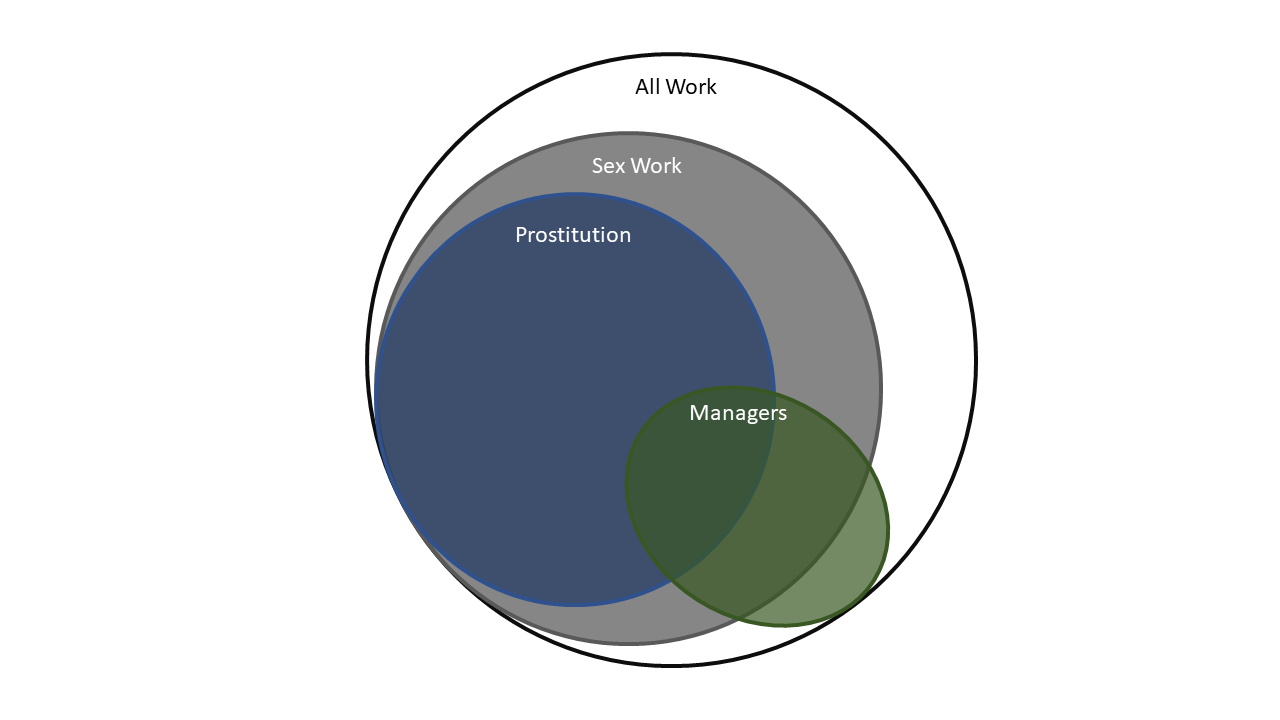
Then we add ‘sex work’ as a subset of ‘all work’.

Slide2
Venn Diagramme: Sex Work

Then, let’s add prostitution as a fully contained subset of sex work (and all work). Again, clearly, this is not to scale. Although sex work can be subdivided into categories besides prostitution, cam girls, phone sex operators, pornographic actors, and so on, and some women may operate in more than one of this subcategories, I will ignore them for the sake of this illustration.

Prostitution can be future subdivided into categories of streetwalkers, escorts, call girls, and so on, each sharing aspects whilst retains distinctions. Besides distinctions in services and autonomy, the ranks comprise of women from different socio-economic classes.

Slide3
Venn Diagramme: Prostitution

Next come ‘pimps’, but before we get to them, let’s recognise for the moment that these people—for better and for worse—provide a supervisory or managerial function. ‘Managers’ exist outside of prostitution, inside the sex industry and out.

Slide4
Venn Diagramme: Managers

Within the sex industry, and particularly within the subset of prostitution, these managers are called pimps, so we’ll focus our attention there. As depicted, not all and perhaps not most prostitutes have pimps. Presumably, there are pimps, if even by some other name, who ‘manage’ sex workers who are not otherwise considered to be prostitutes.

Slide6
Venn Diagramme: Pimps

Now that we’ve established that pimps are not involved in all prostitution, let’s step back for a moment before bringing all of this together. First, let’s recognise that there exists a general category of human trafficking. These humans might be domestic workers, manual labourers, or sex workers.

Slide7
Venn Diagramme: Human Trafficking

But for the sake of discussion, let’s limit the scope to the subset that is human sex trafficking, again noting that not all prostitution involves human sex trafficking.

Slide9
Venn Diagramme: Human Sex Trafficking

Finally, let’s look at the final diagramme. Here we see the overlaps among the entities, and we can see that, theoretically, we can formulate a policy solution that addresses the deeper exploitation without disrupting the broader order of things.

Slide10
Venn Diagramme: Complete

In the end, one cannot simply conflate either human sex trafficking or pimping with prostitution. This is an attempt to win an argument by playing slight of hand with a language shell game. But at no time does Elly create a compelling argument as to why prostitution somehow does not fall into the category of work.

I am not going to enter into debate at this time the issues that Capitalism and Colonialism introduce into the world at large, though I feel that the real debate lies there.

Moreover, looking at the length of this post, I am going to address my response to Arguing for Abolition Pt. 2 – Talk About Class in another entry, hopefully, either today or tomorrow.