Abolishing Prostitution

So, now I’ve gone and done it. I thought that my commentary on prostitution would be a one-off. However, in researching arguments against prostitution, I happened upon this blog, which led me to videos on Elly Arrow’s Youtube channel.  To be fair, she self-identifies as ‘a radical feminist from Germany’, and although there are many cultural similarities between the US and Germany, I could be missing some urgency not present here in the US. Please visit her channel and decide for yourself.

At the start, it seems we have many things in common. She Elly declares, ‘I am the humanist, atheist, pro-lesbian, sex industry-abolishing, gender-critical, radical feminist Liberals and Conservatives warned you about’. Whilst, I am not a Humanist, as I feel this is too narrow of a focus on the larger system, I am an atheist, pro-lesbian, gender-critical, and radical, though perhaps not feminist, as, like the term ‘terrorist’, it’s lost all meaning because it’s been coöpted by so many different factions. . I do have to ponder how one can simultaneously be gender-critical and pro-lesbian or a feminist, as both of these rely on gender identity, but I’ll save this for a possible future topic.

Specifically, she replied to a commented I made on her video, Arguing for Abolition Pt. 2 – Talk About Class. I also commented on How To Make The Case For Prostitution Abolition, so I’ll start there. I haven’t watched the rest of the series or any of her other videos yet, though I may if only to critique them.

Let me get the ad hominem stuff out of the way first. Perhaps she mentions on her blog or in other videos how she came to this place, but I’d like to understand her experiences and motivations that brought here to this conclusion. She says she used to feel differently, so I’d also like to know how she formulated that conclusion, too. It is apparent that she reads a script, which is distracting. Even the choice to read can be edited to sound more natural. It would also make the presentment more succinct. It would also be useful if she would upload her transcripts to the videos so we didn’t have to rely on the auto-translate feature. Pro Tip: This would also help with search indexing and findability.

How To Make The Case For Prostitution Abolition

In this video, Elly gives good advice on how to engage in a ‘debate’.

  1. Make sure your opponent really wants to debate.
    • Emphatically, yes.
  2. Don’t try convincing an opponent all at once. This is a complex issue, and it is unlikely that you will succeed in countering all facets in one conversation.
    • Yes. This is the basis for propaganda and marketing alike. Chip away and win small battles before you worry about the war.
  3. Assume the other side has good intentions. 
    • Good intentions are not necessarily relevant; rather, assume they have a reason for their convictions without recourse to good or bad intentions. What would be an example of bad intentions in this arena anyway?
  4. Don’t antagonise your opponent.
    • Indeed. This is likely to lead to escalating commitment, where they dig in their heals and double down.
  5. No ad hominem attacks: Attack the view, not the person.
    • Solid advice. Continue… 
  6. Change minds on the fence.
    • Sure. If you are in some context where you’ve got onlookers or evesdroppers, make your points, and take wins where they fall. 

In the midst of this setup list, Elly slips in some irrelevant commentary about pimps. This is a related but distinctly separate side issue. Later, she tries to conflate sex trafficking and prostitution, which is again a tangential concern but can be resolved independently. In policy, this is known as scope or specificity. This is an intentional misframing of the argument. Don’t fall for this ploy and adopt this frame. You’ll lose the debate by not recognising that she’s switched domains.

Allow me to illustrate this:

We start simply with a canvas of all work.
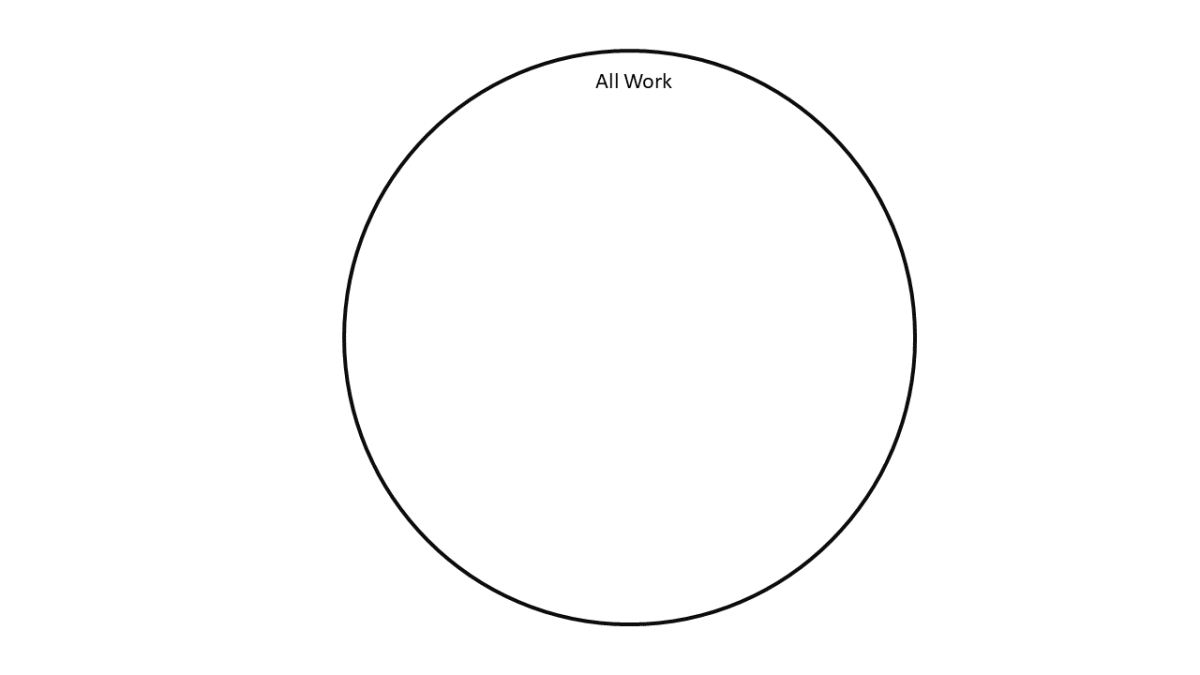
Slide1
Venn Diagramme: All Work

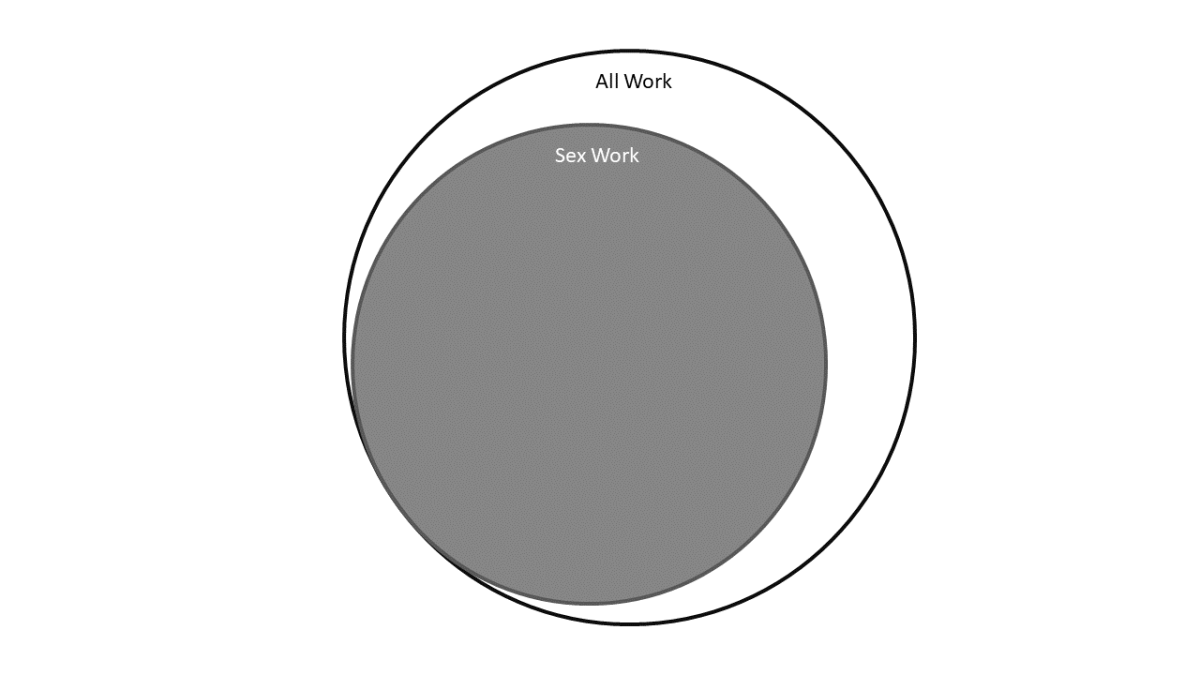
Then we add ‘sex work’ as a subset of ‘all work’.
Slide2
Venn Diagramme: Sex Work

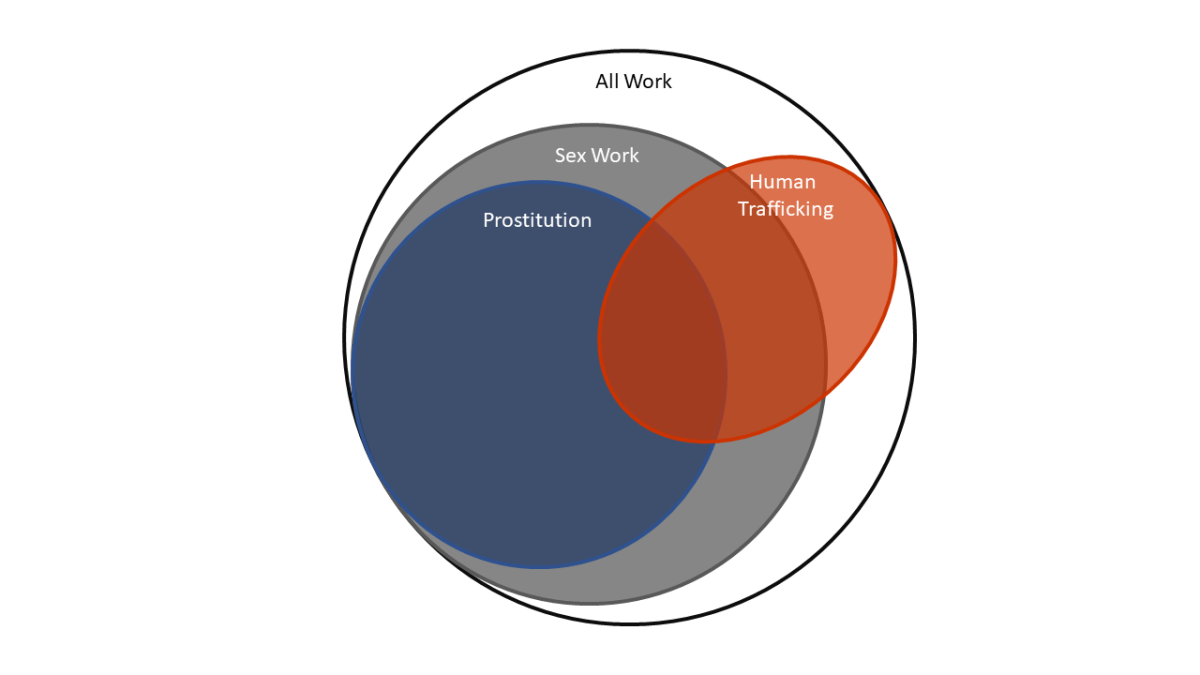
Then, let’s add prostitution as a fully contained subset of sex work (and all work). Again, clearly, this is not to scale. Although sex work can be subdivided into categories besides prostitution, cam girls, phone sex operators, pornographic actors, and so on, and some women may operate in more than one of this subcategories, I will ignore them for the sake of this illustration.

Prostitution can be future subdivided into categories of streetwalkers, escorts, call girls, and so on, each sharing aspects whilst retains distinctions. Besides distinctions in services and autonomy, the ranks comprise of women from different socio-economic classes.

Slide3
Venn Diagramme: Prostitution

Next come ‘pimps’, but before we get to them, let’s recognise for the moment that these people—for better and for worse—provide a supervisory or managerial function. ‘Managers’ exist outside of prostitution, inside the sex industry and out.

Slide4
Venn Diagramme: Managers

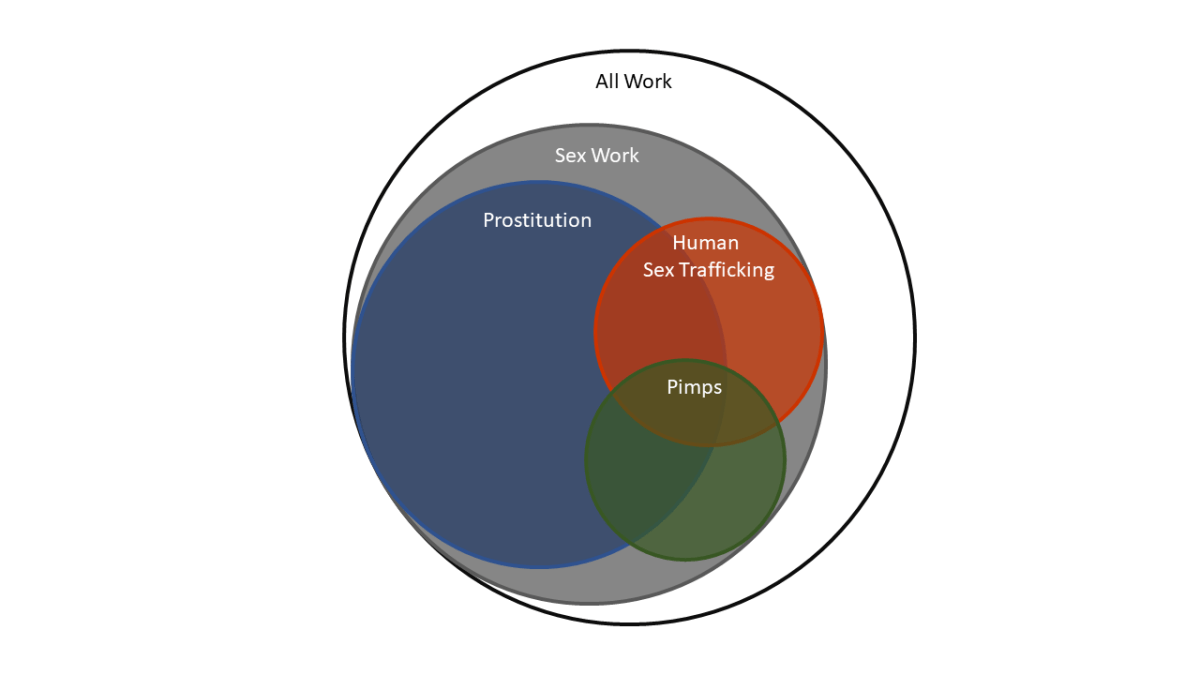
Within the sex industry, and particularly within the subset of prostitution, these managers are called pimps, so we’ll focus our attention there. As depicted, not all and perhaps not most prostitutes have pimps. Presumably, there are pimps, if even by some other name, who ‘manage’ sex workers who are not otherwise considered to be prostitutes.

Slide6
Venn Diagramme: Pimps

Now that we’ve established that pimps are not involved in all prostitution, let’s step back for a moment before bringing all of this together. First, let’s recognise that there exists a general category of human trafficking. These humans might be domestic workers, manual labourers, or sex workers.
Slide7
Venn Diagramme: Human Trafficking

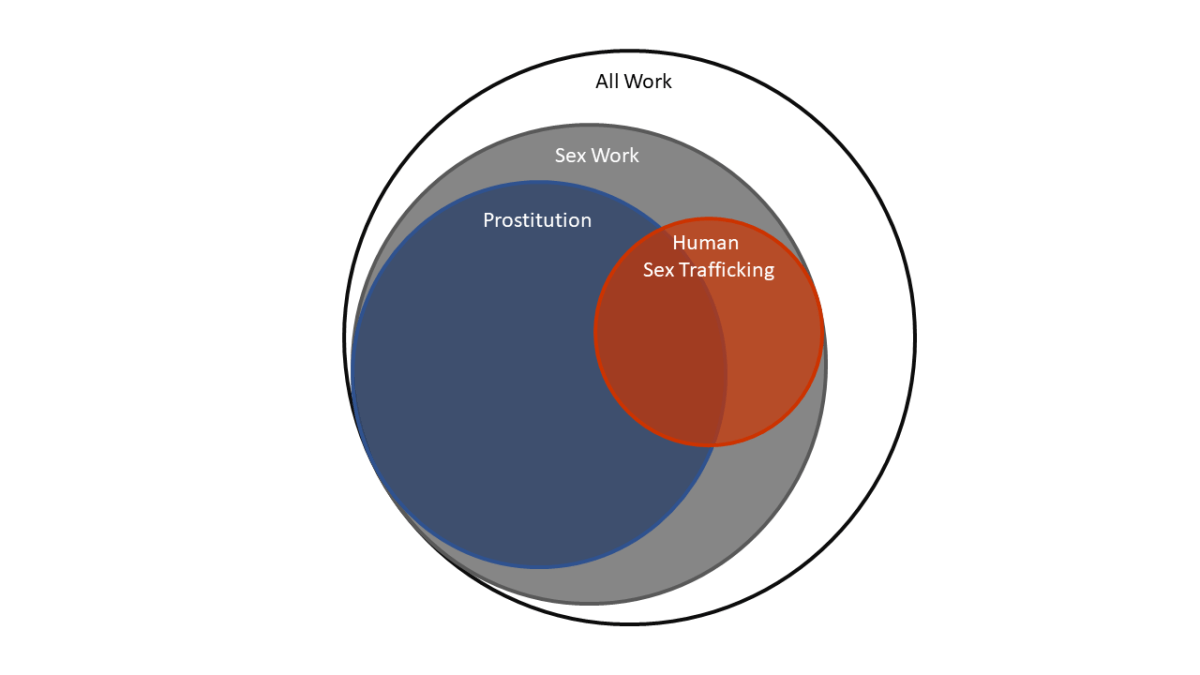
But for the sake of discussion, let’s limit the scope to the subset that is human sex trafficking, again noting that not all prostitution involves human sex trafficking.
Slide9
Venn Diagramme: Human Sex Trafficking

Finally, let’s look at the final diagramme. Here we see the overlaps among the entities, and we can see that, theoretically, we can formulate a policy solution that addresses the deeper exploitation without disrupting the broader order of things.
Slide10
Venn Diagramme: Complete

In the end, one cannot simply conflate either human sex trafficking or pimping with prostitution. This is an attempt to win an argument by playing slight of hand with a language shell game. But at no time does Elly create a compelling argument as to why prostitution somehow does not fall into the category of work.

I am not going to enter into debate at this time the issues that Capitalism and Colonialism introduce into the world at large, though I feel that the real debate lies there.

Moreover, looking at the length of this post, I am going to address my response to Arguing for Abolition Pt. 2 – Talk About Class in another entry, hopefully, either today or tomorrow.

The Rhetoric of Foucault

OK, so this isn’t at all about Foucault’s rhetoric. My main riff this year is the assertion that there is no Truth, only rhetoric—or should I rather say Rhetoric. I created a Reddit post asking for references to other philosophers (or whomever) who had made a similar claim, to which I was offered Vico and Rorty. Unfortunately, there were only two responders, and their assistance was superficial.

What I did encounter by one of the responders was a criticism similar to that levelled at Foucault, hence the inspired title of this post. This critique at its essence is that having proposed no positive solutions to the issues I point to, I cannot defend my position. In fact, as with Habermas‘ fault with Foucault, evidently, I have disarmed myself.

I find this line of argumentation weak tea at best. To argue that one has no claim to declare something incorrect if they don’t have a correct replacement for it is absurd. For example, I don’t know what 13,297 Ă· 1,492 equals arithmetically; but I can assert with confidence that it does not equal 2. Moreover, to criticise, one doesn’t need the ‘ability to generate positive alternatives’.

“There is no truth but rhetoric.”

So when I say there is no Truth but rhetoric (for non-ontic concepts), I am making a Truth statement. As such, this assertion—by my own admission—is only as strong as the rhetoric I can muster to its defence. Alas, my defences are weak, and so the argument fails. Were I to make a stronger argument—a more convincing argument—, it might be accepted as Truth.

Evidently, my first mistake was to separate ontic and non-ontic, which is to say things existing apart from their given names and those whose existence is entirely fabricated. An ontic thing might be a stone, a tree, a planet, a star, or the sensation of pain. These things exist even without language, a label, or an observer. As Saussure and other structuralists have noted, in semiotics, there is the signified (or referent) and the signifier—the object and the identifier. In the context of language, these are tautological.

There_is_no_Spoon[1]
There is no spoon.
Non-ontic things are conceptual, freedom, truth,  justice, rights, gods, and so on. I may opt to replace non-ontic with language-contextual or some such to sidestep the taxonomical quagmire. Or perhaps I’ll adopt the dichotomy of concrete versus abstract. These concepts do not exist outside of language. They are wholly constructed in a complex system created by humans—and humans whilst humans have done OK with complicated systems, they have an abysmal track record when it comes to complex systems. By analogue to the physics of solids, there is more space than atoms, and the atoms and their constituent particles are in constant motion—zero-degrees Kelvin, be damned. Our senses perceive something to be there, but as in that scene in The Matrix, ‘there is no spoon‘.

In my mind, leveraging Saussure’s ideas are useful to depict the differences in the concrete versus the abstract.

1bb[1]

The famous painting depicted above illustrates explains the difference between a signifier and a referent. In this image, there is only the signifier. Magritte makes clear the distinction with the text, Ceci, n’est pas une pipe: This is not a pipe. It is merely a depiction of one. To be even more arcane, the image is a signifier to another signifier that in turn refers to the referent.

A sign is the device that encapsulates the concept. It may be visual—an icon (an illustration of photograph) or a written word or even Braille—or it can be spoken or signed, as with American Sign Language. These are all signs.

cat sign

Notice when one considers a sign that a concrete cat (or in French, chat), it is pretty clear to what one is referring. Above the line, we see the signified, the idea conveyed by the sign. This doesn’t mean that everyone sees the silhouette depicted above, but it is a catlike thing, a feline animal, a mammal, normally with four legs and a tail. Perhaps you are thinking of a particular cat. But to someone with a grasp of the language in which you are communicating, when you say cat, there is little room for ambiguity. In fact, if you are trying to teach someone a different language, say, French, you could show them the cat with the chat signifier, and they would grasp your meaning almost instantaneously.

All language is arbitrary and socially constructed, so there is no connection between the words—say, the spelling or shape of a word—and its referent. The words cat and chat do not look like cats.

There are concrete things that cannot be so readily translated into an icon; for example, the wind. However, one could fairly quickly be able to articulate or gesticulate, as the case might be, the notion of wind. The same cannot be said for the abstract concept of justice.

As I’ve mentioned before, justice, especially one of the restorative or retributive varieties, is a euphemism for vengeance. The distinction is supposed to be found in the intent, but intent cannot be known; it can only be inferred. And, speaking of Foucault, justice can only be delivered from a power position.

But the notion of justice relies heavily on social construct; it has geo-spacial dependencies. What is considered to be just in ancient times may not be considered just now. What is considered just in one country might not be considered to be just in another. And this is more than a difference in instantiation. It is due to the arbitrary if not capricious articulation of a nebulous concept.

Returning to Foucault, (Christian apologist) Nancy Pearcey declares his stance paradoxical: “[when someone] states that it is impossible to attain objectivity, is that an objective statement? The theory undercuts its own claims.”

First, Pearcey merely asks a question about objectivity, but it doesn’t matter. The answer is: this may as well be an objective statement, but it’s just another language game. Wittgenstein (and Russell and Heidegger and Rorty…) was on the right path when he pointed out that the ambiguity inherent in language provide cover for all sorts of mischief. I’m only pretty sure that Derrida might yield paydirt as well. Besides, let’s pretend for a moment that there exists some objective truth, there is no reason (language game; except in accepting the broadest definition, reason is a capability elusive to many if not most humans) to expect that this truth is either accessible or verifiable anyway. The best one can do is to pose a more convincing rhetorical argument.

Reason /ˈrēzən/ (noun)
the power of the mind to think, understand, and form judgments by a process of logic

A similar critique has been advanced by (another Christian apologist) Diana Taylor, and by Nancy Fraser who argues that “Foucault’s critique encompasses traditional moral systems, he denies himself recourse to concepts such as ‘freedom’ and ‘justice’, and therefore lacks the ability to generate positive alternatives.”

So whilst I’ve just managed to stream-of-consciousness my contention, I am not in a position to resolve anything. For now, I’ll settle for documenting my position as I continue to search for other supporters and formulate a more cogent response, a more robust rhetorical presentment.

If anyone can direct me to resources relevant to my position, let me know in the comments. I’ll appreciate it. If you don’t agree—which would be expected, as this is the accepted orthodoxy—feel free to comment as well. 


Sam Harris and the Myth of Perfectly Rational Thought

God is Dead. God is Necessary.

I stumbled upon Professor Jordan Peterson and his defenders of virtue morality, like Dr Stephen Hicks, and I decided to watch some vids.

Full Disclaimer: Not a fan

I ended up on his lecture about Carl Jung.

I’d been interested in archetypal and depth psychology for ages, and I’ve read most of Jung’s work. I still own all of the volumes of his complete works. The difference between me and Professor Peterson is that I take it as metaphor and, by his words, I presume that he doesn’t.

The video clip is cued to the location where Jordan says, speaking of Nietzsche,

“…‘God is dead, and we have killed him’ led Nietzsche to pose another question, which was: What are we going to do to replace him? Because Nietzsche believed—and I think he was absolutely right about this. I can’t see how it could be otherwise—, he believed that the morality that had structured Western society was predicated on the fundamental axiom of divinity, and so, as far as Nietzsche was concerned, the whole purpose of morality was dependent on that axiom being true—or at least being accepted as true. And when that axiom was knocked out by, say, the conflict between science and religion—because in some sense that’s what did it—, then the whole system no longer had anything to stand on and could become entirely questionable…”

“The whole purpose of morality was dependent on [the existence of divinity] being true.”

As I’ve said time and again, this is the primary reason people—especially those defending or seeking some sense of status quo, conservative vanguards, and morality warriors—insist on the existence of a real, objective moral centre or a good-enough version of it—one that coincidentally conforms to their worldview.

I’m afraid that I am going to need to hear something well more convincing than that because I’m not buying what these guys are selling.

Utilitarianism

As I read his Utilitarianism, I want to like John Stuart Mill. He seems like such a clever man, but he is a victim of his Enlightenment Age. Attempting to fabricate order created by science’s encroachment on the absolutes of religion and the shifting sentiments toward monarchies, Mill tries to replace this moral compass with Jeremy Bentham‘s utility.

£1 ≠ £1

The problem is that despite (sort of) dispensing of religious doctrine, Mill was still fettered by the dogma of virtue ethics of dignity and duty. To this, he adds happiness. Not to go full-on Foucault, but these are concepts leveraged, like religion, to maintain power—take an elevated system in a constructed society, and the duty becomes a burden to the bottom, save for pretence of duty and dignity at the top.

I’ve had an issue with the concept of virtue and all of its offspring: duty, justice, and so on. I’ll likely write about this later. I expect that I’ll be reading Mill’s On Liberty next, so stay tuned.

Ignoring my contention that Utilitarianism is baseless, I have two other issues, using economic examples, each related to prospect theory (pdf):

  1. Regressivity: A person with less money values an incremental dollar more than a person with more money.

  2. Loss to gain asymmetry due to risk aversion: A person values losing a dollar more than earning a dollar, ceteris paribus.

Pareto efficiency, a cornerstone of Classical economics, does not take this into account. For this theory, all dollars are created (or perceived to be) equal, so it doesn’t matter whether person A, who earns ÂŁ10,000 p.a., or person B, who earns ÂŁ100.000 p.a.,  gets £100, but in the real world, person A would give it a higher value, so a transfer from A to B would be an inferior transaction to a B to A transaction.

This said, person B values the £100 more than having gained the amount, but it is not clear how to reconcile (in order to reach perceived parity) what the fair equilibrium would be, allowing that equality of outcome might not be the desired outcome.

The Poison of Subjectivism [video]

This essay contains the essence of CS Lewis’ arguments in his fascinating short book The Abolition of Man/Humanity.

In the video, Lewis knocks down a weak strawman argument about subjectivism. He starts with a backstory about biological evolution. In his setup, he conflates empirical tautological truth with moral truth and paints them as equivalent.

Lewis introduces right and wrong and good and evil in order to provoke an emotional to realists and cognitivists, and attempts to underscore it with an appeal to tradition wrapped in an appeal to authority and positive ad hominem  that ‘until modern times, no thinker of the first rank ever doubted that our judgments of value were rational judgments‘ [in situ].

Lewis notes that if one believes that morals are socially conditioned, then we could as soon have been conditioned differently, but he’s just trying to set up his next strawman, which is to say that some subjectivist, say, an educator or reformer, may ask us to improve our morality, and leads into his punchline, that subjectivism will surely ‘be the disease that will certainly end our species‘ [in situ]. I’ll ignore his eternal damnation quip as quaint.

He points out that some indignation toward the Third Reich (Godwin’s Law) is groundless, but what he continues to ignore is that this claim cannot be made on moral grounds. In fact, from the vantage of a Nazi at the time, they were doing the moral thing. Furthermore, had the Nazis won the war, this would be the prevailing morality.

Here Lewis tries to conjure an is from an ought by claiming that without ‘objective standards of good‘, then any ideology is as good as the next, and so he is simply tilting at windmills and arguing with this gossamer strawman. From this condition, he complains that one cannot measure better without an objective measure, so, therefore, there needs to be an objective measure. This, of course, is wishful thinking, like my complaining that I cannot win the lottery without winning the lottery, therefore, I must have won the lottery. (I accept payment by cash, cheque, or Bitcoin.)

In essence, the argument attempts to make a claim that a subjectivist wanting to make a moral claim of ‘better’ or ‘progress’ cannot because there is no ‘better’ or ‘progress’, these terms being subjective. The strawman here is that a subjectivist would make this claim on the basis of moral argumentation. As even Lewis notes, subjectivists claim value judgments as sentiments or complexes, so preferences. This is true; so the claim would be based on a preference rather than on a moral one.

He proclaims that the question ‘why should we preserve the [human] species?’ is somehow profound. It’s a valid question, but, again, it can be answered outside of the realm of morality—constructed or otherwise. Then he goes down some instincts rabbit hole based on this faulty premise but tries to circle back to his standby old universal moral law.

From the rabbit hole down a slippery slope down a rat hole, he rambles anecdotally. Tailing the vid with some supposed objective prescriptions, it mercifully ends.