This quote was made by Owen Jones in an article published in 2012. I share it because I feel the author is not only being cavalier but wrongly so. According to the bio at the end of the article, Owen D. Jones is a professor of law and biological sciences at Vanderbilt University. As I see it, the problem is not some theoretical—What is the sound of one hand clapping?—pseudo-problem. Human agency is the basis of our legal and jurisprudence systems.
Like good magicians, people like Owen want to redirect your focus to neuroscience and consciousness rather than have to explain how the causal engine that is the brain manifests itself ex nihilo.
Doubling down on my causa sui position, humans may be able to make constrained solutions, and yet they never have control over the constrained system they inherit. I discuss this at length elsewhere, but I wanted to address this comment forthright.
I’ll leave with a quote I tend to trot out a lot.
It is difficult to get a man to understand something when his salary depends on his not understanding it.
— Upton Sinclair, prepared speech, I, Candidate for Governor (1935)
Free will is a necessary illusion for power structures to propagate or they will lose a cornerstone of their control mechanisms. And since humans want to feel they are in control, they are willing to accept the downside for the illusion of an upside.
Gregg Caruso is interested in the notion of Agency from the perspective of justice, desert, and sentencing. This is applied philosophy.
My main argument against the possibility of free will is Nietzsche-Strawson’s causa sui argument, which I’ve touched on a few times by now, but I haven’t yet fully articulated my position. I’ll get to that another day. I’d also like to create another video, as I would like to do for this as I explore in more detail.
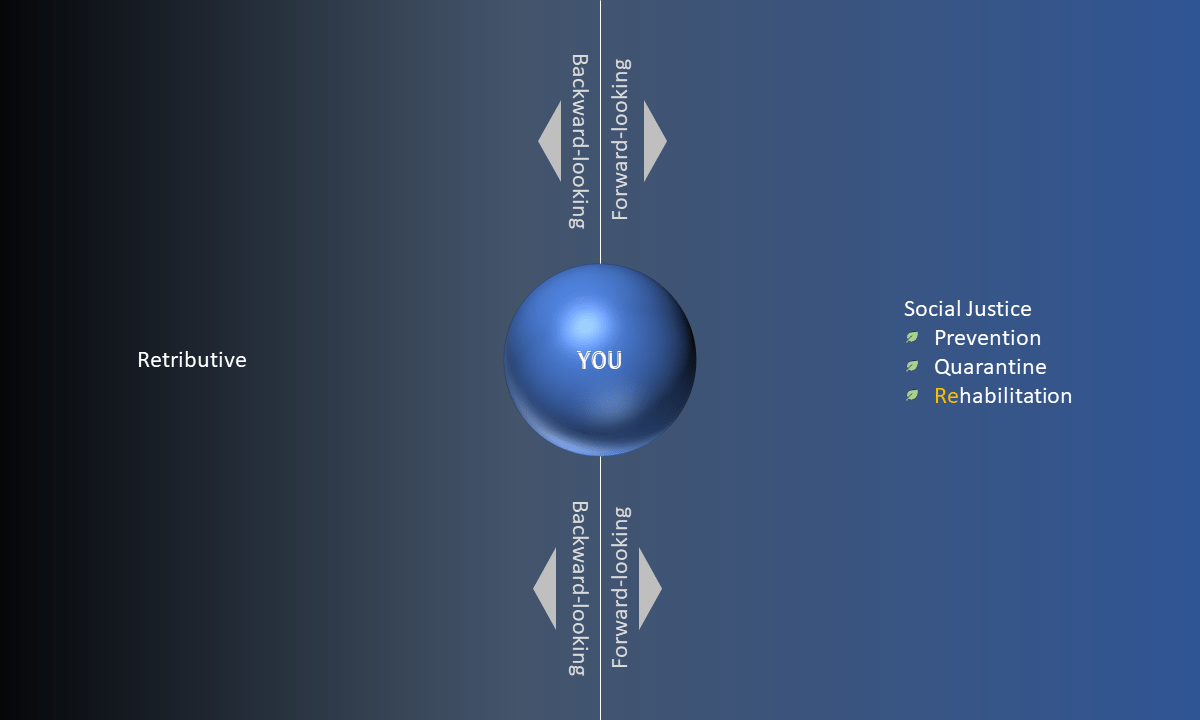
Ostensibly, this is a compatibilist view that leaves a modicum of free will, even with causa sui in place. I hope this illustration will be helpful.
In the centre of the illustration is you, the self of some arbitrary person who shall act as our subject. Let’s assume a couple of basic premises:
We either live in a relaxed causal, deterministic or indeterministic universe.
Causa sui is in full force and effect: one cannot cause any aspect of one’s self.
I include the term relaxed in the first premise, so I don’t have to deal with a fully deterministic universe governed entirely by the notion captured by Schrödinger’s equation. The second premise is in place to serve as a limitation: even if consciousness is an emergent property, its emergence doesn’t grant some insuperable metaphysical powers. One cannot reach outside of one’s self.
The scenario plays out as follows. You have been apprehended for violating some statute. Let’s say that you’ve taken an item from a retail store. As you are leaving the store, the police stop you. When asked if you took the item, you answer in the affirmative. This is a very efficient municipality, so you are taken immediately to a magistrate to make a plea.
In this scenario, Caruso is your attorney at law. His argument is that, given causa sui, you cannot be responsible for who you are. We’ve been here before. Since you can’t be responsible for who you are, any sentence to punish you would be unethical, as you’ve done nothing to deserve it. This is the notion of desert in the realm of retributive justice.
The judge buys this argument, but s/he counters with three possible courses of action. You may not be responsible for who you are, but we are a community of laws. You are a victim of your circumstances, so we cannot look backwards. For whatever reason—and through no fault of your own, by definition—, you were broken relative to complying with community norms.
Social Justice
Firstly, we may wish to make an example of you, to signal the community that we will incarcerate people who break the laws. This is more a public service purpose than a punishment.
Secondly, if you had contracted a communicable disease—we’re looking at you Covid—, you can be quarantined under the consideration of the common good. Framed this way, it is not a punishment, we just don’t want it to happen again.
Lastly, we may also be justified on the grounds of rehabilitation. I highlight the ‘re‘ in rehabilitation because some people may not have been ‘habilitated’ in the first place. Perhaps think of them as feral. In any case, a computer programming analogy might make sense here.
So what’s this all about? Remember, causa sui says that you cannot be held responsible for creating yourself. The claim is that you are a product of your nature and nurture. Genetically speaking, perhaps there was some reason that you could not incorporate inputs into factors that allowed you to appropriately interpret this law—or any law, more generally. Or maybe, you were never exposed to this law or category of law before.
In the preventative vein, we could be signalling, ‘We caught You taking an item from a shop without paying. Now you know this, and we may make an example of you since you are caught as well’.
Quarantine may be a bit of a stretch in this scenario, so feel free to substitute a more serious offence if it helps you to remember this. Perhaps You killed someone. Even without punishment, we may want to get You off the streets before another killing is perpetrated. I’ll come back to this one.
Rehabilitation makes sense even if one is not responsible for one’s self. Presuming that you are a product of programming—family, culture, peers, and so on—, perhaps you just need to be rewired. Perhaps a particular subroutine was not implemented or activated correctly. This rationality could be used as a non-punitive justification.
Counterarguments
The public prevention case may be why offenders were pilloried in by-gone days. Display in a public square may inform some who may have missed the lesson the first time around, hence dissuading taking similar actions. But unless this ‘public service message’ reached enough people, it would probably not be the best rationale.
Quarantine may sound OK on the surface, but it’s actually rather specious. Firstly, that You knicked a trinket. What exactly is the risk of contagion? Petty theft is not known to be particularly communicable. Secondly, just because you’ve done something once is little measure of whether you’ll do it again. In fact, if this were true, then one might have assumed that you could never have committed the offence because of your history.
Rehabilitation may likely be the best option among these. If you missed that particular lesson or had forgotten or diminished the calculus, remediation may do just the trick. However, if your ‘operating system’ is not up to snuff, it’s not a matter of inputs. It’s a matter of processing capability.
Psychological intervention is in its infancy, so the probability of remediating this is low, if not a crap shoot. And not all such processes can be remediated. This could lead one to fall back on the quarantine option, but who is the competent assessor in this case?
It’s easy enough to assess if You is Hannibal Lecter or tells you straight out that s/he intends to repeat the offence. Some cognitive deficiencies are simple enough to recognise. But what about the grey areas—all of that space in between?
And who is making sure that the judges are not being punitive simply because they haven’t yet eaten lunch?
Enfin
Bringing this to a close, if we have no free will, it makes no sense to punish. Sadly, most justice systems promote retributive justice and punishment in sentencing. I’ll spare you my diatribe on how I believe most people attracted to jurisprudence, law, and law enforcement have been conditioned. And whilst Caruso feels justified in foreword action, I am more sceptical. This said, I’ll take what I can get.
This post is pretty much a stream of consciousness. I hope to give it better treatment in a future video.
The CAUSA SUI is the best self-contradiction that has yet been conceived, it is a sort of logical violation and unnaturalness; but the extravagant pride of man has managed to entangle itself profoundly and frightfully with this very folly. The desire for “freedom of will” in the superlative, metaphysical sense, such as still holds sway, unfortunately, in the minds of the half-educated, the desire to bear the entire and ultimate responsibility for one’s actions oneself, and to absolve God, the world, ancestors, chance, and society therefrom, involves nothing less than to be precisely this CAUSA SUI, and, with more than Munchausen daring, to pull oneself up into existence by the hair, out of the slough of nothingness. If anyone should find out in this manner the crass stupidity of the celebrated conception of “free will” and put it out of his head altogether, I beg of him to carry his “enlightenment” a step further, and also put out of his head the contrary of this monstrous conception of “free will”: I mean “non-free will,” which is tantamount to a misuse of cause and effect. One should not wrongly MATERIALISE “cause” and “effect,” as the natural philosophers do (and whoever like them naturalise in thinking at present), according to the prevailing mechanical doltishness which makes the cause press and push until it “effects” its end; one should use “cause” and “effect” only as pure CONCEPTIONS, that is to say, as conventional fictions for the purpose of designation and mutual understanding,—NOT for explanation. In “being-in-itself” there is nothing of “casual- connection,” of “necessity,” or of “psychological non-freedom”; there the effect does NOT follow the cause, there “law” does not obtain. It is WE alone who have devised cause, sequence, reciprocity, relativity, constraint, number, law, freedom, motive, and purpose; and when we interpret and intermix this symbol-world, as “being-in-itself,” with things, we act once more as we have always acted—MYTHOLOGICALLY. The “non-free will” is mythology; in real life, it is only a question of STRONG and WEAK wills.—It is almost always a symptom of what is lacking in himself, when a thinker, in every “causal-connection” and “psychological necessity,” manifests something of compulsion, indigence, obsequiousness, oppression, and non-freedom; it is suspicious to have such feelings–the person betrays himself. And in general, if I have observed correctly, the “non-freedom of the will” is regarded as a problem from two entirely opposite standpoints, but always in a profoundly PERSONAL manner: some will not give up their “responsibility,” their belief in THEMSELVES, the personal right to THEIR merits, at any price (the vain races belong to this class); others on the contrary, do not wish to be answerable for anything, or blamed for anything, and owing to an inward self-contempt, seek to GET OUT OF THE BUSINESS, no matter how. The latter, when they write books, are in the habit at present of taking the side of criminals; a sort of socialistic sympathy is their favourite disguise. And as a matter of fact, the fatalism of the weak-willed embellishes itself surprisingly when it can pose as “la religion de la souffrance humaine“; that is ITS “good taste.”
As I research the agency/free will quandary, I am finding a lot of common minds, as it were. On the free will versus determinism spectrum, I can’t say without reservation that I accept determinism or indeterminism, for that matter, but I can say that free will is weak tea. Causa Sui comes into play, but I’ll get to that.
Audio: NotebookLM podcast on this topic of Causa Sui.
As an aside, similar to the theism versus atheism debate, keep in mind that this debate hinges on free will taking the privileged position occupied by theism. When discussing compatibility versus incompatibilism, it’s whether determinism is compatible or incompatible with free will. I feel that the privilege of free will in this debate is telling insomuch as it reveals a bias on preferred perspective.
If you’ve been reading, I like what Derk Pereboom has to say, but I feel we have a bit of a gap in our accord. But I’m very partial to Galen Strawson’s line of argumentation that doesn’t rely on determinism to declare the free will argument pointless. I believe that there is space to fill in some gaps in his position regarding social responsibility, and maybe there are no gaps; I just am not yet familiar enough with his position. From a strictly deterministic position, I find Robert Sapolsky’s position appealing, but it still ends up being a pissing match. To be fair, I think any position will be a pissing match. I’ll elaborate on this next before I touch on causa sui.
Losing My Religion
In my book, free will is an anachronistic vestige of religion. Not to go too far down a Foucauldian path, religion is a power play. As religion constructs gods, it also constructs notions of free will. Power structures like to leverage these concepts for their own ends.
Interestingly, religion first gave us determinism—at least the Abrahamic monotheistic varieties—, but it needed to construct free will or it would have undermined its ability to cast blame and guilt. When science matured, it said, ‘Hey, hold on there. There’s no room for gods in physics. Everything has a cause and was determined at the start. Your intuition was right at the start. Free will is bollocks.’
Causa Sui
Finally. Causa Sui is the Latin name for a self-caused cause, one that is not the result of prior events. Here is where I really like Galen Strawson’s account. His argument is premised on 4 factors, the first of which is what you do flows from the way you are.
What you do flows from the way you are.
Galen Strawson
In essence, you’ve somehow got to get to be responsible for being the way you are, but you can’t you can’t get back behind yourself in such a way as to be responsible for the kind of person you are. You’ve got to somehow have chosen it, but you can’t choose it unless you already exist as a creature who has preferences.
No Causa Sui
You’d somehow have to get to be the cause of yourself to take fundamental ultimate responsibility for yourself and therefore for your actions that flow from the way you are and therefore free will—indeed more responsibility and free will, and therefore we do not have free will.
In the diagramme, we see you, and the influence of external forces, but at no point are you ever responsible for your own actions. Even if you did make a so-called conscious effort to do something else, it would still be the result of one of these other sources.
Perhaps an inapt example would be for a homosexual person to ‘decide‘ to be a heterosexual person. This is not to say just to act like a heterosexual person, but to actually be attracted to the opposite sex. It should be obvious that this can’t be done, but if you are having difficulty, imagine the mirror example where you are a heterosexual person and you ‘decide‘ to be attracted to people of your own sex. Of course, this is akin to deciding that you like cilantro when you don’t, deciding you like Justin Beiber when you don’t, or deciding that you don’t actually enjoy chateaubriand when you do. Even if you manage to act the opposite of your sexual orientation, it is still not you who is responsible for the apparent change. It’s a response to social forces and external conditioning. You are the way you are because of the way you are. You’ve had absolutely no say in the matter.
You are the way you are because of the way you are.
So what’s the big deal? you might still be asking yourself. If you’ve just done something morally or legally “wrong” —emphasised by big bold scare quotes, you need to be punished or at least blamed irrespective of how you became you, right? Let’s ignore that I am a moral non-cognitivist at the start and pretend that this moral indignation is otherwise meaningful.
Quarantine Justification Theory
Let’s say that someone has done something outside the bounds of social acceptance in some milieu. To make it even easier to consider, let’s imagine for a moment, instead, an autonomous robot that was designed to seek glass and smash it. This robot has no conscience and no free will. It is just a robot programmed to break windows.
This robot has been unleashed on our community. In one sense, some might blame the robot for breaking the windows, but we know that whoever programmed this robot is to blame. But we don’t know who programmed it. What we do know is that we want to stop the robot from breaking more windows.
So we track down the robot and we disable it—or perhaps it’s designed in such a way that it can’t be turned off. Even though the robot is not to blame, it is a menace and we’ve collectively decided to disarm it or quarantine it. We build a glassless room and sequester it away so it can do no more damage.
Some people find this scenario a reasonable justification to quarantine the actor, but I think that this has at least one problem, I’ll mention two considerations I have.
Not a Robot
So, let’s revisit quarantine justification theory with a human actor, and let’s presume no causa sui. As we can’t blame the robot actor, neither can we blame the person actor. As with the robot, the goal is not to punish but to quarantine.
Not to Blame
Now let’s add a dose of reality. This human is not on a window-breaking rampage. Instead, s/he vandalised the window of a shop for some reason; let’s say that s/he was short-changed and wanted to exact damage equal to the shorted change. A police officer witnesses the act and takes the perpetrator into custody. What should the judge do? Remember, the person did not create themself, but s/he did the act s/he was accused of.
The image below shows two scenarios. In scenario A, you are integrated with society; in scenario B, you are quarantined. The question is what is the justification for quarantining you.
Quarantine Justification Model
It’s difficult to argue that this person should be quarantined because this was a tit-for-tat response, not a rampage. It’s unlikely to happen again. One might try to argue that this person should be fined or, in line with quarantine, incarcerated to be made an example, thus acting as a scapegoat to serve as an external social pressure mechanism to disincentivise this retributive action. But this would ostensibly be punishing this person for something beyond their control.
We can even loosen the scenario to consider a person who has robbed a liquor store or kidnapped a child. These events are all too common, but there is nothing to suggest that a person will repeat this activity, so quarantine cum incarceration is hard to justify.
I can envision someone reading this thinking that we need to do something. We can’t let this person get away with it, but if you find yourself drifting in this direction, it’s your programming. You can’t help yourself. You don’t even have this degree of agency.
I haven’t given it enough thought, but it feels like this is similar to the dissonance when one grasps something intellectually, but instinctually or emotionally something just doesn’t sit right. Whilst you try to get outside of yourself, your programming doesn’t allow it.
* If you haven’t sussed it out quite yet, ‘cows are suey’ is how Google’s auto-generated transcript heard causa sui in an interview with Galen Strawson on this topic, and the rest is history.



 Philosophics