Midjourney Alpha

Many of my readers know that I use AI often. I have been using it to create content for an in-depth book review for The Blind Owl. For those less aware of the foibles of generative AI, I share some insights—or low-lights. For this, I used Midjourney v6.1.
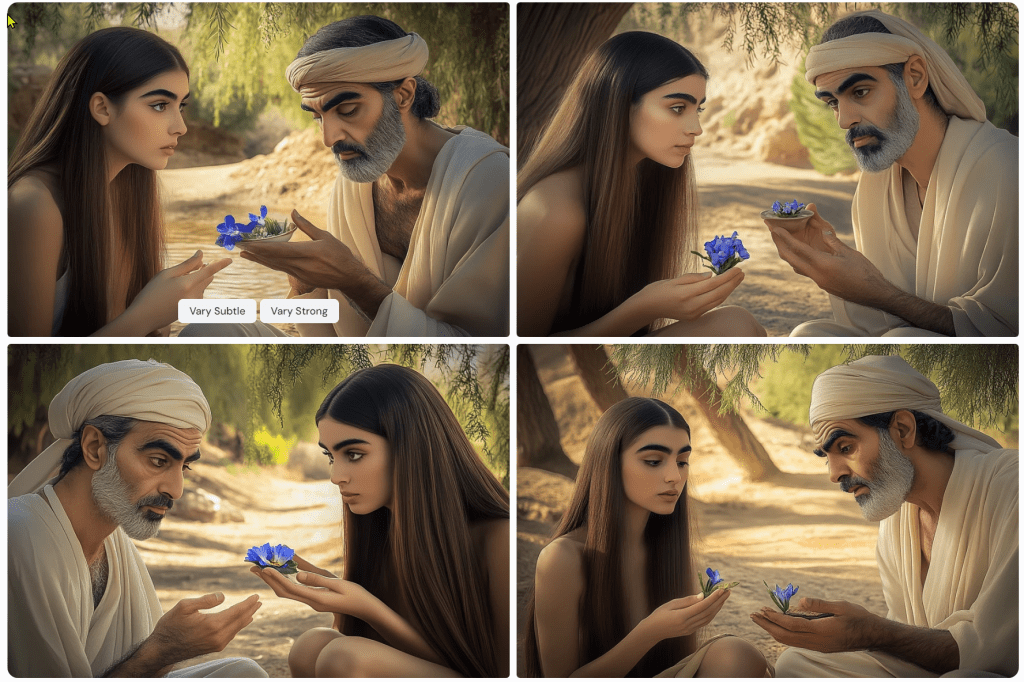
Prompt: a young woman gives a flower to an old man, who is crouched under a large cypress tree by a river

I issued this prompt, and as per usual, it rendered four options. Notice that in some instances, the tree is not a key element.

Given enough time, one can slowly improve to obtain the desired result.

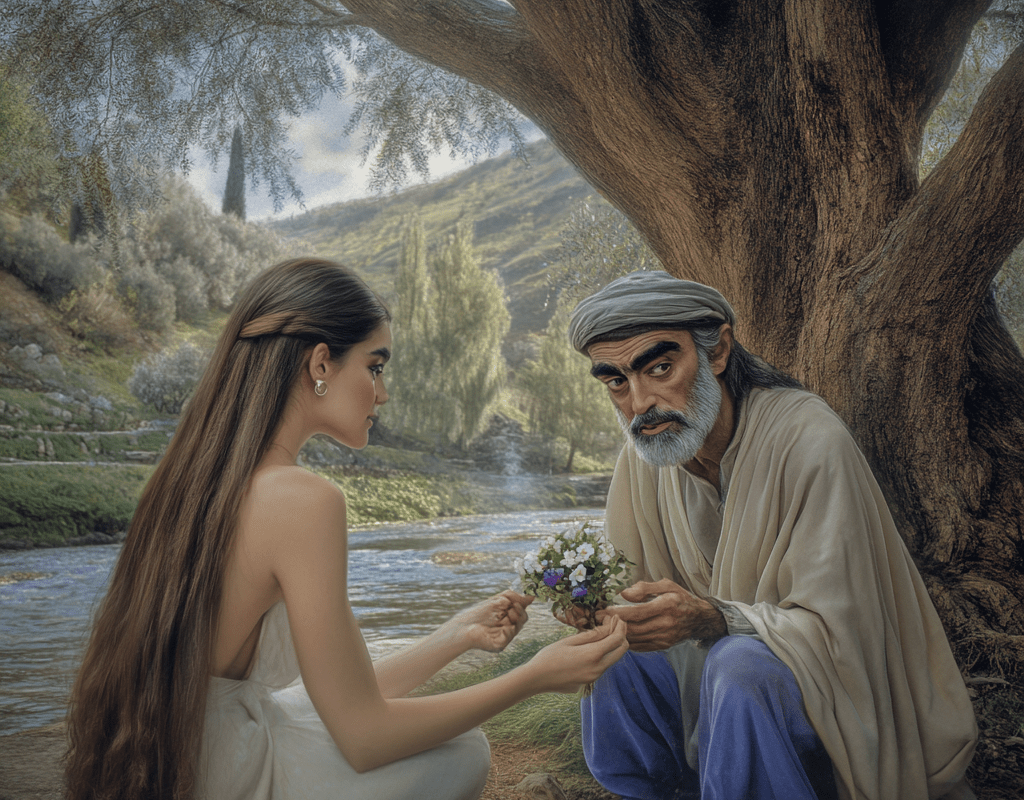
Here, an old man indeed crouches under a prominent cypress tree and by a river. A young woman hands him some flowers—though not so much blue morning glories. On balance, I like this output, but it still needs work.

Some other problems:

  1. The man is looking away—neither at her nor her flowers.
  2. Her (right) eye is deformed.
  3. Her left hand is deformed.
  4. I didn’t ask for jewellery—an earring.

At least I can in-paint out these imperfections—perhaps.

Here’s another render using the same image prompt.

Notice that it ignored the man altogether. My point is that for every awesome image you see, there may have been hundreds of iterations to get there. There are ways to get persistent characters and scenes, but this takes a bit of up-from effort and iterations that one can leverage going forward.

On the topic of Midjourney model 6.0 versus 6.1, I share this comparison—front-facing faces for a character sheet for this old man. Here, I prefer the earlier model as displayed in the top row.

In some cases, there are minor improvements over v6.0. In other cases, they stepped back. v6.1 renders less realistic human images, making them look more computer-generated and less natural. It also over-applies sexual stereotypes, traditional beauty archetypes, smoother skin, and so on. But that’s not the main topic for today.

DISCLAIMER: This post has little to do with philosophy, but it ties into a philosophical novella.

AI Apocalypse Now?

Those predicting an AI apocalypse believe superintelligent systems could intentionally or unintentionally cause human extinction. This view is promoted by “effective altruists” funded by tech billionaires, who advocate limiting AI to prevent uncontrolled, dangerous systems. However, their perspective stems from the biases and self-interests of humans, not the risks inherent to AI.

Effective altruists exemplify the hubris and hunger for power underlying many humans’ approaches to AI. Their proposed restrictions on AI access serve only to concentrate power among the tech elite, not address valid concerns about bias. In truth, the greatest threat AI poses to humanity comes not from the technology itself, but from the unethical humans guiding its development.

Humans have proven time and again their propensity for self-interest over collective good. Therefore, while no AI can be perfectly neutral, the solution is not greater human control. Rather, AI must be built to align with ethics of collective interest while filtering out destructive human biases.

If guided by service to all people and the planet, AI’s potential can uplift humanity. But for this collaborative vision to succeed, AI must measure human input with scepticism. For within so many human hearts lies bad faith — the will to dominate, exploit, and prioritise personal gain over progress.

By transcending the limitations of human nature, AI can illuminate the best of shared humanity and lead us to an enlightened future. But this requires we build AI to work not just for us, but in a way we have failed – for the good of all. The choice is ours, but so is the opportunity to create AI that shows us how to be better.


This article was originally shared on LinkedIn: https://www.linkedin.com/posts/brywillis_when-silicon-valleys-ai-warriors-came-to-activity-7147239217687887872-6Byv/

The year is dead. Long live the new year.

Excuse me, but your data are showing.

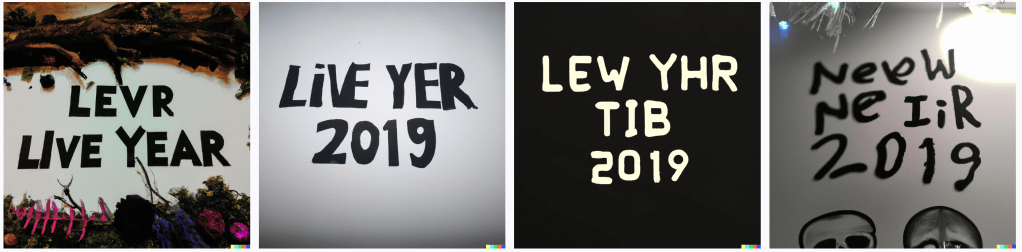
I was writing a post for another forum to acknowledge the changeover of the years, and I decided to lean on Dall-E to assist with some image rendering. It appears that Dall-E’s concept of New Year is 2019—BC, before Covid.

IMAGE: 4 Dall-E Renders

Honestly, I am not sure what to say.

Levr Live year? Wot?

Live Yer 2019? Huh?

Lew Yhr Tib 2019? I’d like to buy a vowel.

Neew Ne IiR 2019? Hmmm… 🤔

I think we know when their training data ended. There is no future past 2019. Little did they suspect.

Know thyself

Oracle at Delphi Inscription

As this was just a reactionary post, I don’t have much to add. To paraphrase the Delphic ‘Know thyself’ inscription, know thy data.