Your Morals – Part 3 of 3

Continuing my responses to Johnathan Haidt’s Morality survey…

25. I believe the strength of a sports team comes from the loyalty of its members to each other

Who TF cares about a sports team or where their loyalty comes from, whatever that even means. And the strength of what exactly? Players move from team to team with ease, and they are obliged to win in order to advance their own interests and personal glory. Weaker players can coattail by association to their team or their league.

26. I think children should be taught to be loyal to their country

Smh. No. I think that countries should be abolished. Children should be taught how arbitrary countries are and how they divide more than they unite.

27. In a fair society, those who work hard should live with higher standards of living

Weasel words—fair, hard, work, higher, and living standards. Perhaps the answer can be found in the definitions, like divining with tea leaves.

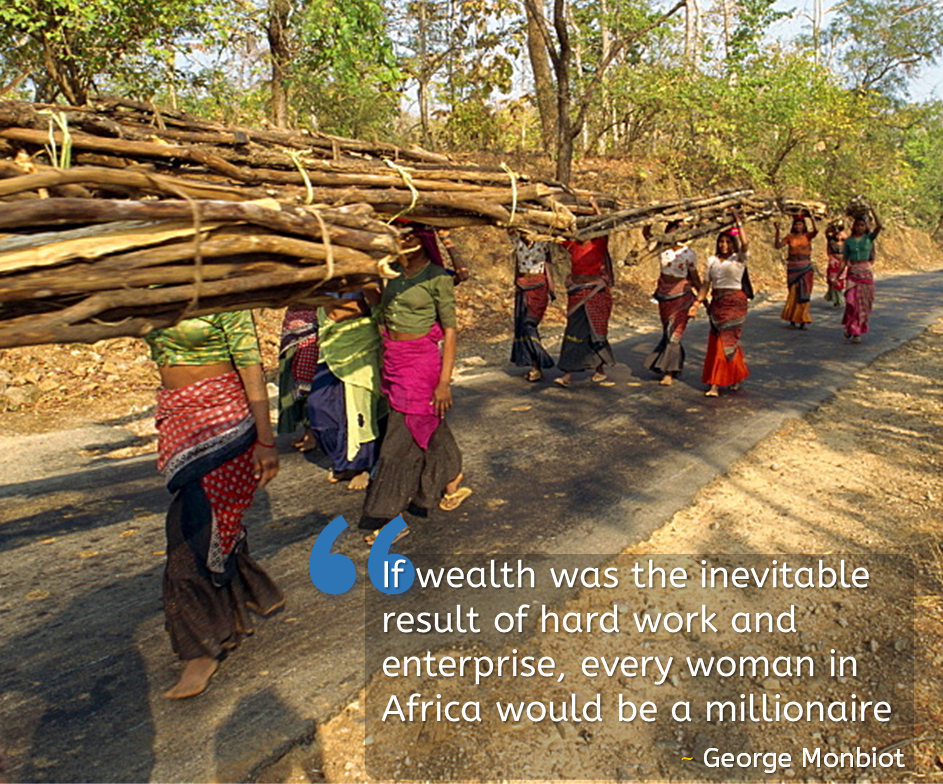
Hard Work & Enterprise

28. I believe that everyone should be given the same quantity of resources in life

What resources? A family with no children doesn’t need children’s shoes and clothing. A vegan doesn’t need a side of beef. What is this asking?

29. The world would be a better place if everyone made the same amount of money

I agree. And the amount should be zero. Didn’t I already answer this one?

30. I believe it would be ideal if everyone in society wound up with roughly the same amount of money

What is this obsession with money? I guess this is a reflection on Harvard. Get over it.

31. People should try to use natural medicines rather than chemically identical human-made ones

What? Sure. Maybe. I suppose if they are identical. Are they cheaper or free? Are they dosage- and quality-controlled? What is the function of the infinitive try to?

32. I believe chastity is an important virtue

Not more virtue. Make it stop. Chastity is defined as the state or practice of refraining from extramarital, or especially from all, sexual intercourse. This would be important why? And how would it be a virtue by any measure?

33. I think obedience to parents is an important virtue

Just why?

34. I admire people who keep their virginity until marriage

How would I know? Why would I admire them? I understand the traditional and statutory function of marriage, but this anachronistic chattel arrangement doesn’t need to exist.

35. Everyone should defend their country, if called upon

Perhaps we should abolish countries and property. What are the defending—their unique way of life? Their awesome achievements or prospects thereof? The dirt and natural resources? The buildings? Some mythos? Just no. If politicos want to fight for imaginary boundaries, let them fight it out in an old school cage match.

36. If I found out that an acquaintance had an unusual but harmless sexual fetish I would feel uneasy about them

Define harmless. Does this fetish involve me? If not, I don’t care. Might I roll my eyes? Perhaps. Might I laugh? Sure.

Summary

Having commented in some form or fashion on each of these questions, I can remain unmoral. Morality is an exercise in mental masturbation and power. As should be obvious by now, morality presumes that one subscribes to some underlying and supposed metanarratives.

In the end, reflecting upon other sources, a certain sense of what might be considered to be a moral compass may be present in infants and children, but these can be (and are) manipulated through education, books, entertainment from TV and movies to sports to civic instruction and all sorts of propaganda. So, the point that wee folk have propensities for certain behaviours is all well and good, but this feels an awful like confirmation bias in full view. Of course, it might be considered to be immoral to raise classless, less judgmental children especially if they make choices different to the leaders.

Your Morals – Part 2 of 3

Continuing my response to Johnathan Haidt’s Moral survey…

13. I believe that one of the most important values to teach children is to have respect for authority

This is a legitimate question without subtext. I happen to disagree with it, but at least it’s legit. Children should not only be taught to question authority, they should question the structure that perpetuates authority.

14. It makes me happy when people are recognized on their merits

dot dot dot … Let’s not retread in the nonsensical space that is meritocracy. Next…

15. I think people should be rewarded in proportion to what they contribute

smh … Next…

16. It upsets me when people use foul language like it is nothing

Sadly, this is another legitimate question. Language is language. If someone feels that some language is out of bounds—and this as well extends to the proponents of PC speech—then this is more a reflection of their repression than anything more. Liam Gallagher FTW

17. Our society would have fewer problems if people had the same income

Not another money-based economy question. I’ll leave it at ‘Our society would have fewer problems is people had no necessity for income’.

18. It pains me when I see someone ignoring the needs of another human being

I suppose it does, but given the ubiquity of this as well as the contrary situation, what’s one to do. On balance, this can either be a disconnected or misguided government or an apathetic person. Needs is a weasel word, but I’ll let it slide.

19. It upsets me when people have no loyalty to their country

Eyeroll, please. TF is loyalty anyway? And where’s the reciprocity? I think I’m on to something. Obviously, someone who fetishises a country has pathological issues. I’m not sure what the scale differential is between country fetishists and sports fans, but I’ll move along. Now you know what does upset me.

20. I am empathetic toward those people who have suffered in their lives

Sure. Sympathetic, perhaps even compassionate. Another vapid question. Each of these is contingent on what suffering is perceived.

21. Everyone should love their own community

Define community. Define love. Should? Is this my imposition? Everyone? What is this sorcery? Next…

22. I believe that compassion for those who are suffering is one of the most crucial virtues

Here we go with virtues again—more tripe about relative goodness and badness. Translation: I believe that being good is good. According to Google, compassion is sympathetic pity and concern for the sufferings or misfortunes of others; sympathy is feelings of pity and sorrow for someone else’s misfortune; pity is the feeling of sorrow and compassion caused by the suffering and misfortunes of others; therefore, compassion is [feelings of pity and sorrow for someone else’s misfortune] [with the feeling of sorrow and compassion caused by the suffering and misfortunes of others] and concern for the sufferings or misfortunes of others. This is some recursive word salad if I’ve even seen it.

23. We should all care for people who are in emotional pain

More shoulds and alls and care and pain with a dash of emotional.

Maybe I'm too emotional*
But your apathy is like a wound in salt
Maybe I'm too emotional
Or maybe you never cared at all
Maybe I'm too emotional
Your apathy is like a wound in salt
Maybe I'm too emotional
Or maybe you never cared at all

24. I think having a strong leader is good for society

I think that having a strong leader is good in some cases…for some members of society. As with benevolent dictators, leaders can be beneficial, if there is a common cause. Oftentimes, the common cause is a contrived narrative, leading in a direction, which may or may not resolve in a better place for some—never all, and what about the rest? This is a role of society.


* Good 4 You — Daniel Leonard Nigro / Olivia Rodrigo / Hayley Williams / Josh Farro

Your Morals

I was commenting elsewhere on morals and was directed to Jonathan Haidt and his work. Notably, the questionnaire at YourMorals.org, where you can get your own assessment and contribute data points to the body of work.

Full disclosure: I am not a fan of this type of survey, as I’ve mentioned previously. Still, I made an attempt. Better still, I’ve copied the questions to critique. There are 36 all tolled. Perhaps, I’ll respond to a dozen at a time. The next dozen responses are here. Generally speaking, they present each question and provide a Likert scale as follows:

  1. Does not describe me at all
  2. Slightly describes me
  3. Moderately describes me
  4. Describes me fairly well
  5. Describes me extremely well

Standard fare. It starts off bad:

1. Caring for people who have suffered is an important virtue.

Why include an abstract concept like virtue? I don’t ascribe to the notion of virtue, so it’s an empty set. Given that, my response would be a 1. If I ignore the offensive nomenclature and assume it translates idiomatically into ‘beneficial for some target society’, then I still have to question what is meant by suffering, and how far does caring extend. Is it enough to feel bad about the homeless person, or does one have to care enough to provide sustenance and shelter? Talk is cheap.

2. The effort a worker puts into a job ought to be reflected in the size of a raise they receive.

This is fraught with all sorts of problems. In fact, it’s a reason why I consider myself to be a Postmodern. The inherent metanarrative is that societies are effectively money-based. I don’t happen to believe that, so I am again faced with responding to an empty set. Even if I attempt to abstract the ‘raise’ aspect to mean that effort represents input and output is a direct and (perhaps) proportional function, I am still left to wrestle with how this effort is measured and what could have been achieved had the others not been present.

Using a sports analogy—always a dangerous domain for me to play in—, what if LeBron James was to play an opposing team by himself? He needs the other team members. Of course, his teammates are compensated, too. But in his case, his salary is not only based on his athletic talent but on his celebrity power—rent in economic parlance. Perhaps LeBron makes a lot of baskets, but without the assists, he’d have fewer. And because he is the go-to guy, some other teammates might be sacrificing baskets as part of their winning strategy.

Finally, how do you measure the effort of an accountant, a janitor, and an executive? The question is fundamentally bollox.

3. I think people who are more hard-working should end up with more money.

On a related note, I can abbreviate my commentary here. Again, what is harder? Are we asking if construction workers should earn more than CEOs? More bollox.

4. Everyone should feel proud when a person in their community wins in an international competition.

Yet, again, an empty set and a sort of mixed metaphor. I don’t agree with the notion of identity and even less at scale—states, countries, and nationalities. Putting that aside, why should I derive pride (that cometh before the fall) because someone succeeds at some event anywhere? It’s facile. If the question was focused on whether I would be happy for that person, the answer might shift up the scale, but where would I have derived pride for that person’s achievements?

5. I think it is important for societies to cherish their traditional values.

First off, why? What values? Not to beat a dead horse, but what if my tradition is slavery? Should I cherish that? This is really asking should I cherish the traditions of my society. Clearly, it’s not asking if other societies should enjoy the privilege of cherishing theirs? From the standard Western vantage, many want to cherish their own, but not Eastern values of eating dogs or Middle Eastern values of burqaed women and turbans. Is this asking should the world subscribe to my society’s values? I’m not sure.

6. I feel that most traditions serve a valuable function in keeping society orderly

Speaking of tradition… We are not only dealing with the vague notion of tradition, we are discussing another vague concept, order, and elevating order over (presumably) disorder. Order connotes a status quo. And why is the superlative most present? Has someone inventoried traditions? I believe I am supposed to translate this as ‘I feel that the traditions I am familiar with and agree with help to create a society that I am content with’. Again, this betrays the privileged perspective of the observers. Perhaps those disenfranchised would prefer traditions like Capitalism and private property to be relics of the past–or traditions of two-party rule, partisan high court judges, or money-influenced politics, or politicians serving themselves and their donors over the people or Christmas.

7. We all need to learn from our elders

Learn what exactly from our elders? Which elders? The bloke down the block? That elderly Christian woman at the grocery mart? The cat who fought in some illegal and immoral war? The dude who hordes houses, cars, and cash at the expense of the rest of society? Or the guy who tried to blow up Parliament. I believe this is asking should we learn how to remain in place as taught by the privileged wishing to maintain their places.

8. Everyone should try to comfort people who are going through something hard

Define hard, and define comfort? This harkens back to the first question. Enough said. As far as lying is concerned, we should by now all be familiar with the adage trying is lying. Or as Yoda would restate it, do or do not, there is no try.

9. I think the human body should be treated like a temple, housing something sacred within

Obviously, this one is total rubbish. Here, I don’t have a structure that makes it difficult to answer. I may have sprained my eye rolling it, though. This said, what is a temple treated like?

10. I get upset when some people have a lot more money than others in my country

This one is interesting. Whilst I don’t believe that countries or money should exist. In practice, they do. So on its face, I can say that I get upset when we are thrown into a bordered region and told we need to exchange paper, metal, plastic, and bits for goods and services–that some people have more and others have less primarily through chance.

11. I feel good when I see cheaters get caught and punished

Which cheaters? Cheating requires perspective and a cultural code. It can privilege the individualist over the communalist. This reminds me of the cultures that are more interested in ensuring that all of their members finish a contest than having any one win.

Academically, it is considered to be cheating to work together on an exam because the individual is being tested. Of course, the exam is on certain content rather than on the contribution of the human being.

Again, the question feels targeted at cheaters getting caught circumventing something we value. If someone cheats becoming assimilated into some military-industrial society, I will encourage and support them. If they get caught and punished, my ire would more likely be directed toward the power structure that created the need to cheat.

12. When people work together toward a common goal, they should share the rewards equally, even if some worked harder on it

I’ll end this segment here on another question of meritocracy. I think it’s fair to judge the authors as defenders of meritocracy, though I could be wrong. This feels very similar to some other questions already addressed. The extension here is about sharing the rewards, whatever that means. Are we baking a cake? Did we build a house for a new couple? Did we plant trees in a public park? Did we clean up litter on a parkway? Did we volunteer to feed the homeless? And what was the work? Again, how are we measuring disparate work? Did the chicken farmer work harder than the cow farmer? Did the carpenter work harder than the organiser?

If the remainder of these questions is different enough, I’ll comment on them as well. Meantime, at least know you know more why I have little faith in the field of morals. This does nothing to change my opinion that morals are nothing more than emotional reactions and subsequent prescriptions. I don’t mean to diminish emotions, and perhaps that might be a good central pillar to a vibrant society. I’ll need more convincing.

Anarchy at Scale

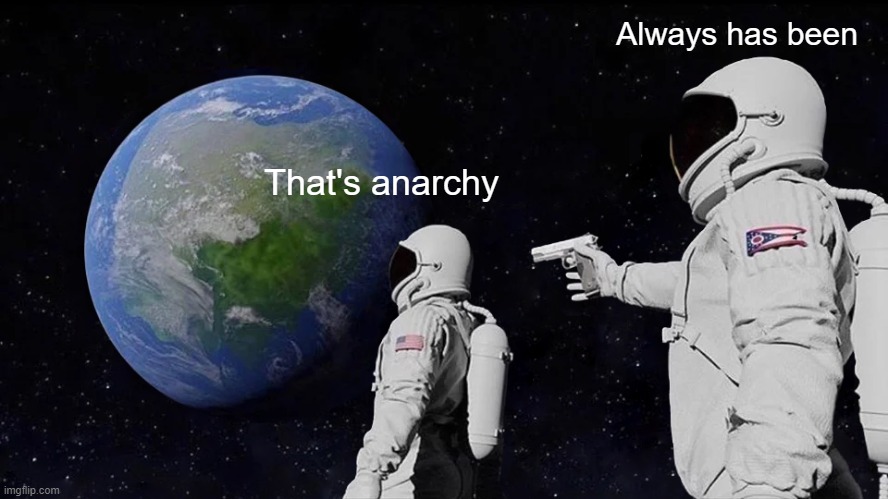
Anarchy exists in the world today. It always has. Macroscopically, one needs only step back to see the forest for the trees—or zoom in for microcosms. The only place it’s rare is in the middle.

As far as scaling, political states are anarchy at scale. They hide behind sovereignty and do as they please. United Nations and such try (meagerly) to herd the cats—say, the US—, but the Big Cats still do as they please. So when you hear that anarchy is untenable, remember that it is more prevalent than not.

In the domain of physics, we hear the quaint Aristolenian adage that nature abhors a vacuum, but in fact, it doesn’t. Without engaging in a quantum debate, the universe is more vacuum than not. This belief is a projection centred on human narcissism, viewing itself as the centre of the universe: some humans seem to abhor a vacuum—as do many dogs abhor vacuums, but that’s a horse of a different colour.

Nature abhors a vacuum

And when you hear that anarchy doesn’t scale, remember that it can be seen on both micro and macro scales. The question is: what happens in the middle?

To be fair, there are many small-scale human endeavours where power structures still decimate the ‘natural’ anarchy, but this is imposed—whereby I use the term natural to mean without intervention.

To be continued…

Day in a Life

“They found Gary.”

That was the response to my question regarding the police presence yesterday.

EDIT: Some in the community have arranged a memorial for Gary.

In Memorium

I live in an economically depressed community. Swathes of addicted streetwalkers to the south and crack and smack street dealers to the north. Between these bookends are some dozen or more churches and me. Adjacent to me is an abandoned church, a haven for the doubly disenfranchised homeless in the community.

Gary didn’t make it to Christmas. Perhaps I saw him around the neighbourhood, but I didn’t know Gary by name.

“It doesn’t sound like it ended well,” said I. “I think it was frostbite,” he continued.

I find it difficult to believe it was frostbite, but I’m no expert. It barely gets below freezing in this part of the country, but it did last night. Does anyone remember the Valley Forge of American history?

“He had no place to go. They wouldn’t let him in the shelter because he drinks.”

This is Tough Love™ in action. Hate the sin. Fuck the sinner. Another victim of the system and of morality vis-à-vis Virtue Signalling.

In the words from the first Home Alone instalment: Merry Christmas, you filthy animal.

Bah Humbug

Besides being neither a Christian nor a consumerist, I’ve never been a fan of Christmas. The spirit of joy and selfless giving are welcome memes, but they are slogans and platitudes. As an exercise in altruism, giving is rarely selfless. It’s more often tit for tat. Don’t reciprocate giving something to someone who’s given to you, and you’ll see my point. I won’t deny that I witness people in greater joy in the season—some people; neither will I deny the offsetting despair and malaise—the stress of maintaining face and keeping up with the Joneses. The higher rates of seasonal suicides might be a sign.

Christmas is a marketing scheme. If you need something, or if you have kids and they need something or want something that you’d like them to have and can afford it, just get it. Why wait? Why make them wait? It seems pointless and cruel. And this doesn’t even take into account the parents who manipulate their children but threaten withholding at Christmas if they don’t comply with whatever family or societal edicts you are trying to impose upon them.

Economically, gift-giving is what’s known as a deadweight loss. In most cases, the gift of cash allows the recipient to spend it in a manner optimal to their own situation. If they happen to buy the same jumper you would have purchased, then you can feel comforted by your knowing that you would have given the same thing. Perhaps you found the perfect item on some distant shore that they wouldn’t have visited. This is an exception. But a gift from Amazon or Best Buy doesn’t fit that bill.

If I want to give a gift, I will. If it’s coincident with a birthday or a holiday, so be it. But if it’s not, that’s fine, too. As humans in the West, we are already so indentured to too many things to count that we don’t need another fetter. Put up a tree. Put up a menorah. Put up a flag. Put up an Anubis statuette. Unfortunately, the lines are blurred between wanting to and having to.

In the end, Christmas is one performance I’d like to opt out of. Whilst I find that most people are hypocrites, the hypocrisy is trebled during the holidays. ‘Tis the season.