Ternary Chart

I am working toward fleshing out my Modernity Triangle. Since I want to illustrate placement graphically, I’ve settled on using a ternary plot—at least for now. I’ve borrowed an existing Excel template, which already contained the simple maths and charting. This is really just the tip of the iceberg as creating appropriate dimensions, measures, and weights is the heavy lifting.

I may work on the aesthetics, but this is the underlying framework. I’ve already commenced a scoping conversation in a previous post. In a nutshell, there are three primative movements—the spectra are Premodern to Modern, Modern to Postmodern, and Postmodern to Premodern.

This chart is meant to be discriptive. As the adage goes, there is no correct placement. If you identify as a Modern, you may wish the dots to bias in that direction, but the same is true if you occupy one of the other corners. For those who prefer moderation as a stance—the Middle Path—, you may be tempted to find comfort in a dot occupying the centre. That’s fine. I’m not judging your worldview.

Taking a moment to mention prescription, the best I can offer at this point is that if you feel you should or want to occupy a particular place. Feel free to create a vector from where you are to where you aspire to be. My only caveat at this point is that sometimes it is hard to reverse tack once the genie’s been let out of the bottle. An example might be agriculture. Humans progressed from Hunter-Gatherers to Aggrarians. Some have ‘progressed’ to Industrial and Postindustrial worldviews. However, not all humans have taken these paths. But due to encroachment of Premodern humans by Moderns, the habitat of Premoderns has made hunting and gethering an untenable lifestyle, so in the contemporary world, only Hunter-Horticulturalist remain.
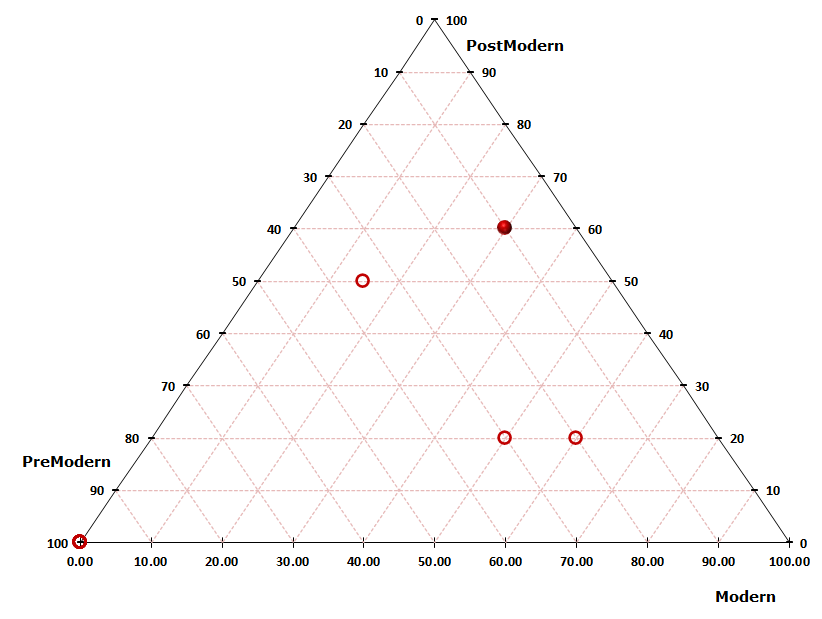
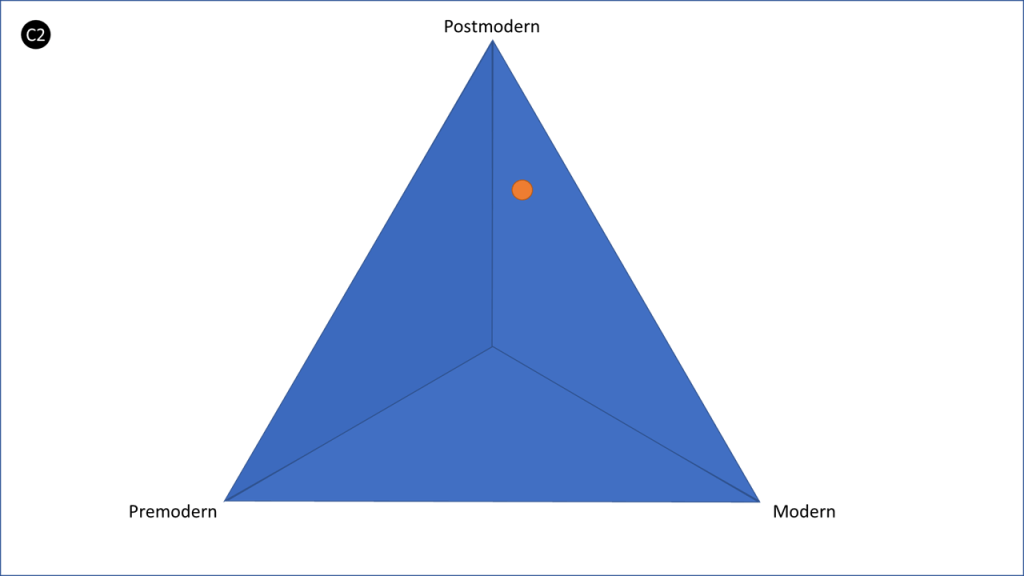
In the accompanying ternary chart, I clumsily place myself where I self-identify, though I could be way off base. As a matter of example, this dot could represent a single dimension as well as some aggregation of dimensions. At the most abstract level, the view should interpret as a person espousing a tendency toward Postmodernism over Modernism fairly far removed from Premodernism. The lower leftmost dot on the Premodern corner could represent a typical pre-Enlightenment peasant as well as a member of some contemporary indigenous tribe such as the Sentinelese.

In the contemporary Western world, I’d image that they might be represented by the 2 dots on the second horizontal, fairly Modern, a smidgeon of PostModern, and more PreModern than they’d likely be comfortable to admit.

Political Compass

I was inspired by the Political Compass conceived by Libertarians attempting to differentiate themselves from a strict Left-Right political frame. My intent is to create something similar. I don’t feel that I have four points to work with, so I settled for three. I discuss how Metamodernism fits into this model elsewhere. Here is how the Political Compass situated the UK parties in the 2019 general election.

Modernity Triangle

I’ve been thinking, but I haven’t had a lot of free time, so I may be fleshing this post out over time.

I participate in several online groups centred around Postmodernism. There are some fellow Postmoderns, and there are some Moderns, some who want to find out what all the hubbub is about, and some detractors. Invariably, the conversation turns to one of definition. This post will not attempt to answer that question. I’ve made that attempt elsewhere and elsewhen.

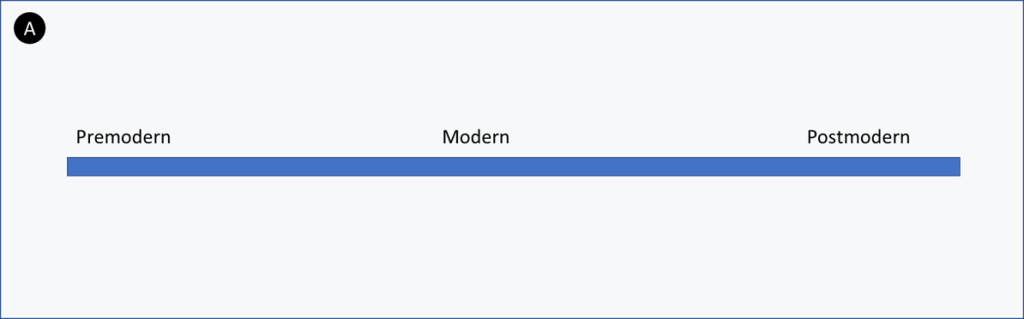
This post is meant to orient the relationship between premodern, modern, and postmodern. Image A depicts a strict linear chronology. I don’t suspect anyone views this progression where at some point Modern philosophy superseded Premodern and was itself superseded by Postmodern thought. In my own experience, this does not ring as valid, and it doesn’t feel like this will unfold in any future.

Image B is a more plausible chronology, though some might prefer a permutation where Premodern eventually fades away and where Modern fades away at another point. Again, experience doesn’t bear out this scenario.

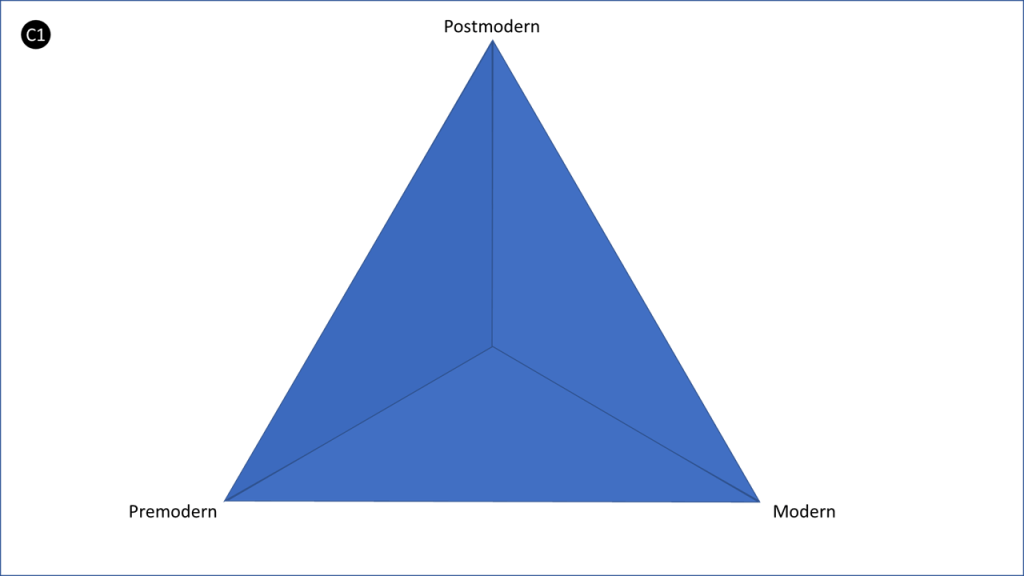
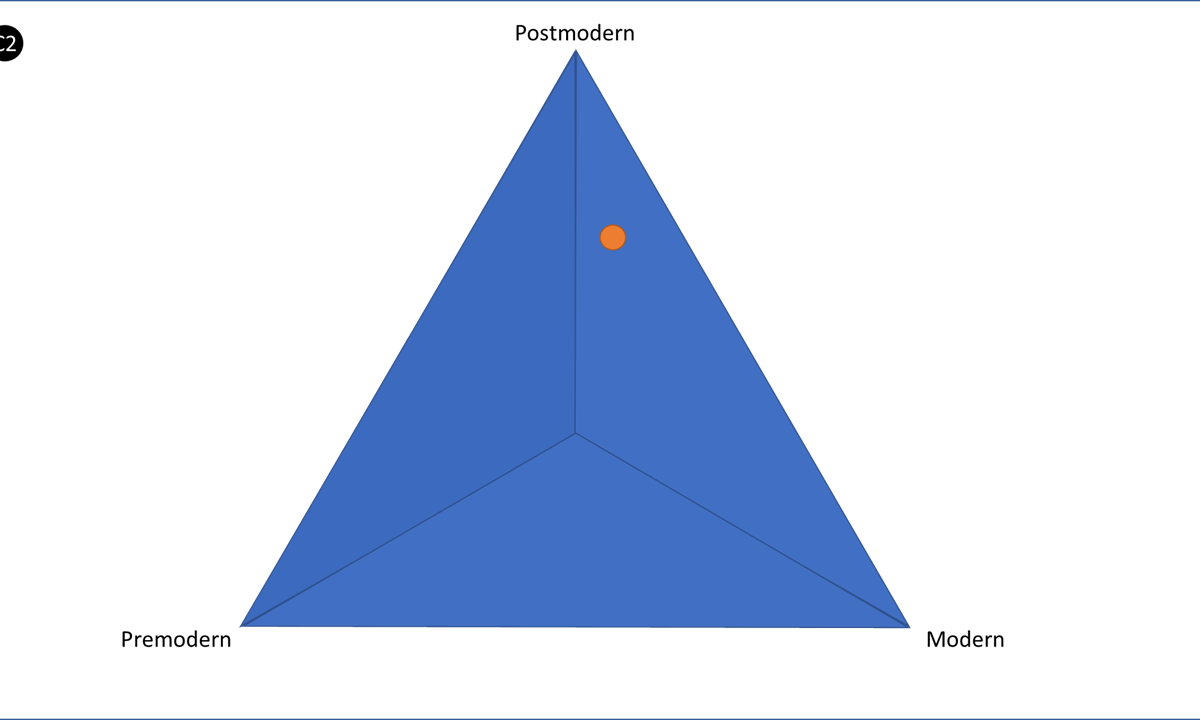
In fact, this is how I came to conceptualise the relationship as a triangle—rather a radial chart limted to three points. This is represented by image C1, where there is a triangular relationship, with each of the schools of thought represented at the angles. The placement of the labels is arbitrary. That Postmodern is rendered at the top should not suggest that it is elevated or better than the others. Neither is Modern better because it resides on the right side. The triangle doesn’t indicate and time dimension.

Image C2 is merely a representation of C1 with a dot to indicate placement on the plane.

Ostensibly, each angle contains dimensions and measures. I haven’t sussed out fully what these dimensions might be, but a triangle might represent individuals or aggregations of individuals. An individual or a group might place differently at different times.

Regarding the triangular plane, the concept is that an entity may hold belief sets of any or all of these worldviews simultaneously. A bit of self-reflection might place be on the orange dot in C2, though the chart is arbitrary and not to scale. No animals were harmed, and so on.

Moreover, it’s important to distinguish between the system of belief and the pragmatic life of an entity. In my case, I feel that I am intellectually a Postmodern. I have an incredulity toward metanarratives, don’t believe in objective truths, and feel that every system requires context to evaluate. This said, I am quite strategic and analytical. Also, although I’ve been called many times a Stoic and Spock from Star Trek, my emotions and cognitive biases and sense perception deficits still allow me to favour the underdog as a Social Justice Warrior.

socialism never took root in America because the poor see themselves not as an exploited proletariat but as temporarily embarrassed millionaires

— No one in particular

It’s been pointed out that many Postmoderns are simultaneously Marxists or otherwise Leftists. Personally, I feel these are simple covariances, that a Conservative has to give more weight to history and teleological arguments, thereby qualifying as a Modern, whereas a Postmodern is more likely to dismiss these are metanarrative-laden. I consider myself a Leftist, but again, this is an emotional rather than intellectual decision. As a Postmodern, intellectually speaking, I believe there is no way to determine whether Anarchosyndicalism is better or worse than Republicanism or Oligarchy, but I know how I feel about these. And without going down some political rabbit hole, it’s plain to see that many people are predictably irrational and vote against their own interests time and again as they believe some narrative where they see themselves in another position where this self-deprecation will pay off in the end. This is embodied in the meme that “socialism never took root in America because the poor see themselves not as an exploited proletariat but as temporarily embarrassed millionaires.” This is usually misattributed to John Steinbeck, but the sentiment remains—don’t tax the rich—because I am just a stone-throw away from that—if only I paid less in taxes.

Finally, there are the Premoderns. These people are not only nostalgics, but they retain superstitious beliefs, favour natural remedies, and Ayurvedic treatments. They retain religious beliefs—some even preferring pre-Judeo-Christian paradigms. And yet they may also be scientists and otherwise structured thinkers. It’s harder for me to conjure scenarios where an entity might simultaneously hold Premodern and Postmodern beliefs. Off the cuff, it seems that one might believe in some sort of cultural relativity and at the same time believe in some shamanic healing or Ayahuasca retreat for cleansing or getting in touch with the universe. I wouldn’t presume it’s that unusual for people to hold antithetical and mutually exclusive beliefs. I am not superstitious, but I carry a lucky penny or some such.

My next step in this journey is to dimensionalise the model. I already have got some ideas, many of which have already been captured here, but my familiarity with Premoderns is limited and probably contains a lot of stereotypes and caricatures.

Please stand by.

Postmodern Labyrinth

I watched the video, What Makes us Postmodern, and its predecesor, What Makes Us Modern, and I immediately discounted any attempts to synthesise Modernism and Postmodernism in some Hegelian manner, Hegel’s approach being somewhat Modern at the start. One can pair the essential dimensions and perhaps arrive at some moderate position, but, firstly, this is a Modern perspective; secondly, Moderns are not likey to abandon their position.

There may be a resolution, but it seems that it will require a paradigm shift—a different perspective still.

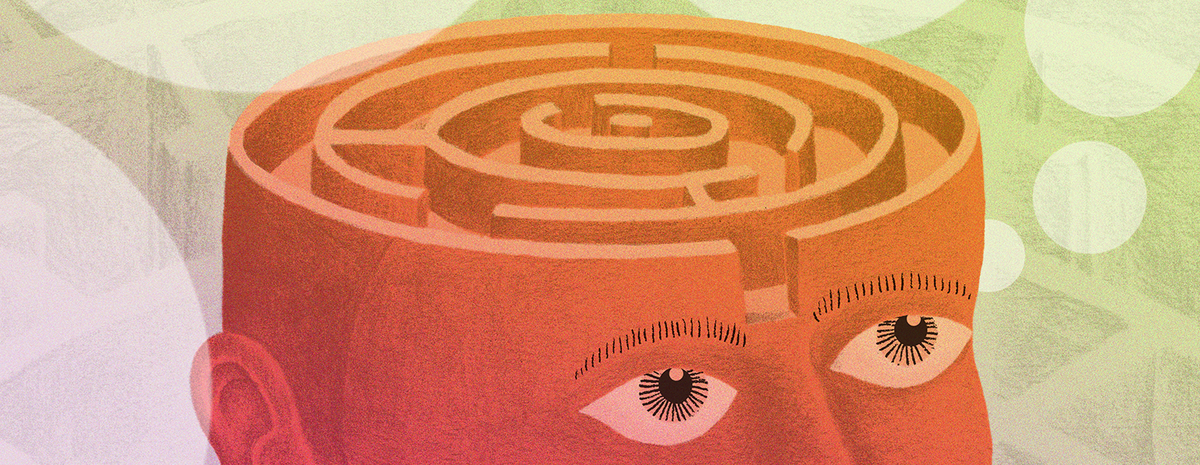
Ancient Greek mythology gives us the story of the Labyrinth. As I am not interested in analysing this from a Jungian perspective, we can safely ignore the Minotaur. The story of the labryrinth is a story for Moderns. It’s a teleological story based on the metanarrative that suggests that one can find order in disorder, if only they have the key.

As the story goes, the labyrinth is an unsolvable puzzle. However, at least one person knows how to solve it, or at least knows how to beat the system. Depending on the source version, Ariadne either assisted Theseus with a thread or jewels.

In a tl;dr version of the story, Theseus is tasked with killing the Minotaur. I’ve recently discussed his ship. Exposition informs us that the Minotaur is mortal, thus killable, but there is no escaping the maze—for reasons. However, Daedalus, the architect of the labyrinth, told Ariadne that there was one way out. If someone were to record their ingress, with say, a thread or jewels, they could then follow these to egress. Definitely not a plot device. Hansel and Gretel took this to heart and marked their ingress with breadcrumbs—or stones, depending upon which version you’re reading.

What Makes this Modern

Though the story of the labyrinth and the Minotaur comes from a pre-modern era, it remains an apt metaphor for modernity.

There is a deliberate underlying structure. In fact, it has been architected by Daedalus. This mirrors the Intelligent Design narrative favoured by Christians.

There is a definitive solution to the puzzle. The story is teleological. If one follows the plan, stays on the path, they will prevail. Go off-script, and perish.

This is a story about structure, about order, about adopting and conforming to the rules. Even though it’s also about gaming the system with cheat codes in more modern parlance. Nowadays, I’d turn off clipping and collision detection, but Ariadne didn’t know these codes. I digress.

Postmodern Reaction

This is not a story for Postmoderns because it starts with a design. For moderns, there is a design. It’s either a vestigial god or science. The belief is that everything has structure. Even if that structure is yet unknown to us. If only we had enough time, we could suss it out. Perhaps it’s past time to re-task Shakespeare’s infinite monkeys.

Reconciliation of this teleological belief is intractable. Rather, it can likely only be solved with rhetoric. Moderns love rhetoric, which explains why they have so much faith in Aristotle and classical philosophers, who still provide a foundation to much philosophy of the Moderns. It’s intractable in the same way that converting someone with some religious conviction to no longer have that conviction.

Modernism is about faith. It may have shifted from faith in gods to faith in logic and reason, science and technology, or organisation and progress. Postmodernism points out that whilst these are possible solutions, they are not the only solutions. Moreover, these have unintended consequences and create collateral damage. They also rely on a privileged perspective. Perhaps I’ll create a segment to illustrate this point using the disruption of COVID-19 as a backdrop.

In the end, Modernism relies on teleologies. The end may not be known, but we can divine a vision and lead people in that direction anyway by employing rhetorical devices. Postmodernism knows that any such narrative is fiction. A postmodern may emotionally buy into the narrative, but they never forget that it’s still fiction.

Modernism relies on order and control to maintain that order. This doesn’t mean that all Moderns are top-down authoritarians. But it does mean that they need crowd control and compliance. The United States are probably mostly Moderns. They like to claim they are individualists, but they are more typically either keeping up with the Joneses or competing with them. Most individuality is trivial at best. “I’m an individual because my BMW is purple.” Quite. And Moderns don’t like much non-compliance. They may want change, but if someone expresses this need for change through civil disobedience, the Modern may viscerally agree, but they will also rationalise that the civil disobedients should have used the admittedly broken system. Moderns like what they call progress, but they can only accept change in small doses at a slow pace, so there’s a friction.

Finally, there’s power. I am not going to rehash Nietzsche or Foucault, but this is a schism. Moderns want order and control. Power structures assist this, but then they don’t like the current actors. If only there were better actors. Nietzsche noted that the masters and the herd had different interests and moralities. Moderns know this on one level but think they can remediate this dichotomy. Because of course, they think they can bring order to everything—Second Law of Thermodynamics notwithstanding.

In the end, these schools will likely attempt to coexist. As for me, I’m a nihilist and somewhat of an existentialist. Yet, I am also a pragmatist as I still have to operate within the world I’ve been thrown into, as noted by Heidegger.