A particularly overworked trope is that of greater good. ‘Greater good‘ is a Utilitarian concept wrought with the same problems as other specious Enlightenment ideas. I’ve written about this from several perspectives. As with many foundation concepts springing from the Enlightenment, ‘greater good’ is founded more on platitudes and some specious ideal than reality. It’s more wishful thinking for a gullible population.
Philosophy students learn in early ethics classes of the paradox of the Trolley Problem. But there is no paradox; it’s just the result of accepting a faulty framework, and so we left with a host of concepts from politics to economics.
The problem is that there is no consistent definition of good—or at least the value judgment is subjective; there is no accounting for taste—, and there is no measurement of it, a problem with Utility Theory in general.
How can one simultaneously be an SJW (Social Justice Warrior) and be a non-cognitivist? How can one who doesn’t believe in the notion of identity nonetheless defend it? How can someone who doesn’t believe in the notion of justice seek it? And how can a conscientious objector apply a ‘warrior’ title to his own identity?
(Viscerally, I am an SJW—at least I consider myself so (because I just said so, right?). As a non-cognitivist, in particular, an emotivist (Ayer), an expressivist (Moore), and a prescriptivist (Hare), why should I care? And isn’t this somewhat paradoxical or perhaps hypocritical?
When in Rome, do as the Romans do.
I used to consider myself an Existentialist Nihilist, and I still have a fondness for this particular worldview. In many ways, at a more mundane, pragmatic level, I operate as an Existentialist, but that’s only because, in the realm of workaday political philosophy, one cannot be so ethereal, as it were.
Even though I don’t believe in any higher purpose for humans or life, I still have an urge for survival, and I recognise that no man is an island, that there is safety in numbers. At least this is my adopted metanarrative. I don’t feel that I am some rugged individual. I rely on others, and I’d prefer amicable relationships over adversarial.
I’ve always valued a sense of personal identity and autonomy, but only as an emotional response. I’ve also never felt the urge to control the identity co-opted by others. This means that if you are gay, straight, trans, pan, or whatever, it doesn’t matter to me.
Do unto others as you would have them do unto you.
Jesus, Sermon on the Mount
If you are a CIS-male and want to wear a dress or enhance your breasts, it’s none of my concern.
FULL DISCLOSURE Although I respect a person’s choice to, say, be trans in whatever shape or form, I don’t consider myself to be pansexual, so I wouldn’t presume that I am going to date that person. Whether this is a prejudice or preference, I am not going to argue the semantics.
Anyhoo….
Despite understanding that identity doesn’t ‘really’ exist and in the end, it doesn’t even matter, I will (and do) vocally defend the ‘right’ of a person to express this identity.
So, perhaps also paradoxically or hypocritically, I’ll comment on someone’s fashion sense —and trust me; I am no fashion maven. So just because I won’t deprive you of your ‘right’ to express yourself the way you chose does not mean I have no opinion (positive or negative) about how you present yourself, and it doesn’t mean that I won’t make a joke or make light of how you express. I am not a fan of politically correct (PC) speech, a trend American Liberals are on the wrong side of.
Intersex Person
In the end, there is the space of objective reality and the space of workaday life. For some accident of history and evolution, I have been thrust into a world where I need to interact with people who believe there is more then there actually is and they subscribe to some metanarrative. Unfortunately, unlike Neo in the Matrix, I am not able to cut through the bullshit, and so my dominant strategy is just to play around. When in Rome, do as the Romans do.
As an emotivist, I am an SJW because it is visceral to me.
As an expressivist, your sense of morality expressed through mores and customs hold no water, and I won’t abide by the restrictions they impose.
As a prescriptivist, I think that you should share my emotion in the spirit of do unto others…
Interestingly enough (or not), I am a fairly typical (albeit eccentric) white male. My self-expression differs more in my beliefs and speech than in my physical person or attire. Talk to me for more than a few moments, and this will become immediately apparent.
Indeed, it has been said that democracy is the worst form of Government except for all those other forms that have been tried from time to time.
Sir Winston Chirchill
I am not a defender of or apologist for Democracy. Any system is only as strong as its weakest link, but save for the rhetorical promises Democracy is nothing but weak links. Turtles all the way down. It’s another failed Enlightenment experiment. Sure, you can argue that the Ancient Greeks invented democracy—or at least implemented it at any scale—, but specious Enlightenment ideals pushed it forward into the mainstream.
The Achilles’ heel of Democracy is the principle-agent problem, the same one that separates management (CEOs) from owners (shareholders). Incentives are different.
Achilles’ Heel
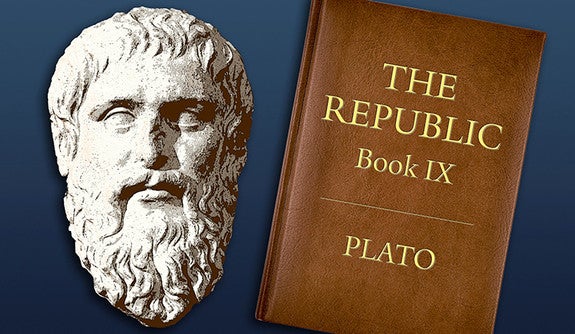
Plato published his solution is Republic, but this proposal was naive at best. The notion that meritocracy is something real or that we can appropriately understand dimensions and measures in order to create the right incentives is another weak link.
Plato’s Republic
We see the same problem controlling elected officials. Time and again, we elect them, and time and again, they disappoint. We, the People, are the principles, and the elected are our agents. People in the US (and in so-called ‘democratic’ societies) have the vote, and yet—per the oft-cited definition of insanity—, they perform the same action and continue to expect different results; in fact; they are always surprised). At its core, it’s an incentive and accountability problem.
Kenneth Arrow wrote about the Impossibility Theorem, where he proved mathematically that no voting system would yield optimal results. Democracy is cursed with mediocrity. We like to soft-pedal the notion of mediocrity with the euphemism of compromise, another Ancient Greek legacy of moderation. If this makes you feel better, who am I to break the delusion? Cognitive dissonance is a powerful palliative.
μηδέν άγαν
Do Nothing in Excess, Delphic Oracle Inscription
Interestingly enough, many people clamour for term limits (a subversion of democracy) because they can’t help themselves from voting for the same shit politicians over and again. They rationalise it and say it is to defend against the other guy’s vote because they’d have never voted for shit representation.
This is often couched as ‘save me from myself’, but it is just as aptly cast as ‘save me from democracy’. I suppose a heroin addict might have the same thoughts.





 Philosophics