Diversity of thought

Je m’accuse. I’m such a bad blogger. I haven’t been focusing much lately, but given the recent events around #BlackLivesMatter, I’ve been doing some thinking. A lot has been said about diversity and inclusion—whether for black lives, females, LGBTQ+, or some other class—, but the issue is more complex and dimensional than a problem with intersectionality.

There is something to be said for experiential diversity, and the benefits of virtual cross-pollination may have some advantages, but much of this is superficial diversity-washing, enough to claim a public relations participation award.

I keep Simone de Beauvoir’s The Second Sex close to the top of my mind much of the time, but this is more than just about feminism. It’s about otherism—the otherness that creates outgroups.

In Beauvoir’s parlance, there are men and there are not-men—others. This is similar to Baudrillard’s dog/not-dog distinction but with more intention, so we arrive at an orthodox/not-orthodox pairing.

Taking workplace diversity as a frame, that they accept blacks, or women, or disabled, or some other identified class is superficial because the common thread is an acceptance of the prevailing meta-narratives, not only of Capitalism, Democracy, meritocracy, authority structures, and the like. As long as you comply with this mindset, sex and gender, the colour of one’s skin, or disability is cosmetic.

To some extent, there will be some diversity of thought. There will be some cultural perspectives, some generational perspectives, and some gender perspectives, but all of these are aligned to the overarching narrative.

In the world—in the United States anyway—, it’s OK to be black or Hispanic as long as you act ‘white’ or ‘American’. Speak with a neutral accent. Listen to mainstream pop. Don’t wear culturally identifiable clothing. This will ensure acceptance. In a way, this is a faux pas of Donald Trump. He comes across as vulgar to those who hold this perspective.

The diversity that’s missing is one that would do things differently. When a woman ascends to a CEO position, she has done so by more or less mimicking the path a man would probably have taken, making similar decisions. Ditto for a black. Double ditto for a black woman.

People outside of this narrow path will not ascend. I’ll ignore the question of whether this is even a worthwhile aim, A woman who takes this path may have to break through a glass ceiling, but for those of us with a more diverse mindset, the ceiling is stainless steel—a meter thick.

But this is for more than CEOs. I am a self-aware eccentric, and although I colour within the lines my thought is typically outside of accepted boundaries. Luckily, I’ve had the good fortune to work with the right people in the right environments to capitalise rather than be hampered by this difference. I’ve been lucky enough to operate with relative autonomy because over the years I’ve generally met or exceeded expectations on my own path.

During a review—or at least a conversation—about a decade ago, a manager told me that he had no idea how I operated but that he didn’t want to interfere for fear of breaking the goose laying the golden eggs. I know this was difficult for him to do and to admit because he is a very structured thinker and felt compelled to create repeatable structures (despite ignoring the structure when it came to him—and, thankfully, me).

This same person—whom I admire despite our having different worldviews—also noted that I operate as a director or orchestrator rather than a typical leader. I feel this is spot on. Even as early as high school, I articulated that I did not consider myself to be either a leader or a follower. I was a self-professed adviser, so it’s no surprise that I find myself in consulting and advisory roles. I realise that in the United States, the world is constructed to be more diametrically than it would otherwise need to be, so I end up being a veritable unicorn in most settings.

As those who know me, my first career was in the entertainment field, where diversity is more part of the rule than the exception—though there are still many normies there, too. My ex-wife asked me countless time why I left the music industry, or didn’t stick to academics or activism, each with their own level of interest to me.

The problem is that this diverse perspective is not something a resume can convey very well as there needs to be a great deal of trust, which is not typically in place for new hires, so many, let’s say, organic and creative thinkers, get left out of the equation to the detriment of cultural diversity.

Vantage

A runner helps a competing runner to complete and win a race. The competitor had been confused, as signage was in a language foreign to him, so the other helped him out.

Iván Fernández Anaya and Adel Mutai Race

Although the debate in the comments thread on LinkedIn of whether the rules of the event supersede the overarching human condition leans heavily toward cooperation over competition, some are vehemently opposed to the thought of ‘breaking the rules’ of the contest.

I suggest that this is an issue of framing. Sporting events are a wholly contained subset of the human condition. If you visualise this as a Venn diagramme envisaged as camera lenses, you’ll see that the event is a deliberate tight shot. One with the broader human experience cropped out. But the viewer has the ability to pull back and capture a wider shot. This shot recognises factors other than winning a petty sporting event. It emphasises cooperation over competition.

There is no moral imperative here. One may adopt either lens without shame. As for me—and apparently most—, the wider shot is preferred. But a wider lens is not always the default view for humans.

Humanism

When it comes to how, as people, we fit into the larger universe, we tend to adopt a human-centric view. And one doesn’t need to be a Humanist to take this position. Most religions do this by proxy, where the gods have appointed humans as the Ones.

How can one not be a racist?

This is the same choice as whether to adopt a tight or a wide shot. And some people take an even tighter shot, where the focus is on nationality or race or colour or sex or gender or affluence or whatever. But the wide shot captures all species on the same plane. Peter Singer is the leading Western philosopher in this space. In his world, Humanism, this human-centred view, is Speciesism.

The most common responses to this charge are to dismiss it on the grounds that ‘humans are superior for reasons’ or that ‘as long as we consider the biosphere as a system, we can still take an elevated position’. I don’t truly accept either of these positions. The first is, frankly, narcissistic, as is the second, but humans have an abysmal track record when systems thinking and complexity are involved.

How can one not be a Speciesist?

The obvious question, then, akin to, ‘How can one not be a racist?’ in these #BlackLivesMatter times, is ‘How can one not be a Speciesist?’ But there are still wider lenses as we pull back to capture the entire taxonomy. We can elevate species to genus to family, order, class, phylum, kingdom, domain, or life. And why stop there except for moral convenience?

Ask yourself: What lens are you using? What is your frame? Where is your focus? What is your depth of field?

Critique of ‘Some Problems with the Intellectual Left’

This post is a commentary on this post, which I happened upon through this other post on via this blog that I follow but that I haven’t yet read because I was distracted by the source. As the title suggests, the source post is about the author’s perspective on ‘some problems with the intellectual left‘. I am not sure who he includes in this group, so I am not defending anyone in particular.

I’ll disclose at the start that although I am sympathetic to the author, I feel he has a worldview I don’t share. He is obviously very frustrated and does not feel his voice is heard. It’s evident that he wants to persuade, yet he hasn’t mastered the art of rhetoric. Not having read his other posts and the concept of political Left and Right being somewhat nebulous, I’ll presume him to identify with the Right rather than the Centre. He seeks and finds solidarity among his brethren on the Right, people it seems who share his perspective, and yet feel alienated from the Left and from society as they envisage it.

I can’t speak for the rest of the world, but in the United States, there is very little conservatism or liberalism in politics. These have been coöpted by the brand politics of Republicans and Democrats. My Conservative and Liberal colleagues are all pretty much fed up with the lack of an ideological anchor in the US. Each claim that neither of the dominant political parties represent them or their ideologies. That might be a topic for another day. What this means is that I will be commenting by referencing the political party brand names, which in the UK translate to Tories and Labour parties.

What I can critique is this polemic. I am neither Conservative or Liberal, though a Conservative may deem me to be a Progressive.

First, it’s nice to see you begin with an admission that you are reacting from a place of emotion. I’ll try to comment on each paragraph in sequence and as necessary.

« A general issue that tends to recur is the arrogance of assumed or presumed access to truth and reality. »

This is an interesting claim. Two things:

(1) Most rational people presume whatever opinion they hold to be true at the time they express it. This is a known cognitive phenonenon for all humans. I am not sure how this is only attributable to Left intellectuals.

(2) Let’s estabish some working definitions. When I read ‘Right’, I presume Conservatism, a fundamental element of which is about traditionalism. ‘Left’, I presume to equate either to Liberalism (non-Classical, so from a US-biased perspective) or Progressivism, which views much of the past as flawed and wishes to remdeiate it.

If we accept as a simple attribute of Conservatism that there is a desire to take what has seemed to work in the past and continue to rely on it now and going forward, then it would seem to me this past would be the single truth upon which to operate. For the Progressive, there are many possible solutions, though, admitedly, a person might choose one as being more apt to be the best past forward, which I sup0pose could be characterised as the truth.

I disagree that the person on the Left would assume this to be the only path forward, so the claim of truth intransigence seems a bit overblown.

« They will take a complicated issue with many ambiguities to it, and present dogmatically one party line as fact. »

I have not experienced this. In practise, I see that the Right is able to signal simplistic slogans and sound bites, where the Left is required to be mired in nuance to explain, thereby losing the attention span of its constituents. Again, I am speaking from the perspective of the US. It may be different elsewhere.

« Not only this, they will try to ridicule and humiliate anyone who disagrees with them. This kind of shaming approach so common on the left to force a sham public consensus, extends as a tactic also and especially to intellectuals on the left. »

As there is no discernable Left or Right in American politics, there is only us and them relative to the two dominant competing brands, each clumps of mud and spercial interests, but neither with a recognisable underlying poltical ideology.

I am going to fast-forward because the tendency to single out one party when both parties are equally guilty continues.

« For all that they may try to condescendingly diagnose people who oppose them as suffering from one from of irreality or another… »

This is not limited to one side or another.

« At no point is there respect for some reality they could be missing »

Neither is this limited to one side or another.

« This is a ludicrous state of affairs. Can you imagine anyone on the right, or just independently minded, being willing or even able to engage in a reasonable dialogue with a group of people who have such strong attachment to their values… »

Notice how we distinguish Left from Right, but we also attempt to associate Right with ‘independantly minded’. I can imagine a so-called indepenant to be able to engage in ‘reasonable dialogue’. I can’t as much image the same for a person on the Right.

« And don’t think this is not the case, because it clearly is a fact… »

This is ironic given the previous claim that the Left is steadfast in owning the truth, yet the claim here is the writer owns the truth. Anything counter to his beliefs is opinion.

« The problem I think is that there is this general tendency among more intelligent people … have been insulated from reality more… »

I’m guess I need to get clarity on how intelligent people are shielded from reality. Is the claim that these people somehow live apart from reality? Apparently intelligent people are some monolithic group.

« …they prefer to hide in theoretical realms and not face the judgement of the practical world. »

What is this hiding mechanism? Does this hiding allow one to avoid reality as we know it? Is the practical world different to the real world?

« As a result, they try to hide their assertions behind claims of neutral fact, camouflaging opinionated things in this way, and by sneaky tactics of exploiting the human desire to fit in, in order to shame people into line with these opinions. »

I am not sure I am able to parse this sentence, but somehow there are sureptitious claims that shame people into compliance. I was under the impression that people of the Left were the free sex hippies of bygone days and Conservatives were ostensibly The Man. Moving on…

« They are not sure enough of themselves and their values… »

I thought the Left were the ones with ‘presumed access to truth and reality’. How would you be unsure if this were the case?

« so they must resort to all this underhand stuff, and once it spreads worldwide we get the kind of climate we are now in today. A climate where a tautological assertion such as climate change, becomes a calling card for worldwide shame and conformity. »

If I am interpreting this correctly, the Left is bludgeoning the general populace into conformity with shame. Again, the Left is not not monolithic entity, so I am not sure what conformity is being forged.

Also, there is a claim that ‘climate change’ is a tautological assertion, yet this missing the point that the assertion is an ‘anthropogenic climate change’ rather than a generalised claim that the climate is changing, an important distinction and not nuance.

« Another issue I have with intellectuals on the left is their disingenuous cherry picking of reality. »

Some examples would be nice.

« They think by obsessing on one “truth” in a much larger debate… »

Again, I believe that the concept of a single truth is one adopted by Conservatives, and I feel this is why more Conservatives believe in the notion of a monotheistic existence because it allows them to believe in a single source of Truth.

« …somehow saves them from criticism and gives them free reign to criticise and ridicule anyone else who questions that “truth”. »

Ditto

« Of course a person questioning it may only be making a point of nuance to distinguish an aspect of truth to it, and an aspect that is not true. »

There are a few possibilities here:

(1) That a thing can be simultaneously true and untrue, such as in a quantum place as exemplified by Schrodengers cat.

(2) That the definition of the thing being discussed is not common, so we are talking about a different reference.

(3) The definition is ambiguous, as captured by the old Groucho Marx joke, ‘I once shot an elephant in my pyjamas; how he got in my pyjamas, I’ll never know.’

(4) The topic being discussed can be further broken down or clarified, as portrayed by the African story of the man walking down the street wearing a hat coloured red on one side and blue on the other. Asked to recount, the people on one side declared his hat to be red, and the other that it was blue. In fact, they only had access to a partial truth based upon their own limited vantage.

(5) Neither side has access to the truth, as exemplified by the stoey of the blind men and the elephant, one who envisions the tail as a rope and another who envisions the ears as a carpet.

« But once you try to go into that debate, they have achieved their aim which was solely to get you on the defensive… »

Pretty sure this is a fundamental Debating 101 tactic we learn in high school

« …so now they can just belabour their same dumb point over and over and look like they know what they are talking about. »

Perception is reality, as the adage goes.

« All these kinds of underhand tactics… »

This author sounds bitter and has a difficult time communicating his position or gaining traction on his ideas. A person coming from this position will likely be defensive and put others on the defensive from the start. I’ll presume that these ideas are ones associated to the Right. I haven’t read any of his other writings, so I don’t have a broader or deeper perspective.

« Individuals must rebel against this encroaching totalitarianism… »

Again, the author is tilting windmills or strawmen as the case might be. I’m not sure I can parse this final paragraph, so I’ll just end here.

Unintentional Indoctrination

Fiction in the form of film, television, and books has an insidious propaganda effect. This effect is not necessarily conscious or intentional. In practice, it may simply be a meme as a result of prior programming.

I don’t tend to engage with much fiction, though I have in the past. I hadn’t really considered the indoctrination effects at the time. Lately, on account of my significant other, I’ve been consuming fiction via Netflix, Amazon Prime, HBO, Starz, and the like. It’s mostly drivel, in my opinion, but I like to spend time with her, and we can connect discussing plot lines and such over a shared experience.

I find the repetition of facile but culturally prevailing themes such as right and wrong, good and evil, heroes and villains, the power of community and the detriment of the individual, except for the rugged individual, who prevails against all odd.  

These shows propagate pop-psychology beliefs and over-simplify complexity to create a digestible narrative, but which is the equivalent of eating refined white bread instead of whole grains.

My point is not that the writers are seeking to influence the masses, it’s just to point out that this is the case. People view this, and use it to calibrate their own believe systems, but it’s a recursive, self-referential model—an echo chamber. I haven’t done any investigation or research into whether people have already made this connection. I will if I get the time.

One might argue that a counter model would not be well-received, and a goal of most fiction is to gain an audience and earn some money, so give the people what they are asking for and don’t make them think about their worldview. Besides, a single film or series is likely to challenge ones prevailing filters anyway. Even if someone were to create an anti-theme, cognitive dissonance may just rationalise it as a statement, so satire rather than objective criticism.

We do have Absurdist authors, like Franz Kafka, Donald Barthelme, or even Kurt Vonnegut, who rather point out absurd situations in life and some possible speculative fictions, but these Post-Modern writers are accepted, though arguably not widely consumed, save for intellectuals and their quasi-counterparts.

If I had more time, I’d document a few examples, but these shows are typically difficult to sit through once casually let alone carefully dissect. Perhaps, I’ll do this for the sake of science.

Cancer

Without considering the veracity of this article or the underlying methodology employed, what if it were true that cancer is a random event?

Setting aside that it is only a co-factor and there are other dimensions such as the type and virulence, what does this inform us about research funding? Is this a veritable cash cow for researchers and ripe with charlatans?

After examining 32 different kinds, researchers determined that 66% of all cancers were driven by chance, 29% were due to environmental causes, and 5% inheriting a mutation.

Op. cit.

Sure, different cancers have different correlative percentages, whether 35% for lung cancer or 95% for prostate cancer, and there may be different covariant factors, but, as might be the case for prostate cancer, we only have about 5% to address systematically, and we don’t even know that tweaking within this 5% will have ant material benefits to the health outcome of the patient. At least we have 65% of leeway for lung cancer.

Is there an inverse relationship between the proportion of randomness and positive health outcomes?

I don’t know the answer to these questions. I am also aware that some randomness is probably due to methodology, approach, and simply not necessarily fully understanding the mechanisms behind cancer—or the cause of the seemingly random genetic mutation. I’m not sure how one selects a control group to limit other causes.

Best Ever

I’m not sure I need to ask why people over-value things familiar to them. Is there such a thing and a Pangloss Syndrome: We all live in the best of all possible worlds? For most people, it seems, their nation is the best nation, the best county, province, or state, the best city, town, or village. Perhaps I’m over reaching, but we do tend to value these things as remarkably better than average, and isn’t it nice that we weren’t born somewhere else?

I’m not sure if this affinity runs stronger in different political mindsets, Liberals versus Conservatives or such. Anecdotally, I could see Conservatives hanging on the memory of the good old days, if only it weren’t for X, Y, or Z, this would truly be a great [insert geolocational reference]. Liberals, instead, hang on to the prospect of tweaking a nice foundation and progressively shaping it.

Our village is better than the adjacent ones—except for the ones out of financial reach, but those are populated with those wealthier people, and who could tolerate them; our team is the best team—better luck next year; our schools are the best schools—they try harder.

Behavioural economics demonstrates that people value things they own— endowment effect: even if they didn’t choose the item; even if they had valued it less just moments before they took possession of it. This might likely be explained as an product of evolution, but it feels to have gotten out of hand.

Dismissal of Emotivism

In my post, The Truth of Truth, I linked to a BBC page outlining Emotivism. I did this even though the leading paragraph reads, as follows:

Emotivism is no longer a view of ethics that has many supporters. Like subjectivism it teaches that there are no objective moral facts, and that therefore ‘murder is wrong’ can’t be objectively true.

BBC Ethics Guide

As I subscribe to Emotivism and its Prescriptivist progeny, I’ll respond from my perspective. Let’s parse the paragraph stepwise:

Emotivism is no longer a view of ethics that has many supporters.

Notice immediately the appeal to popularity. People have been convinced rhetorically that this cannot be true, primarily because they are uncomfortable with the notion. People tend to resort to escalating commitment, digging in their heels and doubling down on their position.

Just because something is popular doesn’t make it incorrect, but neither are unpopular opinions untrue.

Like subjectivism it teaches that there are no objective moral facts

Indeed, as I’ve discussed at length, there are no moral facts. Morals are human constructs of language and subject to contextual framing. The prevailing meta-narrative is that a moral code is necessary in a society, which is further predicated on the notion that society is necessary. Any moral code is, then, by definition, subject to this underlying meta-narrative.

I can say that I think society and cooperation are necessary for the continuation of our human species, but this is also admittedly and unabashedly self-centred hubris—another unquestioned meta-narrative.

We also have a domain boundary problem. At times, we have altered the boundaries to exclude people from the definition, hyper-focus on people in the definition, or exclude entire other species and kingdoms.

All of these are subjective. So when the inevitable response is, ‘I mean for humans’, we now know the subject.

‘murder is wrong’ can’t be objectively true.

On the topic of emotion, murder is a heavy hitter. After all, who is going to argue that murder is not wrong, let alone subjective?

Even on the surface it’s obvious that this is a tightly scoped claim, and there a few things going on here:

  1. Murder is a legal subset of killing.
  2. As for the victim—murderee anyone?—, s/he is defined to be human. We cannot murder dogs or roses.
  3. As for the actor—I’m going with murderer here—, this subset is limited to (A) humans, (B) killing not authorised by the State, and (C) unintentional killing.
    • A human can be declared a non-person or a partial person in order to exempt it from the moral charge. We’ve seen this time and again throughout history, entire classes of people who could be killed with no moral outrage.
    • A human can be exempted (given a free pass) by maintaining that their killing isn’t murder whilst others are vilified for killing not yet regarded as murder. The rules are subject to change without recourse.
      • The State declares that killing in some justified circumstance puts a person in some protected realm outside of the scope of murder. These might be military personnel, police officers, executioners, and so on.
      • Abortion antagonists claim that doctors performing these procedures should be considered to be murders.
      • Euthanasia opponents claim that doctors performing these procedures are murders.

If one—the subject—does not accept this frame, s/he also doesn’t accept the, let’s say, verdict. Vegan philosopher, Peter Singer claims that all animal life should be protected, that any killing is immoral. Some have claimed that nature itself should have a voice.

And so a statement like ‘murder is wrong’ is nothing more than a prescriptive emotional statement:

I feel that murder is bad (emotions with justification defended by protective layers of reason), and you should too.

Just Saying

Not an ounce of objectivity to be found, excepting, of course, for the objection I have to the counter-claim.


I’ll save you a click to the BBC page. These paragraphs are as silly as the first.

Emotivism has become unpopular with philosophers because the theory that led the Emotivists to think that moral statements were meaningless has fallen from favour.

Less technically, if expressing moral judgements is really no more than expressing one’s personal opinion there doesn’t seem any useful basis for arguing about moral judgements.

In practical terms, Emotivism falls down because it isn’t very satisfying. Even (most) philosophers think moral statements are more than just expressions of feeling.

And it’s perfectly possible to imagine an ethical debate in which neither party has an emotion to express.

Non-philosophers also think there is more to ethics than just the expression of an attitude or an attempt to influence behaviour. They want a better explanation and foundation for shared standards of morality than Emotivism can provide.

The Truth about Truth (Fourth Amend)

Please note that this content has been subsumed into the originating article: The Truth about Truth.

This is a response to this comment by Landzek from The Philosophical Hack regarding the notion of intended truth in communication, the fourth amendment in a series of posts extending the concept commenced in The Truth about Truth.

Extending the simple asymptotic function from the first amend, we might see (in Graph 4a) a slight variation in interpretation due to the insufficiencies of language—providing us with a close enough for the government approximation to some shared perception. People in this group will tend to agree on some perception, say, that the earth is spherical.* The average distance from perception to reality is the same for all in-group members, give or take some small variance that I’ll dismiss as an insignificant rounding error.

Graph 4a: Correspondence of Truth to Reality (Simplified in-group concurrence)

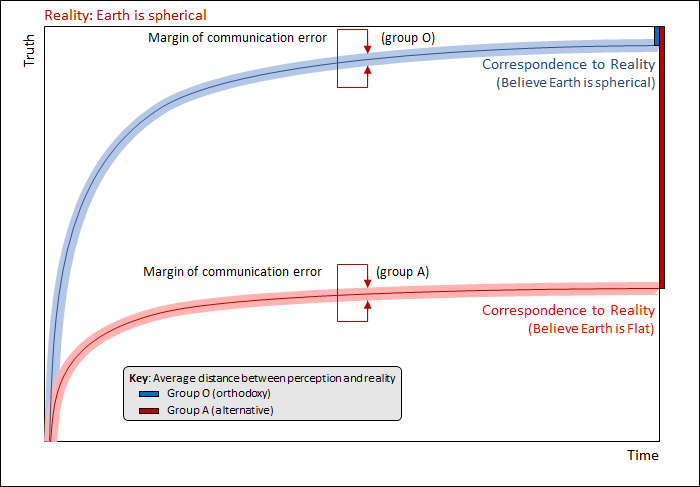
Graph 4b, however, illustrates two opposing perceptions of reality. In this example, I show proponents of orthodoxy (group O), who claim the earth to be roughly spherical, arbitrarily closer to reality than proponents of an alternative theory (group A), who claim that the earth is flat.

Each in-group has some variance from the mean notion, but ex-group members are orders of magnitude apart, as measured by the blue and red bars to the right of the chart. If we assume some binary condition that the earth is either spherical or flat with no other options, one of these might be considered to be right whilst the other would be wrong. We can establish this situation relative to the ex-groups, but, still, neither of these is comparable to Reality™ .


Graph 4b: Correspondence of Truth to Reality (Simplified ex-group concurrence)

The intent of each group may be to promote the perspective of the group—each claiming to be closer to the truth than the other. It is easy to imagine a situation where both claimants are equally distant from the truth:

Imagine two groups, each making opposing claims:

  • Tarot is superior to Astrology in predicting the future.
  • Astrology is superior to Tarot in predicting the future.

I’ll go out on a limb here and create a reality where the future is not predictable by either measure, irrespective of what each in-group believes.


* I understand that the earth being an oblate spheroid is primarily an analytical distinction, so is tautologically true, but I am using a simplification of a commonly accepted fact.

The Truth about Truth (Third Amend)

Please note that this content has been subsumed into the originating article: The Truth about Truth.

THIRDRhetoric is a primary driver to fashion our sense of how close or distant we are from reality. Rhetoric shapes and focuses the frame.

War Is Peace, Freedom Is Slavery, and Ignorance Is Strength

1984, George Orwell

I’ve already commented at length about the primacy of rhetoric. To recap for the purpose of this disquisition, the only meaningful arbiter of truth is rhetoric—the ability to persuade the larger populace to accept something as true.

Here, I’d expect someone to counter with, ‘Just because people are convinced that something is true doesn’t make it so’, and they’d be right. However, as we cannot access the underlying reality accept through our admittedly fallible senses, who’s to argue?

Moreover—going off on a tangent—, we know that other lifeforms—let’s stick with the animal kingdom—have different senses than humans, and some humans perceive things differently to the normie (if I may adopt a spectrum term) .

Sharks have electroreception (re: The Ampullae of Lorenzini), which allows them to perceive small changes in electrical fields as well as what’s termed a lateral line ( mechanoreceptor function), which allows them to recognise changes in environmental pressure. Other known sensory adaptations are echolocation in bats and dolphins and chemoreceptors (notably in insects and snails).

We are probably also aware that different animals have differing degrees of sense acuity compared to humans. Dogs hear frequencies above the human threshold and have better olfactory discrimination. Birds of prey have superior vision. Women typically have a broader colour vocabulary.

Bees see in ultraviolet; snakes can ‘see’ in infrared; owls have night-vision.

And then there’s synesthesia, a condition in which one sense is simultaneously perceived as if by one or more additional senses. A person with synesthesia may perceive sound as colour (chromesthesia) or perhaps taste.

Given concepts of normality, we presume we are synesthesia are normal and these other people are somehow not, but for all we know, we normies are evolutionary dead ends, soon to be displaced by synesthesiacs. (Is that even a word? It is now.)

But I digress.

Perception is reality. If one can convince you of something, e.g. Donald Trump is a good president, then it’s ostensibly true to you. If one can convince an entire population that something is true, e.g. the plot of Orwell’s 1984, or The Matrix, then who’s to say otherwise.