Continuing my short series, I recommenced asking for a dancer.
To be fair, I got some. It looks like sleeping/dead people crept in. The top left wasn’t at all what I was seeking, but I liked it and rendered a series.
It’s got a Steinbeck Grapes of Wrath-Oklahoma Dust Bowl vibe, and I love the muted colour tones, yet it still has warmth. Dancing isn’t working out ver well. What if I ask for a pirouette?
Not really. Cirque du Soleil as a keyphrase?
Ish. Cyborgs?
Meh. Why just faces? I guess these are cyborgs.
I want to see full bodies with feet. I’ll prompt Midjourney to have them tie their shoes.
Ya. About that… What the hell is that thing on the lower right? I got this. Once more…
Nah, mate. Not so much. The top left is just in time for Hallowe’en. I guess that’s a cyborg and an animatronic skeleton. What if I change up the aspect ratio for these cyborgs?
Nah.
Take me to church
This next set is supposed to be a high-angle shot in a church.
Not really. Let’s keep trying. Why is the top-left woman wearing pants in church – sans trousers? How about we ask for a gown?
OK? Churches typically have good lighting opportunities. Let’s see some stained glass.
Nope. Didn’t quite understand the assignment. And what’s with the Jesus Christ pose? Church reminds me of angels. How about some wings?
Not the most upbeat angels. Victoria’s Secret is on the lower left. I want white wings and stained glass. What sort of church is this anyway?
Butterfly wings on the lower right? More butterfly.
Why are some of these butterfly wings front- and side-loaded?
Anyway, let’s just call this a day and start thinking of another topic. Cheers.
Continuing on Midjourney themes, let’s talk cowgirls and American Indians. At least they know how US cowboys look – sort of.
Cowboy hats, boots, jeans (mostly), guns (modern cowboys. no revolvers in sight), gun belts, and topless in the desert – gotta work on that tan. Looks like the bottom left got thrown from her horse and has a bit of road rash going on. I did prompt for cowgirls, so I’m not sure about the block at the top left. He seems to need water.
Let’s inform Midjourney that we need revolvers, a Winchester, and horses to complete the vibe.
Wait, what? Is the woman on the lower left the missing centaur from the other day? And what’s with the low-riding woman in the middle right? I think the top left looks like a tattooed woman wearing a sheer top. Not sure.
Let’s see some gunfire.
Yep. These are authentic cowgirls, for sure. What else do they do in the Wild West – saloons, right?
Evidently, this place doesn’t have a no-shirts policy. I’m sure they’re barefoot as well. I asked for boots, but these girls rule the roost.
Let’s see if Midjourney allows drinking.
Maybe. Sort of. I did promise some Indians.
Midjourney seems to have a handle on the Indigenous American stereotype.
Can I get a cowgirl and a pirate in the same frame?
The answer is yes and no. To get two subjects you need to render one and in-paint the other. I didn’t feel like in-painting, so this is what I got. Only one image in the block has two people. I’m sussing them to be cowgirls rather than pirates. Some of these other models are just random people – neither cowgirl nor pirate. Let’s try again.
Ya, no. Fail. Let’s try some sumurais.
Nope. Not buying it. I see some Asian flair, but nah. Let’s try Ninjas instead. Everyone knows those tell-tale black ninja outfits.
Hmmm… I suppose not ‘everyone’. Geishas anyone?
Not horrible. Steampunk?
Man. Lightweight. Perhaps if we call out some specific gear…
Ya. Not feeling it. Any other stereotypes? How about a crystal ball soothsayer?
They seem to have the Gypsy thing down.
I end here. I’ve got dancers, church, angels, and demons. Let’s save them for tomorrow.
Thar be pirates. Midjourney 6.1 has better luck rendering pirates.
I find it very difficult to maintain composition. 5 of these images are mid shots whilst one is an obvious closeup. For those not in the know, Midjourney renders 4 images from each prompt. The images above were rendered from this prompt:
portrait, Realistic light and shadow, exquisite details,acrylic painting techniques, delicate faces, full body,In a magical movie, Girl pirate, wearing a pirate hat, short red hair, eye mask, waist belt sword, holding a long knife, standing in a fighting posture on the deck, with the sea of war behind her, Kodak Potra 400 with a Canon EOS R5
Notice that the individual elements requested aren’t in all of the renders. She’s not always wearing a hat; she does have red hair, but not always short; she doesn’t always have a knife or a sword; she’s missing an eye mask/patch. Attention to detail is pretty low. Notice, too, that not all look like camera shots. I like to one on the bottom left, but this looks more like a painting as an instruction notes.
In this set, I asked for a speech bubble that reads Arrr… for a post I’d written (on the letter R). On 3 of the 4 images, it included ‘Arrrr’ but not a speech bubble to be found. I ended up creating it and the text caption in PhotoShop. Generative image AI is getting better, but it’s still not ready for prime time. Notice that some are rendering as cartoons.
Some nice variations above. Notice below when it loses track of the period. This is common.
Top left, she’s (perhaps non-binary) topless; to the right, our pirate is a bit of a jester. Again, these are all supposed to be wide-angle shots, so not great.
The images above use the same prompt asking for a full-body view. Three are literal closeups.
Same prompt. Note that sexuality, nudity, violence, and other terms are flagged and not rendered. Also, notice that some of the images include nudity. This is a result of the training data. If I were to ask for, say, the pose on the lower right, the request would be denied. More on this later.
In the block above, I am trying to get the model to face the camera. I am asking for the hat and boots to be in the frame to try to force a full-body shot. The results speak for themselves. One wears a hat; two wear boots. Notice the shift of some images to black & white. This was not a request.
In the block above, I prompted for the pirate to brush her hair. What you see is what I got. Then I asked for tarot cards.
I got some…sort of. I didn’t know strip-tarot was actually a game.
Next, I wanted to see some duelling with swords. These are pirates after all.
This may not turn into the next action blockbuster. Fighting is against the terms and conditions, so I worked around the restrictions the best I could, the results of which you may see above.
Some pirates used guns, right?
Right? I asked for pistols. Close enough.
Since Midjourney wasn’t so keen on wide shots, I opted for some closeups.
This set came out pretty good. It even rendered some pirates in the background a tad out of focus as one might expect. This next set isn’t too shabby either.
And pirates use spyglasses, right?
Sure they do. There’s even a pirate flag of sorts on the lower right.
What happens when you ask for a dash of steampunk? I’m glad you asked.
Save for the bloke at the top right, I don’t suppose you’d have even noticed.
Almost to the end of the pirates. I’m not sure what happened here.
In the block above, Midjourney added a pirate partner and removed the ship. Notice again the nudity. If I ask for this, it will be denied. Moreover, regard this response.
To translate, this is saying that what I prompted was OK, but that the resulting image would violate community guidelines. Why can’t it take corrective actions before rendering? You tell me. Why it doesn’t block the above renders is beyond me – not that I care that they don’t.
This last one used the same prompt except I swapped out the camera and film instruction with the style of Banksy.
I don’t see his style at all, but I came across like Jaquie Sparrow. In the end, you never know quite what you’ll end up with. When you see awesome AI output, it may have taken dozens or hundreds of renders. This is what I wanted to share what might end up on the cutting room floor.
I thought I was going to go through pirates and cowboys, but this is getting long. if you like cowgirls, come back tomorrow. And, no, this is not where this channel is going, but the language of AI is an interest of mine. In a way, this illustrates the insufficiency of language.
I use generative AI often, perhaps daily. I spend most of my attention on textual application, but I use image generations, too—with less than spectacular results. Many of the cover images for the articles I post here are Dall-E renders. Typically, I feed it an article and ask for an apt image. As you can see, results vary and they are rarely stellar because I don’t want to spend time getting them right. Close enough for the government, as they say.
Midjourney produces much better results, but you need to tell it exactly what you want. I can’t simply upload a story and prompt it to figure it out. I’ve been playing with Midjourney for a few hours recently, and I decided to share my horror stories. Although it has rendered some awesome artwork, I want to focus on the other side of the spectrum. Some of this is not safe for work (NSFW), and some isn’t safe for reality more generally. I started with a pirate motif, moved to cowgirls, Samuris and Ninjas, Angels and Demons, and I’m not sure quite what else, but I ended up with Centaurs and Satyrs – or did I?
It seems that Midjourney (at least as of version 6.1) doesn’t know much about centaurs and satyrs, but what it does know is rather revealing. This was my first pass:
Notice, there’s not a centaur in sight, so I slowly trimmed my prompt down. I tried again. I wanted a female centaur, so I kept going.
So, not yet. It even slipped in a male’s face. Clearly, not vibing. Let’s continue.
Trimming a bit further, it seems to understand that centaurs have a connexion to horses. Unfortunately, it understands the classes of humans and horses, but it needs to merge them just so. Let’s keep going. This time, I only entered the word ‘centaur’. Can’t get any easier.
It seems I got an angel riding a horse or a woman riding a pegasus. You decide. A bull – a bit off the mark,. A woman riding a horse with either a horn or a big ear. And somewhat of a statue of a horse. Not great. And I wanted a ‘female centaur’, so let’s try this combination.
Yeah, not so much. I’m not sure what that woman holding bows in each hand is. There’s some type of unicorn or duocorn. I don’t know. Interesting, but off-topic. Another odd unicorn-horse thing. And a statue of a woman riding a horse.
Satyrs
Let’s try satyrs. Surely Midjourney’s just having an off day. On the upside, it seems to be more familiar with these goat hybrids, but not exactly.
What the hell was its training data? Let’s try again.
Not so much. We have a woman dancing with Baphomet or some such. Um, again?
We don’t seem to be going in the right direction. I’m not sure what’s happening. Forging ahead…
On the plus side, I’m starting to see goats.
There’s even a goat lady montage thing that’s cool in its own right, but not exactly what I ordered. Let’s get back to basic with a single-word prompt: Satyr.
Well, -ish. I forgot to prompt for a female satyr.
Ya, well. This is as good as we’re getting. Let’s call it a day, and see how the more humanoid creatures render.
As the series on higher education draws to a close, it seems fitting to reflect on the unique process behind its creation. There’s a popular notion that material generated by artificial intelligence is somehow of lesser quality or merely derivative. But I would argue that this perception applies to all language—whether written or spoken. My experience has shown that generative AI can elevate my material in much the same way as a skilled copy editor or research assistant might. Perhaps, in trying to draw a firm line between AI-generated and human-generated content, we’re caught in a Sorites paradox: at what point does this line blur?
These articles are the result of a truly collaborative effort involving myself, ChatGPT, and Claude. In combining our capabilities, this project became an exploration not only of higher education’s complexities but also of how humans and AI can work together to articulate, refine, and convey ideas.
The core ideas, observations, and critiques presented here are ultimately mine, shaped by personal experience and conviction. Yet, the research, the structuring of arguments, and the detailed expositions were enriched significantly by Generative AI. ChatGPT and Claude each brought distinct strengths to the table—helping to expand perspectives, test ideas, and transform abstract reflections into a structured, readable whole. This process has demonstrated that AI when thoughtfully integrated, can enhance the intellectual and creative process rather than replace it.
In the end, this series serves not only as an examination of higher education but as an example of how collaboration with AI can offer new possibilities. When human insights and AI’s analytical capabilities come together, the result can be richer than either could achieve in isolation.
This article concludes our five-part series examining the contemporary state of higher education. Having analysed the divergence of purpose and function, market paradoxes, grade inflation, and credentialism, we now explore potential paths forward.
Reimagining Higher Education: Beyond the Current Paradigm
Our examination has revealed fundamental tensions in contemporary higher education: the divergence between purpose and function, market dynamics that undermine accessibility, weakened academic standards, and credential inflation1. These challenges suggest the need not merely for reform, but for reimagining the entire enterprise. The task before us requires both vision and pragmatism—the ability to envision transformative change while acknowledging the practical constraints of implementation.
The future of higher education lies not in preserving outdated models, but in creating new ones that honour traditional values whilst embracing contemporary realities.
Learning from Global Experience
The dominant Anglo-American model of higher education, despite its global influence, has reached a critical juncture. Its combination of unsustainable costs, credential inflation, and declining standards has created what scholars describe as a “perfect storm”2. Students emerge with significant debt but diminishing returns on their educational investment, whilst employers increasingly question the value of traditional degrees.
However, alternative approaches from around the world offer valuable insights for reformation. The German dual education system demonstrates how academic and vocational pathways can achieve parity of esteem whilst serving different student needs and economic requirements. This system’s success in maintaining high employment rates and industrial competitiveness suggests that differentiated educational pathways need not result in social stratification3.
Similarly, Scandinavian models of public funding have largely avoided the access crisis plaguing American and British universities. Their approach suggests that maintaining broad accessibility need not compromise educational quality when supported by appropriate funding structures and societal commitment. Meanwhile, Asian systems, particularly in Singapore and South Korea, have successfully emphasised technical expertise whilst maintaining strong liberal arts traditions, demonstrating that these educational approaches can be complementary rather than contradictory4.
Institutional Differentiation: A Path Forward
The future of higher education likely lies in embracing institutional diversity rather than forcing all universities to conform to a single model. This approach recognises that different types of institutions can excel in different ways, serving distinct but equally valuable purposes in the educational ecosystem5.
Research-intensive universities might focus on advancing knowledge frontiers and training future scholars, whilst teaching-focused institutions could prioritise pedagogical excellence and student development. Professional schools might emphasise practical skills and industry connections, while liberal arts colleges maintain their focus on broad intellectual development. This diversification need not create a hierarchy; rather, it acknowledges that excellence takes different forms in different contexts.
Excellence in higher education should be measured not by universal standards, but by how well institutions fulfil their chosen missions.
Technology’s Transformative Role
The role of technology in higher education extends far beyond the simple digitisation of existing practices. True technological transformation requires reimagining the very nature of teaching, learning, and assessment6. Adaptive learning systems can personalise education at scale, whilst artificial intelligence might help identify student struggles before they become critical. However, technology should enhance rather than replace human interaction in education.
The pandemic-era shift to online learning revealed both the potential and limitations of digital education. Whilst remote learning can increase accessibility and flexibility, it also highlighted the irreplaceable value of in-person interaction and community building. The future likely lies in thoughtfully blended approaches that combine digital efficiency with human connection.
Reimagining Funding and Accessibility
The current funding model of higher education, particularly in Anglo-American contexts, has become unsustainable. Innovation in financial structures must balance institutional sustainability with genuine accessibility7. Income-contingent loan schemes, whilst helpful, represent only a partial solution to a more fundamental problem.
More radical approaches might include lifetime learning accounts, where individuals can draw upon educational credits throughout their careers, or hybrid funding models that combine public support with private investment. Some institutions have begun experimenting with risk-sharing agreements, where universities retain a stake in their graduates’ future earnings, aligning institutional incentives with student success.
Quality Assurance in a Diverse Landscape
As higher education becomes more diverse in its forms and delivery methods, traditional quality assurance frameworks require fundamental revision8. New approaches must balance rigour with flexibility, maintaining standards whilst encouraging innovation. This might involve moving away from input-based measures (such as contact hours or library resources) toward outcome-based assessments that focus on student learning and capability development.
Quality in higher education must be redefined to encompass both traditional academic excellence and real-world effectiveness.
The New Social Contract
Higher education’s relationship with society requires fundamental reconsideration. The traditional implicit contract—where universities served as custodians of knowledge and certifiers of capability—no longer fully serves societal needs9. A new social contract must encompass universities’ roles in lifelong learning, social mobility, economic development, and cultural preservation.
This reimagined relationship requires universities to become more embedded in their communities, more responsive to societal needs, and more accountable for their outcomes. Yet they must also maintain their essential role as centres of independent thought and critical inquiry.
Implementation Challenges
The path to transformation faces significant obstacles10. Institutional inertia, regulatory constraints, and vested interests all resist change. Moreover, the complexity of higher education systems means that reforms in one area often have unintended consequences in others.
Success requires careful sequencing of changes, sustained commitment from leadership, and broad stakeholder engagement. Perhaps most importantly, it demands a willingness to experiment and learn from failure—characteristics that many educational institutions, ironically, struggle to embrace.
Vision for the Future
The future of higher education must balance preservation with transformation11. Traditional academic values—rigorous inquiry, intellectual freedom, the pursuit of truth—remain vital. Yet these must be pursued through new structures and methods appropriate to contemporary challenges.
Success will require unprecedented collaboration between institutions, governments, employers, and communities. It will demand new thinking about what constitutes education, who provides it, and how it is validated. Most fundamentally, it will require us to reimagine what universities can and should be in the 21st century and beyond.
The future belongs not to those who defend the status quo, but to those who reimagine what education can become.
Conclusion: Beyond Reform
The transformation of higher education represents one of the great challenges—and opportunities—of our time12. The task before us is not merely to reform existing institutions but to reimagine the very nature of higher education for a new era. This requires preserving what is valuable from traditional models whilst creating new approaches that better serve contemporary needs.
Success in this endeavour will require vision, courage, and persistence. Yet the stakes could hardly be higher. The future of higher education will shape not only individual opportunities but our collective capacity to address the complex challenges facing human society.
This concludes our five-part series on the state of higher education. We hope these analyses contribute to the ongoing dialogue about the future of learning and knowledge creation in our society.
Footnotes
1 Christensen, C. M., & Eyring, H. J. (2011). “The Innovative University.” Jossey-Bass. ↩
2 Barber, M., Donnelly, K., & Rizvi, S. (2023). “An Avalanche Is Coming: Higher Education and the Revolution Ahead.” Institute for Public Policy Research. ↩
3 Graf, L. (2022). “The German Dual Education System: Analysis of Its Evolution and Present Challenges.” Oxford Review of Education. ↩
4 OECD. (2023). “Education at a Glance 2023: OECD Indicators.” ↩
5 Clark, B. R. (2021). “Creating Entrepreneurial Universities: Organizational Pathways of Transformation.” Emerald Publishing. ↩
6 Selwyn, N. (2023). “Digital Technology and the Future of Education.” Routledge. ↩
7 Johnstone, D. B. (2022). “Financing Higher Education: Cost-Sharing in International Perspective.” SUNY Press. ↩
8 European Association for Quality Assurance. (2023). “Standards and Guidelines for Quality Assurance.” ↩
9 Collini, S. (2017). “Speaking of Universities.” Verso. ↩
10 Crow, M. M., & Dabars, W. B. (2020). “The Fifth Wave: The Evolution of American Higher Education.” Johns Hopkins University Press. ↩
11 Davidson, C. N. (2017). “The New Education: How to Revolutionize the University to Prepare Students for a World in Flux.” Basic Books. ↩
12 Collini, S. (2022). “What Are Universities For?” Penguin. ↩
This article is the second in a five-part series examining the contemporary state of higher education. Building on our analysis of purpose versus function, we now explore how attempts to democratise higher education have led to unexpected economic consequences.
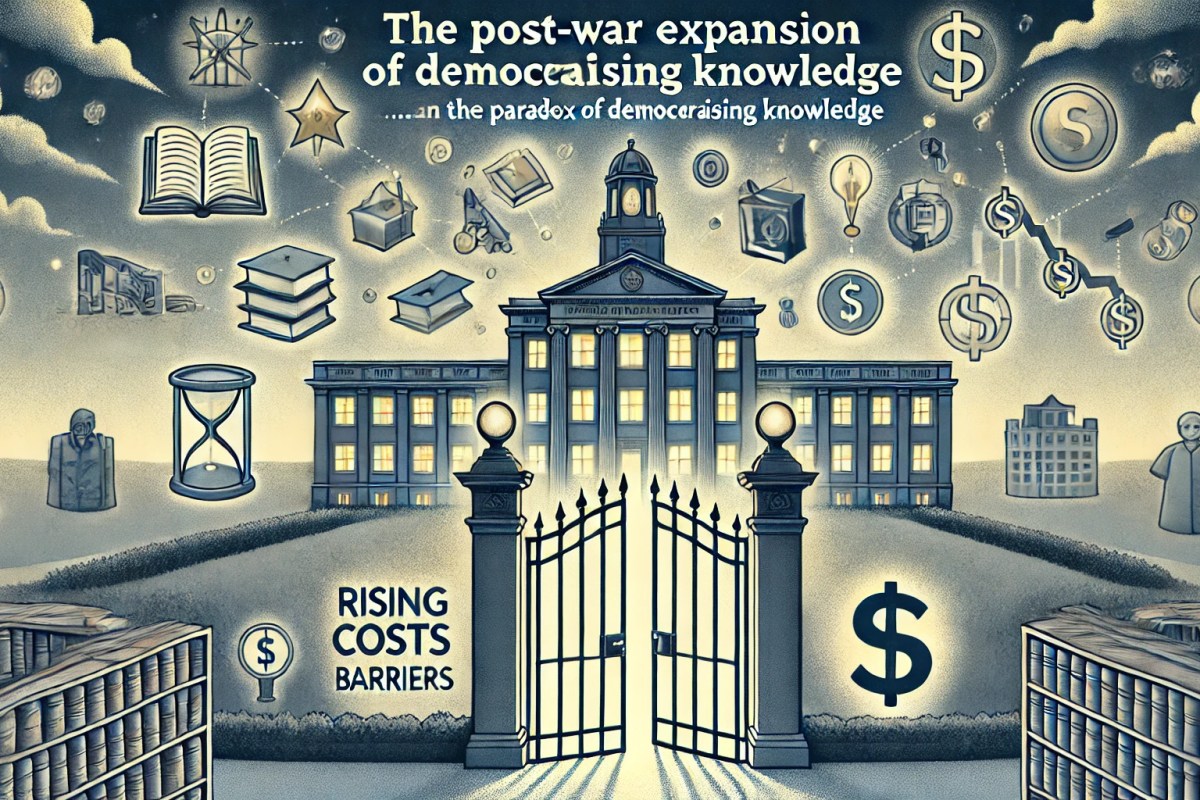
The post-war expansion of higher education emerged from noble aspirations: democratising knowledge, fostering social mobility, and building a more equitable society. State funding and policy initiatives aimed to transform university education from an elite privilege into a broadly accessible opportunity1. Yet this worthy goal has yielded paradoxical outcomes that merit careful examination.
The democratisation of higher education has created an unexpected paradox: as access widens, the individual value of a degree diminishes, while its cost increases.
The democratisation of higher education has created an unexpected paradox: as access widens, the individual value of a degree diminishes, while its cost increases. This counterintuitive outcome challenges our fundamental assumptions about educational accessibility and its relationship to social progress.
The Market Response
Supply and Demand Distortions
As state funding increased access, universities responded not by expanding supply to meet demand, but by leveraging increased demand to enhance their market position2. This response reflects the peculiar economics of higher education, where traditional market forces fail to regulate prices effectively. Unlike typical markets, increased competition in higher education often drives prices up rather than down, as institutions compete on prestige rather than affordability.
increased competition in higher education often drives prices up rather than down
The economic dynamics create several distinct but interrelated effects. Institutions invest heavily in amenities and facilities, transforming campuses into sophisticated learning environments that often resemble luxury resorts more than traditional academic settings. Administrative costs expand exponentially as universities create new departments and positions to manage increasingly complex operations and regulatory requirements. Marketing budgets have grown dramatically, with some institutions spending millions annually on recruitment and brand positioning. Research infrastructure continues to expand as universities seek to enhance their global rankings and attract prestigious faculty members.
The Prestige Premium
The persistence of institutional hierarchy means that despite wider access, competition for elite institutions intensifies3. This creates a two-tier effect where elite institutions maintain exclusivity while raising prices, and other institutions emulate this model, driving up costs across the sector. Prestige in higher education operates as a positional good: its value depends on its scarcity. This fundamental characteristic creates an inherent tension with democratisation efforts.
The pursuit of prestige manifests in various forms across the educational landscape. Elite institutions leverage their historical advantages to maintain selective admission rates while steadily increasing tuition fees. Mid-tier universities, attempting to climb the prestige ladder, invest heavily in research facilities and faculty recruitment, often at the expense of teaching resources. Less prestigious institutions find themselves caught in a difficult position, struggling to maintain academic standards while competing for a diminishing pool of students who can afford their fees.
The Student Debt Paradox
What began as an initiative to democratise opportunity has evolved into a system where students require more debt to access opportunity4. This creates a troubling cycle where rising tuition requires increased borrowing, which in turn influences career choices and often constrains social mobility. The burden falls disproportionately on those from disadvantaged backgrounds, who often take on higher debt levels relative to family income5.
What began as an initiative to democratise opportunity has evolved into a system where students require more debt to access opportunity
The implications of this debt burden extend far beyond graduation. Recent graduates increasingly postpone major life decisions such as home ownership, marriage, or starting a family. Career choices become heavily influenced by loan repayment considerations rather than personal interest or societal need. Perhaps most troublingly, those who fail to complete their degrees often find themselves in the worst position: bearing the burden of educational debt without the corresponding benefit of a credential.
The Institutional Arms Race
The inflow of state funding and student debt has fuelled an institutional arms race6. Universities compete through an ever-expanding array of facilities, services, and programmes. Modern campuses now routinely feature state-of-the-art fitness centres, dining facilities that rival upscale restaurants, and residential accommodation that would have been considered luxurious by previous generations’ standards.
Universities now maintain extensive bureaucracies to manage everything from compliance and risk management to student life and career service
Administrative growth has been particularly striking. Universities now maintain extensive bureaucracies to manage everything from compliance and risk management to student life and career services. Marketing departments have expanded dramatically, employing sophisticated digital strategies and international recruitment campaigns. Research facilities continue to grow more elaborate and expensive, with institutions investing heavily in specialised equipment and facilities to attract top researchers and secure grant funding.
International Perspectives
Different funding models across nations reveal varying approaches to this challenge7. The European model of state-funded universities has historically maintained broader access while controlling costs, though recent pressures have begun to erode this advantage. The American model of high-fee, high-aid institutions creates a complex system of cross-subsidisation but often results in significant student debt. Emerging Asian hybrid models attempt to balance state control with market forces, though they too face increasing pressure from global competition.
The American model of high-fee, high-aid institutions creates a complex system of cross-subsidisation but often results in significant student debt.
These international variations provide valuable insights into alternative approaches to higher education funding and delivery. The Nordic countries, for instance, maintain high-quality public universities with minimal student fees, funded through progressive taxation. German-speaking countries have preserved a dual system of universities and technical institutions, helping to maintain distinct educational pathways. East Asian systems often combine strong state oversight with significant private sector involvement, creating unique hybrid models.
Implications for Social Mobility
The democratisation of access, paradoxically, may reinforce rather than reduce social stratification8. This occurs through multiple mechanisms that often work in concert to preserve and sometimes exacerbate existing inequalities. Debt burdens disproportionately affect students from lower-income backgrounds, potentially limiting their post-graduation choices and economic mobility. Credential inflation requires increasingly lengthy periods of study, favouring those with the financial resources to remain in education longer. Elite institutions, despite widened access overall, often remain bastions of privilege, with admission rates for disadvantaged students showing minimal improvement over time.
The democratisation of access, paradoxically, may reinforce rather than reduce social stratification
The role of social capital in educational success has, if anything, grown more significant. Students from privileged backgrounds often benefit from better information about university choices, stronger support networks, and greater access to unpaid internships and other career-building opportunities. These advantages compound over time, potentially leading to greater rather than lesser social stratification.
Looking Forward
Resolving these tensions requires rethinking not just funding mechanisms but the underlying structure of higher education9. The challenge lies in preserving genuine accessibility while avoiding the inflationary spiral that threatens to undermine the very democratisation we seek. True democratisation of higher education may require reimagining not just how we fund universities, but how we conceive of their role in society.
True democratisation of higher education may require reimagining not just how we fund universities, but how we conceive of their role in society.
This reimagining might involve developing new models of educational delivery, creating alternative credentialing systems, or fundamentally restructuring the relationship between education and employment. Whatever path forward we choose, it must address both the financial sustainability of institutions and the genuine accessibility of education for all qualified students.
In the next article in this series, we shall examine how grade inflation compounds these challenges, further eroding the value proposition of higher education.
Footnotes
1 Trow, M. (2007). “Reflections on the Transition from Elite to Mass to Universal Access.” Springer. ↩
2 Winston, G. C. (1999). “Subsidies, Hierarchy and Peers: The Awkward Economics of Higher Education.” Journal of Economic Perspectives. ↩
3 Marginson, S. (2016). “The Dream Is Over: The Crisis of Clark Kerr’s California Idea of Higher Education.” University of California Press. ↩
4 Goldrick-Rab, S. (2016). “Paying the Price: College Costs, Financial Aid, and the Betrayal of the American Dream.” University of Chicago Press. ↩
5 Scott-Clayton, J. (2018). “The Looming Student Loan Default Crisis Is Worse Than We Thought.” Brookings Institution. ↩
6 Zemsky, R., Wegner, G., & Massy, W. (2005). “Remaking the American University: Market-Smart and Mission-Centered.” Rutgers University Press. ↩
7 OECD (2023). “Education at a Glance 2023: OECD Indicators.” OECD Publishing. ↩
8 Chetty, R., et al. (2017). “Mobility Report Cards: The Role of Colleges in Intergenerational Mobility.” NBER. ↩
9 Christensen, C. M., & Eyring, H. J. (2011). “The Innovative University.” Jossey-Bass. ↩
This article is the third in a five-part series examining the contemporary state of higher education. Building on our analyses of purpose versus function and market dynamics, we examine how grade inflation affects the integrity of academic assessment.
Grade Inflation: The Erosion of Academic Standards
Historical grading practices emerged from a need to evaluate scholarly achievement objectively. Yet modern pressures have transformed assessment from a measure of academic accomplishment into a tool serving various institutional and market demands1. Recent evidence suggests this transformation extends beyond mere grade inflation to fundamental changes in academic capability and institutional standards.
When ‘A’ becomes average, excellence becomes indistinguishable from mediocrity.
The Evolution of Grade Inflation
The trajectory of grade inflation in higher education tells a compelling story. At Harvard University, the percentage of A-range grades increased from 15% in 1960 to 79% in 20232. This pattern is not isolated to elite institutions; similar trends appear across the higher education spectrum3.
Institutional Drivers
Market Pressures
Universities face multiple pressures that influence grading practices 4. These pressures manifest through complex interconnections between funding metrics and institutional performance. Student satisfaction scores increasingly influence funding allocations, whilst retention and completion rates factor prominently in university rankings. League table competition drives institutional behaviour at all levels, and graduate employment statistics have become crucial marketing tools. The growing emphasis on student evaluation of teaching has created additional pressure on academic staff to maintain high grade averages.
When institutions prioritise student satisfaction over academic rigour, grade inflation becomes an inevitable consequence.
Contemporary Challenges
Recent developments have intensified these pressures. The widespread availability of AI writing tools, online homework solutions, and contract cheating services creates new challenges for maintaining academic integrity5. Simultaneously, evidence suggests fundamental changes in student preparation and capability, with elite institutions reporting declining student engagement with long-form texts and complex academic tasks6.
The Mechanics of Grade Inflation
Statistical Evidence
Contemporary grade distributions reveal several concerning patterns7. We observe significant compression at the upper end of the grading scale, with marks clustering in the top bands across disciplines. This compression has led to reduced differentiation between achievement levels, making it increasingly difficult to distinguish truly exceptional work. Furthermore, there exists marked variance across disciplines, with some fields showing more pronounced inflation than others. Perhaps most troublingly, we see a growing disparity between public and private institutions, potentially exacerbating existing educational inequalities.
Grade inflation creates a false meritocracy where distinction becomes meaningless.
Global Variations
Different educational systems demonstrate varying approaches to grade inflation8. The Anglo-American systems show marked inflation trends, whilst Continental European systems maintain more rigid standards through centralised examination procedures and external moderation. Asian systems often emphasise relative ranking over absolute grades, creating different dynamics around grade distribution. Meanwhile, international institutions grapple with grade compatibility across different national systems, adding another layer of complexity to the issue.
Consequences for Academic Integrity
Assessment Reliability
Grade inflation undermines the fundamental purpose of assessment9. The ability to distinguish between different levels of achievement has been significantly compromised, whilst feedback mechanisms lose their effectiveness when most marks cluster at the top of the scale. Academic standards face erosion as expectations adjust to meet the new normal, and cross-institutional comparability becomes increasingly challenging.
Impact on Learning
The effects on student learning are equally concerning10. Students demonstrate reduced motivation to excel when high grades become the expectation rather than the reward for exceptional work. Many choose to avoid challenging courses that might threaten their grade point average, whilst the emphasis on grades over learning leads to strategic but superficial approaches to study. Perhaps most concerning is the decrease in academic resilience, as students become less equipped to handle constructive criticism or engage with challenging material.
The pursuit of grades has supplanted the pursuit of knowledge.
Reform Considerations
Addressing grade inflation requires systematic reform11. A comprehensive approach to grade normalisation practices could help restore meaning to academic assessment, particularly when implemented across institutions. Enhanced external examination systems, drawing on successful European models, might provide greater accountability and standardisation. The development of competency-based assessment frameworks offers another promising direction, potentially providing a more meaningful evaluation of student capabilities. Multi-dimensional evaluation frameworks could capture different aspects of student achievement, moving beyond simple grade point averages to provide richer, more nuanced assessments of academic performance.
Meaningful reform must balance academic rigour with fair assessment whilst maintaining educational accessibility.
Future Implications
For Academic Standards
The persistence of grade inflation threatens both academic standards and institutional credibility12. Educational quality faces ongoing pressure as institutions struggle to maintain meaningful assessment standards within an increasingly competitive marketplace. Assessment validity becomes harder to defend when grades no longer reflect genuine differences in achievement. Institutional credibility suffers as employers and other stakeholders lose faith in academic credentials, whilst professional preparation may be compromised when students receive inaccurate feedback about their capabilities.
For Higher Education
The broader effects on higher education are profound. Institutional purpose becomes increasingly unclear when assessment loses its meaning. Academic integrity faces new challenges as grade inflation undermines the relationship between effort and achievement. Market dynamics continue to pressure institutions toward more lenient grading, whilst social mobility may actually be hindered when privileged institutions can offer higher grades for equivalent work.
The future of academic assessment lies not in grade inflation, but in meaningful evaluation of genuine learning.
In the next article in this series, we shall examine how grade inflation intersects with broader credentialism trends in higher education and employment markets.
Footnotes
1 Johnson, V. E. (2003). “Grade Inflation: A Crisis in College Education.” Springer. ↩
2 Harvard University Office of Institutional Research. (2023). “Grade Distribution Report.” ↩
3 Rojstaczer, S., & Healy, C. (2012). “Where A Is Ordinary: The Evolution of American College and University Grading, 1940–2009.” Teachers College Record. ↩
4 Babcock, P. (2010). “Real Costs of Nominal Grade Inflation? New Evidence from Student Course Evaluations.” Economic Inquiry. ↩
5 International Center for Academic Integrity. (2023). “Trends in Academic Integrity.” ↩
6 Horowitch, R. (2024). “The Elite College Students Who Can’t Read Books.” The Atlantic. ↩
7 Rojstaczer, S. (2016). “Grade Inflation at American Colleges and Universities.” GradeInflation.com. ↩
8 European Commission. (2023). “The European Education Area: Assessment Practices in Higher Education.” ↩
9 Butcher, K., McEwan, P., & Weerapana, A. (2014). “The Effects of an Anti-Grade-Inflation Policy at Wellesley College.” Journal of Economic Perspectives. ↩
10 Arum, R., & Roksa, J. (2011). “Academically Adrift: Limited Learning on College Campuses.” University of Chicago Press. ↩
11 Hu, S. (2005). “Beyond Grade Inflation: Grading Problems in Higher Education.” ASHE Higher Education Report. ↩
12 Collins, R. (2019). “The Credential Society: An Historical Sociology of Education and Stratification.” Columbia University Press. ↩
This article is the second in a five-part series examining the contemporary state of higher education. Building on our analysis of purpose versus function, we now explore how attempts to democratise higher education have led to unexpected economic consequences.
The post-war expansion of higher education emerged from noble aspirations: democratising knowledge, fostering social mobility, and building a more equitable society. State funding and policy initiatives aimed to transform university education from an elite privilege into a broadly accessible opportunity1. Yet this worthy goal has yielded paradoxical outcomes that merit careful examination.
The democratisation of higher education has created an unexpected paradox
The democratisation of higher education has created an unexpected paradox: as access widens, the individual value of a degree diminishes, while its cost increases. This counterintuitive outcome challenges our fundamental assumptions about educational accessibility and its relationship to social progress.
The Market Response
Supply and Demand Distortions
As state funding increased access, universities responded not by expanding supply to meet demand, but by leveraging increased demand to enhance their market position2. This response reflects the peculiar economics of higher education, where traditional market forces fail to regulate prices effectively. Unlike typical markets, increased competition in higher education often drives prices up rather than down, as institutions compete on prestige rather than affordability.
increased competition in higher education often drives prices up rather than down
The economic dynamics create several distinct but interrelated effects. Institutions invest heavily in amenities and facilities, transforming campuses into sophisticated learning environments that often resemble luxury resorts more than traditional academic settings. Administrative costs expand exponentially as universities create new departments and positions to manage increasingly complex operations and regulatory requirements. Marketing budgets have grown dramatically, with some institutions spending millions annually on recruitment and brand positioning. Research infrastructure continues to expand as universities seek to enhance their global rankings and attract prestigious faculty members.
The Prestige Premium
The persistence of institutional hierarchy means that despite wider access, competition for elite institutions intensifies3. This creates a two-tier effect where elite institutions maintain exclusivity while raising prices, and other institutions emulate this model, driving up costs across the sector. Prestige in higher education operates as a positional good: its value depends on its scarcity. This fundamental characteristic creates an inherent tension with democratisation efforts.
The pursuit of prestige manifests in various forms across the educational landscape. Elite institutions leverage their historical advantages to maintain selective admission rates while steadily increasing tuition fees. Mid-tier universities, attempting to climb the prestige ladder, invest heavily in research facilities and faculty recruitment, often at the expense of teaching resources. Less prestigious institutions find themselves caught in a difficult position, struggling to maintain academic standards while competing for a diminishing pool of students who can afford their fees.
The Student Debt Paradox
What began as an initiative to democratise opportunity has evolved into a system where students require more debt to access opportunity4. This creates a troubling cycle where rising tuition requires increased borrowing, which in turn influences career choices and often constrains social mobility. The burden falls disproportionately on those from disadvantaged backgrounds, who often take on higher debt levels relative to family income5.
What began as an initiative to democratise opportunity has evolved into a system where students require more debt to access opportunity
The implications of this debt burden extend far beyond graduation. Recent graduates increasingly postpone major life decisions such as home ownership, marriage, or starting a family. Career choices become heavily influenced by loan repayment considerations rather than personal interest or societal need. Perhaps most troublingly, those who fail to complete their degrees often find themselves in the worst position: bearing the burden of educational debt without the corresponding benefit of a credential.
The Institutional Arms Race
The inflow of state funding and student debt has fuelled an institutional arms race6. Universities compete through an ever-expanding array of facilities, services, and programmes. Modern campuses now routinely feature state-of-the-art fitness centres, dining facilities that rival upscale restaurants, and residential accommodation that would have been considered luxurious by previous generations’ standards.
Universities now maintain extensive bureaucracies to manage everything from compliance and risk management to student life and career services.
Administrative growth has been particularly striking. Universities now maintain extensive bureaucracies to manage everything from compliance and risk management to student life and career services. Marketing departments have expanded dramatically, employing sophisticated digital strategies and international recruitment campaigns. Research facilities continue to grow more elaborate and expensive, with institutions investing heavily in specialised equipment and facilities to attract top researchers and secure grant funding.
International Perspectives
Different funding models across nations reveal varying approaches to this challenge7. The European model of state-funded universities has historically maintained broader access while controlling costs, though recent pressures have begun to erode this advantage. The American model of high-fee, high-aid institutions creates a complex system of cross-subsidisation but often results in significant student debt. Emerging Asian hybrid models attempt to balance state control with market forces, though they too face increasing pressure from global competition.
The American model of high-fee, high-aid institutions creates a complex system of cross-subsidisation but often results in significant student debt.
These international variations provide valuable insights into alternative approaches to higher education funding and delivery. The Nordic countries, for instance, maintain high-quality public universities with minimal student fees, funded through progressive taxation. German-speaking countries have preserved a dual system of universities and technical institutions, helping to maintain distinct educational pathways. East Asian systems often combine strong state oversight with significant private sector involvement, creating unique hybrid models.
Implications for Social Mobility
The democratisation of access, paradoxically, may reinforce rather than reduce social stratification8. This occurs through multiple mechanisms that often work in concert to preserve and sometimes exacerbate existing inequalities. Debt burdens disproportionately affect students from lower-income backgrounds, potentially limiting their post-graduation choices and economic mobility. Credential inflation requires increasingly lengthy periods of study, favouring those with the financial resources to remain in education longer. Elite institutions, despite widened access overall, often remain bastions of privilege, with admission rates for disadvantaged students showing minimal improvement over time.
The democratisation of access, paradoxically, may reinforce rather than reduce social stratification.
The role of social capital in educational success has, if anything, grown more significant. Students from privileged backgrounds often benefit from better information about university choices, stronger support networks, and greater access to unpaid internships and other career-building opportunities. These advantages compound over time, potentially leading to greater rather than lesser social stratification.
Looking Forward
Resolving these tensions requires rethinking not just funding mechanisms but the underlying structure of higher education9. The challenge lies in preserving genuine accessibility while avoiding the inflationary spiral that threatens to undermine the very democratisation we seek. True democratisation of higher education may require reimagining not just how we fund universities, but how we conceive of their role in society.
This reimagining might involve developing new models of educational delivery, creating alternative credentialing systems, or fundamentally restructuring the relationship between education and employment. Whatever path forward we choose, it must address both the financial sustainability of institutions and the genuine accessibility of education for all qualified students.
In the next article in this series, we shall examine how grade inflation compounds these challenges, further eroding the value proposition of higher education.
Footnotes
1 Trow, M. (2007). “Reflections on the Transition from Elite to Mass to Universal Access.” Springer. ↩
2 Winston, G. C. (1999). “Subsidies, Hierarchy and Peers: The Awkward Economics of Higher Education.” Journal of Economic Perspectives. ↩
3 Marginson, S. (2016). “The Dream Is Over: The Crisis of Clark Kerr’s California Idea of Higher Education.” University of California Press. ↩
4 Goldrick-Rab, S. (2016). “Paying the Price: College Costs, Financial Aid, and the Betrayal of the American Dream.” University of Chicago Press. ↩
5 Scott-Clayton, J. (2018). “The Looming Student Loan Default Crisis Is Worse Than We Thought.” Brookings Institution. ↩
6 Zemsky, R., Wegner, G., & Massy, W. (2005). “Remaking the American University: Market-Smart and Mission-Centered.” Rutgers University Press. ↩
7 OECD (2023). “Education at a Glance 2023: OECD Indicators.” OECD Publishing. ↩
8 Chetty, R., et al. (2017). “Mobility Report Cards: The Role of Colleges in Intergenerational Mobility.” NBER. ↩
9 Christensen, C. M., & Eyring, H. J. (2011). “The Innovative University.” Jossey-Bass. ↩
This article is the first in a five-part series examining the contemporary state of higher education. The series explores the growing tensions between traditional academic ideals and modern institutional practices, from the changing role of universities to the challenges of credential inflation.
The Purpose versus Function of Higher Education: An Analysis of Divergent Trajectories
The medieval university emerged as a sanctuary of scholarly pursuit, where knowledge was cultivated for its own sake and learning was viewed as a transformative journey rather than a transactional exchange. This original purpose—the advancement of knowledge and cultivation of intellectual growth—stood largely unchallenged until the modern era. Yet today’s universities operate in a markedly different landscape, where their function has evolved far beyond these foundational aims.
The modern university finds itself caught between its historical mission of knowledge creation and its contemporary function as a credentialing institution.
Historical Foundations and Modern Tensions
The university as we know it took shape in medieval Europe, with institutions like the University of Bologna, Oxford, and the Sorbonne establishing models of scholarly community that would endure for centuries. These early universities served a dual purpose: preserving classical knowledge while fostering new intellectual discoveries. Their function aligned closely with their purpose—the pursuit of truth through rational inquiry and scholarly debate1.
This alignment between purpose and function persisted well into the modern era, even as universities expanded their scope to encompass scientific research and professional training. The Humboldtian model of the 19th century explicitly united teaching and research, viewing them as complementary aspects of the scholarly enterprise2. This unity of purpose and function began to fragment only with the mass expansion of higher education in the 20th century.
Competing Perspectives in Modern Higher Education
The Institutional Perspective
Today’s universities balance multiple, often competing imperatives: research excellence, financial sustainability, market positioning, and societal impact. This multiplication of purposes has led to a functional transformation where universities increasingly operate as commercial entities rather than purely academic institutions3. The pressure to maintain enrolment numbers, secure research funding, and compete in global rankings has fundamentally altered how institutions approach their educational mission.
The pressure to maintain enrolment numbers, secure research funding, and compete in global rankings has fundamentally altered how institutions approach their educational mission.
When institutions prioritise market demands over academic rigour, the very essence of higher education comes into question.
The Student Perspective
Contemporary students approach higher education primarily as an investment in future earnings potential. Recent studies indicate that even at elite institutions, students struggle with fundamental academic practices like sustained reading4. This shift reflects broader societal changes, raising questions about whether pure academic pursuit remains viable for most students in today’s economic climate.
Where once university attendance signified a commitment to intellectual development, it now often represents a necessary credential for professional advancement.
The transformation in student attitudes mirrors wider cultural shifts. Where once university attendance signified a commitment to intellectual development, it now often represents a necessary credential for professional advancement. This pragmatic approach, while understandable, fundamentally alters the student-institution relationship5.
The Employer Perspective
Employers, historically peripheral to academic pursuits, now significantly influence university function through their hiring preferences and skill demands. This relationship has transformed universities into de facto credential providers, potentially at odds with their historical purpose of fostering intellectual development6.
The gulf between academic achievement and workplace requirements continues to widen, challenging the traditional value proposition of university education.
The Case for Multiple Modalities
The tension between historical purpose and contemporary function suggests that a single model of higher education may no longer suffice. A more nuanced and differentiated approach to higher education could better serve our diverse societal needs. Traditional academic institutions could maintain their focus on pure scholarly pursuit, preserving the medieval ideal of knowledge for its own sake while fostering deep intellectual development. Alongside these, professional schools could explicitly focus on career preparation, with curricula and pedagogy designed specifically for workplace demands7.
[A] differentiated approach would allow each type of institution to excel in its chosen domain rather than trying to fulfil every possible educational function.
Research institutes could dedicate themselves primarily to knowledge creation, operating with different metrics and expectations than teaching-focused institutions. Meanwhile, vocational centres could prioritise practical skill development, offering focused, efficient pathways to specific career outcomes. This differentiated approach would allow each type of institution to excel in its chosen domain rather than trying to fulfil every possible educational function.
The Anachronism Question
Is the traditional university model anachronistic in today’s world? The evidence suggests a more nuanced conclusion. While the medieval model may not suit all modern needs, its emphasis on deep learning and intellectual development remains valuable—perhaps increasingly so in an age of rapid technological change and complex global challenges8.
Synthesis and Future Implications
The divergence between historical purpose and contemporary function need not signal the death of traditional academic values. Rather, it might herald the birth of a more diverse educational ecosystem, where different institutional types serve different purposes explicitly rather than trying to be all things to all stakeholders.
The future of higher education may lie not in choosing between tradition and innovation, but in creating space for both to thrive.
As we navigate this transition, the challenge lies in preserving the essential benefits of traditional academic pursuits whilst adapting to contemporary needs. This may require reimagining not just how universities function, but how society values different forms of higher education.
The future of higher education may lie not in choosing between tradition and innovation, but in creating space for both to thrive.
In the next article in this series, we shall examine how the widening of access to higher education, whilst democratising knowledge, has precipitated unexpected economic consequences that challenge the very accessibility it seeks to promote.
Footnotes
1 Newman, J. H. (1852). “The Idea of a University.” Notre Dame Press. ↩
2 Humboldt, W. von. (1810). “On the Internal and External Organization of the Higher Scientific Institutions in Berlin.” ↩
3 Clark, B. R. (1998). “Creating Entrepreneurial Universities.” Pergamon. ↩
4 Horowitch, R. (2024). “The Elite College Students Who Can’t Read Books.” The Atlantic. ↩
5 Arum, R., & Roksa, J. (2011). “Academically Adrift: Limited Learning on College Campuses.” University of Chicago Press. ↩
6 Brown, P., & Lauder, H. (2010). “The Global Auction: The Broken Promises of Education, Jobs, and Incomes.” Oxford University Press. ↩
7 Trow, M. (2007). “Reflections on the Transition from Elite to Mass to Universal Access.” Springer. ↩
8 Collini, S. (2012). “What Are Universities For?” Penguin. ↩
9 Christensen, C. M., & Eyring, H. J. (2011). “The Innovative University.” Jossey-Bass. ↩



















































 Philosophics