Emotivism and the rest are categorised under the non-cognitivist branch whilst ethical subjectivism falls into the cognitivist bucket. Intuitively, humans appear to have an innate bias toward accepting cognitivism, much in the same way as they seem to be wired to believe in supernatural concepts and see images of Jesus in toast. Whether these are vestiges of some successful evolutionary strategy is beside the point, but the problem it creates is that, in contrast, non-cognitivism is perceived as counterintuitive.
In its essence, cognitivism can be distilled down to the belief that moral statements are truth-apt, which is to say that they can be evaluated as true or false. Because of the current created by intuitionists, I lead with my fallback position, which is one of ethical subjectivism or more likely error theory.
Heads I win; Tails you lose
Although for reasons I’ll articulate later, entering a conversation assuming truth-aptness, the conversation can at least focus on the compositionality and universality components because whether I believe that moral statements cannot be evaluated as true or false, the default cognitive position of the general population is that they can be. This is not to say that I identify as a quasi-realist, which is to believe that there is no truth-aptness but to behave (pretend) that they do.
Image: Deciding the truth-aptness of a moral claim
God Is Dead
In his critique of Enlightenment beliefs, Nietzsche declared that ‘God is dead’ as he understood the implications of a society absent a justification for not only believing that morality claims are truth-apt but that they are true, divinated from some metaphysical, supernatural, and universal power. In practice, the Enlightenment replaced God with a rather animated and interactive concept of Nature, hence were born all sorts of natural rights. You may get a sense of some déjà vu, as humans, not being particularly creative, just reappropriated and rebranded the same tropes Theists use prior to that. They just performed a search-and-replace of God with Nature in a manner similar to the Christian appropriation of pagan holidays.
Image: God is dead
Non-cognitivism has generally fallen out of favour primarily because it was sort of painted into a corner by the Frege-Geach (embedding) problem, but this issue is only intractable if you accept the given frame.
I should probably just link out to a different source to explain the Frege-Geach problem because I feel it’s a red herring, which only presents a problem if you accept the frame established by the Structuralist
The problem here is that language is a complex, socially constructed communication system. Even if we accept Chomsky’s theory of the innate ability to parse language, the syntax, lexicon, and grammar are still arbitrary human constructs. I can’t likely repeat this point often enough: humans have a poor track record of creating and comprehending complex systems, examples of which are the various half-cocked socio-political, economic, jurisprudent, and philosophical systems. Hubris is evidently a successful evolutionary selection factor, as it persists everywhere and certainly in people of power.
The logical positivists ran into a similar problem when they proposed the verification principle that asserted that a statement is only truth-apt if it is either an ANALYTICAL statement or a SYNTHETIC statement, and yet this assertion with neither analytical nor synthetic, so it itself does not meet the verification principle. It’s simply a normative prescription.
Fundamentally, this quandary underscores the deficiencies of the constructed language system more than anything else, what I am developing with a working title of Insufficiency Theory. A tangent to this theory is my concept that the only moral truth (and many social truths) are simply rhetorical victories—situations where one agent employing rhetorical devices has convinced others as the truth of some condition.
Intermission
A problem with writing an unstructured stream of consciousness is that you look up and realise your post is getting pretty lengthy, and there is a lot more depth than you expected. Due to this, I am going to unpack this over several posts over several days.
Disclaimer
DISCLAIMER: I am not a professionally-trained philosopher, linguist, psychologist, or gynaecologist for that matter. I had considered studying Linguistics at uni as well as Philosophy, but I opted instead to study Economics and Finance, as these appeared to be more pragmatic. As relates to philosophy and language, I am an autodidact. This said, this particular area is new to me, so I am certain that I am missing key elements and may have large gaps in my understanding. In some cases, I’ve read more excerpts and others’ perspective on these people and their work than their actual work product. I am trying to catch up, but that leads me to a place fraught with selection and affirmation bias—though I do try to comprehend counter arguments as well. Moreover, I am painfully well aware of the Dunning-Kruger effect, and I am trying to allow for enough time to elapse to move further along this curve.
This post takes a different approach than the previous two videos. First, I am reversing the video content and my response, so the video content is quoted.
As I listened to the video, I was taken aback by how rife the content was with logical fallacies. In fact, this would be perfect fodder for an introductory Logic 101 class to evaluate for these fallacies. Although I do not call out these fallacies exhaustively, I do highlight some of them.
One common factor of prostitutes is the history of surviving emotional, physical or often sexual abuse and violence.
Given that these are undefined and unqualified, I am not sure that there is any woman who has never had any violence of some degree or another. I presume this should be further qualified that it is directed toward her. I’ll be perfectly frank: I have never dated a woman who has not been raped at least once in her lifetime, some had been several times, and several others had been molested as children. Only a couple of these had any connections to sex work of any form, so it is interesting that this a raised as a vector, first for the over-expansive domain and second without contrast to other women in a sort of control group fashion.
These previous aspects have been suggested to be even stronger than the factor of poverty.
Notice again the speaking in generalities. No facts are being asserted here. We are trapped in a telephone game, where hearsay and speculation dominate the held position. Somebody anonymous person somehow somewhere suggested that some relationship might exist. There is nothing there.
Some poor women will be prostitutes, and others will take underpaid or illegal jobs…
Duly noted. And some will graduate from college and become computer programmers. And so?
…but the ones opting for prostitution will have had a history of sexual violence.
Notice that no claim is being made that this violence is more or less frequent than the cohort not opting for prostitution.
That a middle-class girl may also find herself working as a prostitute because someone taught her that she was worthless.
Wow. So much to unpack here. The narrator, Elly, is asserting a parallel between prostitution and worthlessness. The implication is a person with worth would not choose this profession because she would choose a worthy profession. I wonder where and how this worth is determined.
…and the only thing of value she could do was to give sexual access to men.
So Elly, whether she admits it or not is deprecating women who choose this profession, but she tries to shroud it in language that she feels otherwise.
Now comes the psychobabble about trauma reenactment, as if it were a thing, and in a classic misdirect, she asserts that this is not even her own judgment; in fact, it is the analysis of these women who are clearly qualified to make a professional judgment of this nature in the realm of pseudoscience.
Anecodote: Women come to the conclusion that they’ve been abused their whole lives, so why not get paid for it.
Here is where I break to discuss post hoc ergo propter hoc fallacy or anecdotal evidence. Anecdotal evidence is frequently misinterpreted via the availability heuristic, which leads to an overestimation of the prevalence of an occurrence. This is a well-documented logical fallacy. This fallacy is employed when the person arguing has no real data to support their position, so they opt for personal stories, hearsay, and anecdotes. Related to this is confirmation bias, which is the result of, having established a position, only seek out facts that support the position even if these facts are outnumbered by contrary facts by orders of magnitude.
Such thinking is the basis behind anti-vaccination groups and homoeopathy advocates. The best these people can do is to point to themselves or a friend or a friend of a friend who benefited (or was disadvantaged) by some therapy or other action.
What is the basis for this claim, and what is the scope?
Media culture promotes the message be pretty, be fuckable, or be invisible
Here, we are in full agreement. The technical fallacy here is that for every 10 girls subjected to these messages, 1 becomes a prostitute. Yet even by conservative statistics, at least 1 in 5 women have been raped, 1 in 4 have been sexually abused. So the cause and effect don’t add up. In the US, about 14% of people are officially considered to in poverty.
In statistics, there is a concept of signal and noise. The problem is that understanding statistics is not natural for humans. It involves the analytical System II, in Daniel Kahneman‘s parlance, rather than the heuristic, System I. A cognitive problem plaguing people is apophenia, where they read patterns into data that simply are not there. A form of this, called pareidolia, is how people see Jesus’ face in toast.
No body can stand beign penetrated to 10 to 30 male strangers every single day.
So the 10 to 20 customers a night I commented was unrealistic has now morphed into 10 to 30. It is somehow important to note that these are strangers, presumably as a nod to acknowledge that 30 acquaintances would be just fine because there would be enthusiastic consent and mutual arousal. Beware stranger danger.
If indeed prostitution is just a job like any other job, like, say, flipping burgers, then I would wager you would have absolutely no issue switching jobs with a prostituted person for one day and let it be your anus that’s penetrated in the state of non-arousal by 15 men during one night.
O! Europa. Firstly, I wouldn’t trade my jobs to flip burgers let alone be a prostitute. Secondly, there are scores upon scores of ‘typical’ jobs I would have no interest in switching into. Nor would I presume that many others could actually do my job in any case. Why would someone presume that the punter wouldn’t notice the old switcharoo? And what’s with the anal penetration. Some prostitutes will ‘do’ anal for an up-charge, but many—perhaps even most—prostitutes won’t even accept anal at any price. This is about boundaries.
And someone seems pretty obsessed with the prospect of being penetrated by 15 men. I’d chalk this up to a power struggle, a foray into the world of penetration politics. Even gay men discriminate between top and bottom, so it’s rather a submission thing rather than a female thing.
Prostitution is incompatible with enthusiastic sexual consent
Elly runs through a bizarre strawman scenario that is too silly to even repeat here, and then she returns to some Disney Princess fantasy world of wooing and requited love.
She (sort of) acknowledges (without saying as much) that there is a distinction between economic and social spheres. I’d suggest reviewing the Isreali daycare study, where they learned that lesson the hard way. This does not mean that some people don’t blend the two spheres. It also doesn’t mean that a woman might not put out for a hamburger but might be persuaded by steak.
Anecdotally, I am aware of some women who say they would have sex with their favourite celebrity—if only he would ask.
In the end, this has become more and more disappointing. As so much of this material are vast generalisations and practically at the level of conspiracy theories, there is not even a debate to be had. There are so many technical flaws, I feel I need to pull a yellow card. There is nothing to push against except for the lack of structure or method. It’s all so nebulous. It’s all so quixotic, tilting at windmills.
To be honest, I don’t see how this would convert someone on the fence, let alone an opponent. This material is pretty much relegated to echo-chamber choir preaching.
I think I need to get back to the topic of subjectivism and out of the weeds of activist politics.
Apparently, there was a part 0 and a part 2. I didn’t realise that, so I skipped video 1. My bad, as this is one I was particularly interested in.
In this video, Elly’s premise is to focus on the right to buy sex instead of the right to sell it. Pausing for a moment, I’d like to point out that sex is neither bought nor sold; rather access is rented or leased, in a manner similar to renting a streamed movie on Amazon or Netflix. You retain no rights to ownership or future access. You don’t get to keep it when your time is up. Rather than adopt new nomenclature, I’ll continue with the convention in place.
Rather than asking is there a right to sell sex, ask is there a right to buy it, AND ask is there a right to profit off of selling someone else for sex.
Ignoring whether a right can even exist ontologically, I’ll go along and pretend that a right can exist. We’ve been down this street before, but I am commenting in real time, and I am not yet even a minute in. Essentially, she suggests asking two questions:
Is there a right to buy sex?
Is there a right to profit off of selling someone else for sex?
Clearly, these two questions are related. The right to buy sex begs the question from whom, so even though the focus is redirected from the seller to the buyer, there cannot be a buyer without a seller. In practice, the seller is a critical piece of the equation. For example, I may have a right to buy an automobile, but you only have the right to sell it if it is your property; you can’t rightfully sell me your neighbour’s car.
Separately, is there a right to profit from selling sex [as a first party transaction] in the first place, and for selling someone else for sex [as a second party transaction] in the second place?
[SPOILER ALERT] » This video does not yield the anwers to these questions.
The next order of business is to use these talking points…
Discuss what motivates men to by prostituted women.
Discuss how they view and treat them rather than discuss statistics.
…followed by this assertion.
“There is plenty of evidence that men are motivated to buy prostituted women because prostitution at its core means the availability of sexual access with little to no boundaries to young, attractive women anywhere at any time for affordable prices.”
This is where I go off the rails and critique poor methodology and poor rhetorical form. Let’s unpack this:
There is plenty of evidence that…
First, plenty is a weasel word. It carries no rhetorical weight unless it is followed with, well, plenty of evidence. How much is plenty? Is there plenty of counter-evidence? Is the evidence more prevalent than the counter evidence or vice versa.
Second, what is the source of this unspecified, uncited, and unattributed evidence. Elly references links; perhaps they are the evidence she is references. What is the quality of this evidence?
Not to offend, but this wouldn’t even pass as a Wikipedia comment.
…men are motivated to buy prostituted women because…
Apart from the inability to actually know someone’s motivation, I am interested in seeing where this leads.
Elly uses the noun phrase prostituted women. As she employs the adjective form prostituted, I am led to wonder what the motivation was for this word choice.
My initial thought is that she is modifying the noun women because wants to differntiate buying women from buying prostituted woman, but I don’t think this is quite right.
My next thought is that her motivation to convey that these women have no agency or volition; they are passive objects who are prostituted against their will.
My third, or perhaps it was my first, thought is why not emply the plural noun prostitutes. She has already established context that her focus is women, so I am left feeling there is a deeper subtext. Perhaps I am reading too much in.
…prostitution at its core means the availability of sexual access with little to no boundaries to young, attractive women anywhere at any time for affordable prices.
This is some definition. I’ll need to unpack this one slowly:
This definition get to the heart of the matter from the perspective of the punter.
Prostitution is the availability of sexual access… Yup. Nailed it.
…with little to no boundaries… Wait, what? Where did this come from? Is there some subclass of prostitutes to which this applies? Surely does not define all prostitutes? Does this define most prostitute? As I understand it—at least the escorts of Backpage of days gone by, a victim of FOSTA—, escorts to have boundaries. Moreover, some boundaries can be expanded by an up-charge. Even reading the negative reviews on the Invisible Men Project, it is apparent that many of the complaints were that the woman refused one service or another, which is to say to enforce a boundary. This appears to be counterevidentiary.
…to young… I wonder how we are defining young. I wonder what the average age of a prostitute is. A quick Google search of ‘prostitution’ yeilds a recent arrest of 7 women. I am not saying this is a valid random sample or size, but their ages range from 27 to 55 with an average age of just under 40-years old. I suppose to a 70-year-old, these are young. Let’s move on…
…attractive women… Attractiveness is relative, but let’s just say there’s no accounting for taste. Without comment, I’ll leave it to you to decide the attraction level of these same arrested women.
…anywhere… This is a bold assertion.
…at any time… This is an another bold assertion. I am certain there is support for this claim somewhere.
…at affordable prices. Finally, the end of this parsing party. Affordabilty is another relative term. Who’s the punter and what’s the cost? I’m noticing that first guy perportedly spent £340 for 45 minutes. That’s about $450 US for the peeps reading on this side of the pond, and I am just going to go out on a limb and suggest that is beyond the affordability range of most Americans by several hundred dollars.
At the end of the day, I am left with the impression that the purpose of this definition is to incite and inflame not to objectively define anything. In the court system, this is what one would call leading the witness. As such it would be inadmissible. I concur.
Her next course of action is to determine ‘If your opponents are aware of widespread social stigma in society against prostituted people, which causes risks or disadvantages during interactions with law enforcement or social services, ask them if Johns are somehow magically exempt from this’.
Resulting from my previous search, it seems buyers not exempt. In fact, 6 of the 8 people arrested were men ‘charged with patronizing a prostitute’.
Again, an unsubstantiated claim was countered in less than a minute. It feels to me that the tactic is to throw so much word salad at the opponent that they simply can process the mis- and dis-information, and without recourse to Google, they may be overwhelmed and convert having never researched any of the false claims. Donald Trump relies heavily on this technique.
If they are unable to see the misogyny in the words and actions of punters, introduce them to punter forums…where prostitutes are rated like products.
The claim of misogyny is one of intent. It is not a claim that the words are offensive. It is a claim that the intent behind the words is fueled by some inherent hatred of women. I’m sorry but this is unadulterated psychobabble.
I did read the negative reviews on the punter forums, and to be honest at the expense of being accused of mansplaining, these don’t read much differently to bad service reviews on on Yelp or Google. And, yes, the woman are rated—albeit like services not like products: like my stylist butchered my hair; my gardner killed my dog; whatever. Linguistically, this is akin to code switching. They are employing the vernacular of the forum.
Do some of these men hate women? Sure. Who knows? Do they hate all women? Do all men who frequent prostitutes hate women? Do they hate all women or just prostitutes? Do they hate their mothers? Is their hatred of prostitutes simply a hidden hatred of their mother manifest in hatred of women? Do they hate other categories of people? Do they kick cats and beat dogs? Of course they do, and then they go home and beat their wives and children and speak poorly about their aunts and mothers.
Of course, this line of reasoning is just as inane as the line that inspired it.
She mentions men who freely admit to abusing and raping women.
Wait, what? I didn’t see that. I must have been distracted by the snuff films.
I can tell this is just turning into a rant. If there is one thing I can’t stand—and there is more than one thing I can’t stand—is sloppy academics. The rules of engagement for defending a position with integrity are simple. If the goal is to win at any expense, then, as the saying goes, all is fair in love and war. But I am not sure what the prize is here. I am not one to have much faith in the intellectual capacity of most humans, but even I am pretty sure that the majority of people can see right through this subterfuge.
Shake it off, Bry. Just shake it off. Push through it. No pain no gain.
Presumed motivators for men to pay for prostitutes are because…
A. Men want to have sex with no responsibilities with maximum control and no required effort of actually impressing and winning over the other person, and because other men are willing to provide it by pimping out others for their own lucrative profit.
Wow. Another unfounded, ungrounded assertion. Just some claim pulled from thin air. Also, I am pretty sure I heard her say A, as if to enummerate some list, but I never heard any subsequent letters.
Men want to have sex…
So far, so good…
…with no responsibilities…
I’ll presume she means with no additional strings attached. I am not sure what other responsibilities we could be talking about.
…with maximum control…
I am pretty sure we’ve already trodden this teritory. Perhaps he feels he has (or even has) more control over a prostitute than over some alternative woman. Perhaps he wife or partner won’t allow him to do something or another, but I have a feeling that this maximum control claim is a bit more hyperbole than reality justifies.
…and no required effort of actually impressing and winning over the other person…
I am fast-forwarding a bit because this feels like reading it will be like watching paint dry or grass grow. By what Romantic construct is this a thing? Someone’s watched too many Disney films. And this is a game, and the person who pays to avoid effort is a cheater? He jumped the queue. Hmmm. When I say it like that, it does seem awfully juvenile.
…and because other men are willing to provide it by pimping out others for their own lucrative profit.
Let’s just tag some barely relevent rationale on because we can.
And let’s pepper our speech with superlatives so the hyperbole doesn’t feel lonely.
Prostitution exists because of the demand not because of a subset of women who are nymphomaniacs.
I have to admit that I loved this last line.
Also [prostitution does] not [exist] because of poverty. Poverty is a supporting factor.
Rachel wins the strawman argument contest of the year. Who is asserting that poverty is the sole arbiter of prostitution? Apparently, some unnamed source in Parliament.
Prostitution exists for one reason: male demand —Rachel Moran
This logic exhibits a fundamental lack of understanding of the basic rules of transactional economics and equilibrium in context with supply and demand.
Not to be a dick about it, but I can demand a Ferrari until the cows come home, but this will not conjure a Ferrari. Believe me, I’ve been waiting for those cows to come home for ages. Also, the supply of Ferraris does me no good either because the transction price is too high; therefore, I cannot afford a Ferrari.
Rachel however is correct—In your face Jean Baptiste Say!—when she recognises that supply does not create its own demand. Sorry believers in Conservative economics dogma. But I digress.
Even if this nymphomaniac offered her services for free, there could be no transaction without demand, so the monetary exchange is a secondary factor.
Don’t sugarcoat the violence that punters and pimps commit.
Also, don’t differentiate violence that happens on the job, such as a dope dealer or a loan shark that would have occurred, perhaps even sooner, whether or not she was a prostitute. Let’s just pretend that these are related to her line of work because it helps to inflate number to make our position more sellable.
When a prostituted woman is raped or killed, the most likely rapist and/or killer is a pimp or a John. That makes prostitution the only so-called occupation which [sic] changes the most likely perpetrator of severe bodily harm from a partner or relative to your customer or employer.
And this is relavent how? Perhaps we should make associating with partners and relatives illegal. It seems that they are the biggest concern.
Why is this a so-called occupation? Is this not a job or line of work?
Lastly, make it very clear that this dynamic and this level of violence does not magically change under legalised prostitution.
OK.
The set of men buying and selling women doesn’t really change.
I disagree. Where prostitution is illegal, the good men are going to exit the system, and only bad men will remain. Of course, if you define all men who frequent prostitutes as misogynists, then I suppose you’ve created a situation where all men are bad, and so I stand corrected.
Let’s see how that renders as a categorical syllogism:
– All men who frequent prostitutes are bad.
– Joe is a man who frequents prostitutes.
∴ Joe is bad.
I see how it works. I stand corrected. All punters are evil. Burn them.
Under legalisation, too, men retain their disgust for the prostituted and their disrespect for their boundaries.
Here we go again with the broadbrushing.
Ample evidence are the punter forums of Germany, the Netherlands, and New Zealand. This contempt and the sever mistreatment does not change unless there is effective widespread social intervention that teaches children for elementary school onwards that prostituted women and men are just as human and deserving of respect as anyone else and that all sexual interaction requires enthusiastic consent, which means that it cannot be bought.
Prostituted women and men are just as human and deserving of respect as anyone else…which is why we should deprive them of their livelihoods. Nothing says “I respect you” more than kicking the chair out from under you. That’s my creed.
Not merely consent but enthusiastic consent. Not only do I have to work, I have to do so enthusiastically.
Abolitionists have an issue not with the prostitutes but in the system they are caught in and the men who operate and benefit from it.
I think I am approaching the end of this clip.
The systems they are caught up in is Capitalism and a market economy, a system that presumes to be able to put a price on anything.
A cynic is…a man who knows the price of everything, and the value of nothing. — Oscar Wilde
Hatred of a system does not equate to hatred of a person in that system.
I agree, and so…
Humans have a piss poor track record in understanding complex systems, whether weather, poitical, sociological, economic, or otherwise. The issue here is that you can hate the system and love the person, but if you disrupt the system intentionally or otherwise, the wide ranging effect may prove disaterous.
Punters love the system but hate the women. Abolistionists care about the women.
Where is all this categorical hatred coming from?
Lastly, Elly mentions that she is working on a video piece to summarise the important stats and info on who punters are, what they do, and why they do it.
And here is where I will challenge your integrity. Who here would believe—especially insomuch as by her own admission that she recommends hiding inconvenietly opposing facts—any reporting would contain an accounting of unbiased and unabridged data, metrics, or summaries or that proper methodological rigour would be applied for the study.
On the topic of studies, in the description of the video on the page, there are links, which I’ve copied here for comment.
This is a PDF of speaking notes or a transcript of Rachel’s presentation in London, based on her experience as a sex-trade survivor. Rachel’s is a sad story, but it is her story.
Yet again, a list of cherry-picked perhaps 180 quotes from some Canadian forum. This is contemptuous. I only read about a dozen and a half of them. In order to be even somewhat useful (instead of being polemic) would be to see all of the reviews, and to see what percentage of people wrote these reviews. You can’t convince me that there are no doting reviews. These are exempted because they dilute the disingenuous shock value of only negative reviews. Even a simple word cloud would be more useful than this hatchet job. (I feel like finding one of these forums and cherry-picking the rest of the story just out of spite.)
This is a full forum of resources. I have not done anything more than scan the initial page where I landed. I may return for more context. If you seek additional information, visit. I think it goes without saying that the information here is slanted, much like watching Fox News in an attempt to understand American Liberal politics.
How Porn Creates the John: Porn, Trafficking and the Social Construction of Masculinity (Youtube video from a lecture given in December 2012)
Being on the topic of social constructivism, this one should be right up my street. I haven’t watched even a moment of this video, so am probably commenting prematurely, but it is interesting to me how some people accept the concept of social constructivism when it relates to a different perspective, but rarely do they accept their own perspectives as social constructions. This is a cognitive bias.
I am not so sure I have the interest in commenting on the rest of the series. To be honest, Elly has other series as well. I’d like to take a look, but I’m afraid I’ll have a similar reaction that the position and content haven’t been well thought out. Perhaps a strong editor would help, a disinterested party who would maintain (or otherwise elevate) the integrity of the content and who would provide needed rigour.
In the end, Elly’s message would be stronger and more cogent, and she could shed the chaff whilst retaining the substance.
In this post, I continue the commentary I commenced here, based on this post. You can find the setup there. This commentary is in reaction to the video below. The duration of the source video is 6:58 minutes. I’ve formatted this post with my reactions in quote style. Hopefully, it will make reading it easier.
The question of choice
In her opening statement, Elly argues that one should refrain from arguing about the degree of volunteerism of any individual woman; rather focus on what prostitution means for women as a class.
This is an interesting position for her to take primarily because much of her argumentation is anecdotal. Her advice seems to be to create a defence and hide behind a wall of aggregates whilst attacking with an offensive of anecdotes, but do not allow your opponent the same ability.
She recommends that an advocate point to select (and non-peer reviewed) studies that underscore the negative aspects of prostitution.
Rather than provide a full picture of a complex issue, you should paint it black with a broad brush and hope no one notices your one-sided argument. No one will even be the wiser for it.
85% of People Hate Their Jobs
—Gallup Poll
Make the argument about sex, class, and racial oppression.
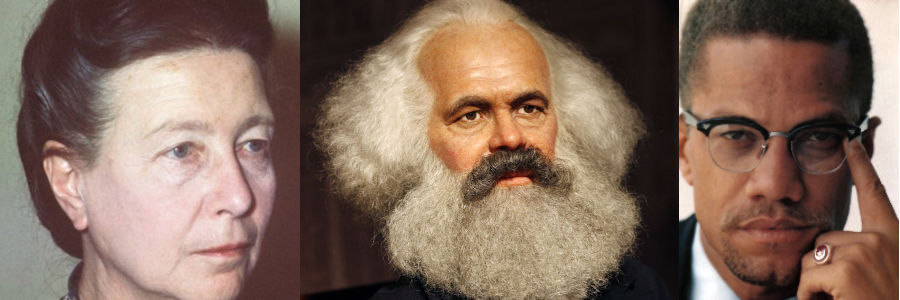
Hullo Simone de Beauvoir, Karl Marx, and Malcom X. These arguments have never been cited before.
Establish the position that this is not normal work.
Because saying it makes it so, and prostitution provides no social benefit. You know what else is not normal work? Juggling astronauts who prepare tax statements on weekends.
I used to give my undergraduate students policy assignments that forced them to consider and cite supporting and opposing views with the instruction that if you cannot find information opposing your position, you have no justification in maintaining your position and in any case your bias is showing.
Explain how it comes and is justifiable that a vast majority of those buying are males of stable income and those bought and sold are mostly female, poor, and disproportionally of colour.
It comes this way because that’s how power structures operate. Do I think the guy hand-washing my car really wants to be washing my car? Do I believe that he feels self-actualised?
If men of power were more interested in homosexual encounters, there would be more male sellers, but if statistics are correct, only 10% of the population is gay, so it would be unusual for it to be otherwise, 90% of men preferring female sex partners.
Returning to Capitalism for another moment, this is why prostitutes are mostly poor, and the people of colour comprise most of the poor, so in effect, this is double counting. Clearly men without income would—pretty much by definition—not be able to pay for sexual services.
This bent toward poor and of colour remains true of all prostitution.
This is not true. In fact, most high-class call girls in the West are white, many of whom who are attending or have attended university and some who are college graduates.
This aside, like ALL capitalist endeavours, it is about class, race (and sex) acting simply as additional classifiers.
She makes an argument that the abolitionist movement consists predominantly of white feminists.
I have never heard this argument, but it makes sense that someone might make it. These are the women with time on their hands to perform these duties. Who is going to work 3 jobs to make ends meet and have time to pitch in here?
In any case, this assertion can be verified. What proportion of the organisations are of whites versus coloured—and how are we defining white and coloured in the first place. This has always been an awkward taxonomical choice. Perhaps the distinction is between so-called cultured women and the hoi polloi.
She continues with the advice that you need to make your opponent ‘explain why no amount of privilege shields women from violence‘.
I fail to see the relevance of this point. Is there some amount of privilege that shields men from violence?
Wait, there’s more. She clarifies the privilege point, arguing that so-called high-class escorts or independent dominatrixes are raped, too.
Of course, this doesn’t address proportionality. Again, this is arguing from anecdote. Accountants are raped. Retail workers are raped. Doctors are raped.
How many client encounters do these women have in total, and how many rapes occur as a proportion of this total? Would making this illegal reduce the number or rapes? What about the proportion of rapes?
How many poor women are raped independent of their profession? Are poor women raped or subjected to violence more often than more affluent women? Are women of colour subjected to more violence than so-called white women?
Someone needs a lesson in comparative social statistics. Whilst I’m at it, I recommend reading Damned Lies and Statistics: Untangling Numbers from the Media, Politicians, and Activists and More Damned Lies and Statistics: How Numbers Confuse Public Issues, if not the original classic How to Lie with Statistics. Though given the paucity of citations in favour of anecdote and oblique references, this may prove to be a bit premature.
Don’t let them divide prostitution into good and bad.
Liberals and Leftists who argue that branding all prostitution as violent and exploitative does a disservice to happy, consenting sex workers and their sexual agency.
She asserts that the happily prostituted woman in non-representative.
And so this minority of so-called ‘good prostitutes’ should be swept under the rug and ignored, their livelihoods be damned. They are a statistical anomoly, a rounding error. Fuck them and the horses they rode in on. They are in the minority, and so their voice deserve to not be heard.
Continuing, she notes that even where prostitution is legal, trafficking exists.
This simply underscores the problem with conflating human sex trafficking with prostitution. This line of argumentation is like noting that even where manufacturing or farming is legal, there are still slavers and slaves. So the solution, it seems, is to make all manufacturing and farming illegal because some people employ forced labourers.
Women do not have the power to weed out the riffraff.
Whilst arguing that we should lump all ‘classes’ of prostitutes in a single heap, we should cherry pick the worst case metrics. Elly cites a number of customers (Johns, punters) at 10 to 20 men per night. This is clearly representative of the lowest end of prostitutes as well as high-volume brothels. This is not representative of independent call escorts and girls, for whom 1 to 3 or 4 is a more likely range for a day.
Out of nowhere, she makes a claim about ‘John’s and their hatred for [sic] the prostitute’ that ‘prevents the creation of a magic shield that keeps her safe and happy’.
Follow normal statistical expectations and laws of large numbers, it would be curious if for some reason prostitutes had a different response profile.
I would guess that of sex-trafficked women, the figure would be closer to 100%, as I would expect of any slave.
In an attempt to make an emotional connection, the video closes with quotes by some women with industry experience. Apart from again being anecdotal, I am pretty sure one can be fairly certain that selection bias is in play here as well—especially in light of her advice to deflect attention to ‘studies that underscore the negative aspects of prostitution’.
I am going to take one for the team—TOFTT in the parlance of the hobby—and listen to the next in the series. To be fair, producing content and video for Youtube takes a lot of work and commitment. I don’t mean to undercut Elly’s ambition or even her position. I just don’t think it’s been well-considered and is rife with unnecessary bias. As I’ve said, it feels like she has come to a position emotionally and is attempting to build a structure around it. However, structure does not equal logic.
After watching the video, I commented, and Elly indulged me in a series of exchanges, which I’d like to address here. I had only read the first question and wrote a response, intending to answer the remaining issues here. Unfortunately, Elly had provided additional context, so my response was slightly off base. My errata is here.
My position was in the form of the question: would women be more safe or less safe if prostitution was illegal?
When I read the rest of her response, I noticed that she is an advocate for asymmetry in favour of the woman, making it illegal only to purchase sex but not illegal to sell it. Canada uses this model. Let’s look at this for just a few moments and then reflect by analogy.
Firstly, this does absolutely nothing to kerb the inherent violence against prostitutes. The ones who continue this line of work are faced with the same client pool they had at the start. I could even pose the argument that some of the non-existent good guys might self-select out leaving the bad apples to rule the roost. I guess we’d have to see.
Secondly, let’s look at this technically by analogy. Say I am a baker. That’s how I support my family. And let’s say that a law is passed to make the buying of baked goods illegal but not making it illegal to sell baked goods. How does this not negatively affect my livelihood? How is this in any way fair that my source of income has been cut off? Answer: It’s not. There is no difference to this scenario and that of the prostitute who is free to offer her services for sale but making it illegal for someone to actually pay her for her services.
Commodification of humans. Elly has a schism here as well. She strongly opposes prostitution on these ground, yet she is somehow fine (or at least relatively more fine) with other forms of human commodification. In fact, she makes a distinction that I don’t make.
Levels of certainty. I am accused (perhaps too strong of a verb on my part) of failing to distinguish between the levels of certainty in waiting tables versus prostitution, but I feel this is akin to making perfection the enemy of the good. I do understand that these women are relatively more vulnerable, and I do understand they have a higher degree of risk. I also understand there is an element of risk driving my car to work over walking, but it does not follow rationally that I walk instead of drive simply because of some statistical delta.
Shades of grey. We both agree there are shades of grey, but then continues by saying that because it is too difficult to parse, say, prostitution from sex trafficking, so why bother. Just pretend it’s all the same, and fuck the collateral damage.
Women in full control. This is where I can’t even comprehend. How is this a criterion? I have to wonder where is it that anyone has full control (apologies to Sartre). I don’t have full control. I am not even sure what percentage of control I do have—90%, 80? I might agree that I have more control than some representative prostitute, but then I’d have to ask on what dimensions is this evaluation being made.
Consenting women under duress. So we return to this: [H]ow freely an independent prostituted woman is consenting to sex with a buyer [is]. Again, Elly makes a false distinction based on culturally constructed biases between the nature of the work, in the case of prostitution, sex, and the nature of some other work, say, accounting.
Not to be flippant, but if I am a prostitute and I do not consent to sex, I don’t get paid, and my bills pile up. If I am an accountant and do not consent to do your taxes, I don’t get paid, and my bills pile up. The same level of coercion is in place.
Perhaps the distinction is corporeal. But this is not what is being said. One can forcibly have sex with a woman—this is called rape, and it is already illegal—, but one cannot forcibly force someone to do your taxes.
Social safety nets. This is the last topic, and again there is no panacea. If the reason a woman becomes a prostitute is to simply feed herself or her family, then there are social solutions that most people would not begrudge her of receiving, but if that reason is to support a drug habit, that number drops precipitously. And one can argue that she should just stop. Of course, these people have no idea what it means to be an addict. And if you live in the US, you’ve got a better chance of becoming president than getting any meaningful help, and any help you might receive will come with heavy doses of moralising and shaming. You might as well just try to make it on your own.
So, now I’ve gone and done it. I thought that my commentary on prostitution would be a one-off. However, in researching arguments against prostitution, I happened upon this blog, which led me to videos on Elly Arrow’s Youtube channel. To be fair, she self-identifies as ‘a radical feminist from Germany’, and although there are many cultural similarities between the US and Germany, I could be missing some urgency not present here in the US. Please visit her channel and decide for yourself.
At the start, it seems we have many things in common. She Elly declares, ‘I am the humanist, atheist, pro-lesbian, sex industry-abolishing, gender-critical, radical feminist Liberals and Conservatives warned you about’. Whilst, I am not a Humanist, as I feel this is too narrow of a focus on the larger system, I am an atheist, pro-lesbian, gender-critical, and radical, though perhaps not feminist, as, like the term ‘terrorist’, it’s lost all meaning because it’s been coöpted by so many different factions. . I do have to ponder how one can simultaneously be gender-critical and pro-lesbian or a feminist, as both of these rely on gender identity, but I’ll save this for a possible future topic.
Let me get the ad hominem stuff out of the way first. Perhaps she mentions on her blog or in other videos how she came to this place, but I’d like to understand her experiences and motivations that brought here to this conclusion. She says she used to feel differently, so I’d also like to know how she formulated that conclusion, too. It is apparent that she reads a script, which is distracting. Even the choice to read can be edited to sound more natural. It would also make the presentment more succinct. It would also be useful if she would upload her transcripts to the videos so we didn’t have to rely on the auto-translate feature. Pro Tip: This would also help with search indexing and findability.
How To Make The Case For Prostitution Abolition
In this video, Elly gives good advice on how to engage in a ‘debate’.
Make sure your opponent really wants to debate.
Emphatically, yes.
Don’t try convincing an opponent all at once. This is a complex issue, and it is unlikely that you will succeed in countering all facets in one conversation.
Yes. This is the basis for propaganda and marketing alike. Chip away and win small battles before you worry about the war.
Assume the other side has good intentions.
Good intentions are not necessarily relevant; rather, assume they have a reason for their convictions without recourse to good or bad intentions. What would be an example of bad intentions in this arena anyway?
Don’t antagonise your opponent.
Indeed. This is likely to lead to escalating commitment, where they dig in their heals and double down.
No ad hominem attacks: Attack the view, not the person.
Solid advice. Continue…
Change minds on the fence.
Sure. If you are in some context where you’ve got onlookers or evesdroppers, make your points, and take wins where they fall.
In the midst of this setup list, Elly slips in some irrelevant commentary about pimps. This is a related but distinctly separate side issue. Later, she tries to conflate sex trafficking and prostitution, which is again a tangential concern but can be resolved independently. In policy, this is known as scope or specificity. This is an intentional misframing of the argument. Don’t fall for this ploy and adopt this frame. You’ll lose the debate by not recognising that she’s switched domains.
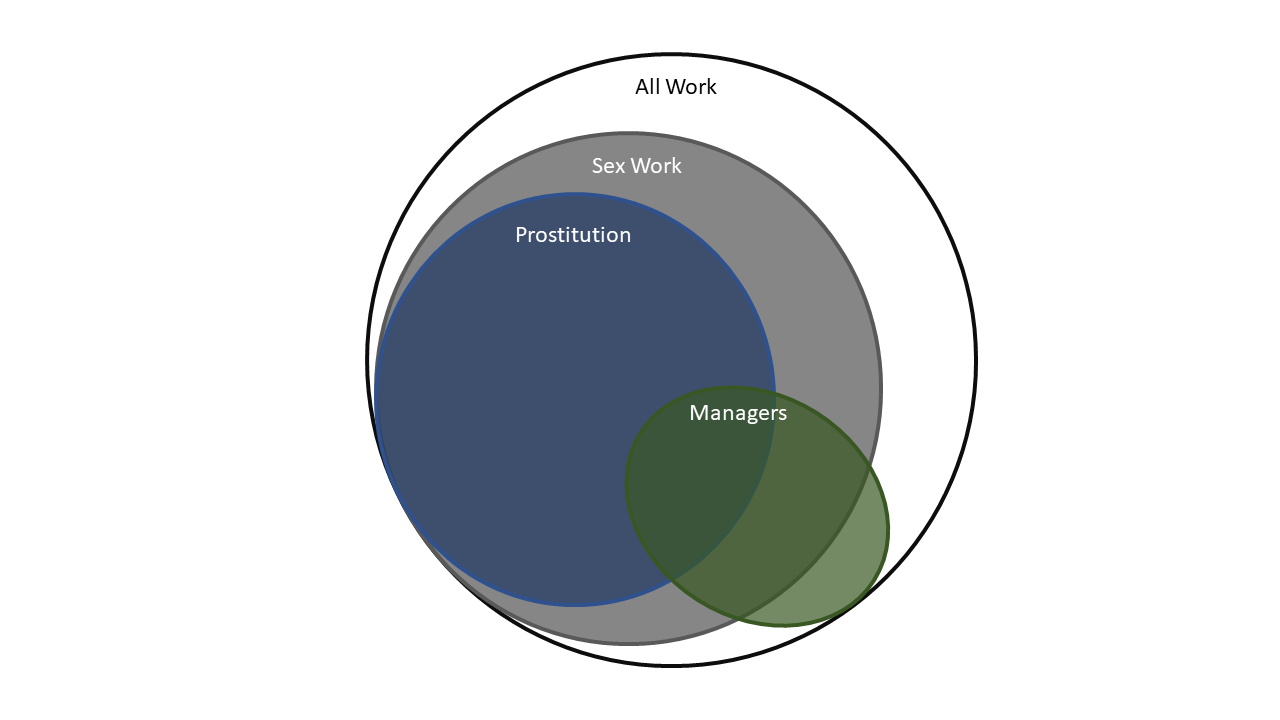
Allow me to illustrate this:
We start simply with a canvas of all work.
Venn Diagramme: All Work
Then we add ‘sex work’ as a subset of ‘all work’.
Venn Diagramme: Sex Work
Then, let’s add prostitution as a fully contained subset of sex work (and all work). Again, clearly, this is not to scale. Although sex work can be subdivided into categories besides prostitution, cam girls, phone sex operators, pornographic actors, and so on, and some women may operate in more than one of this subcategories, I will ignore them for the sake of this illustration.
Prostitution can be future subdivided into categories of streetwalkers, escorts, call girls, and so on, each sharing aspects whilst retains distinctions. Besides distinctions in services and autonomy, the ranks comprise of women from different socio-economic classes.
Venn Diagramme: Prostitution
Next come ‘pimps’, but before we get to them, let’s recognise for the moment that these people—for better and for worse—provide a supervisory or managerial function. ‘Managers’ exist outside of prostitution, inside the sex industry and out.
Venn Diagramme: Managers
Within the sex industry, and particularly within the subset of prostitution, these managers are called pimps, so we’ll focus our attention there. As depicted, not all and perhaps not most prostitutes have pimps. Presumably, there are pimps, if even by some other name, who ‘manage’ sex workers who are not otherwise considered to be prostitutes.
Venn Diagramme: Pimps
Now that we’ve established that pimps are not involved in all prostitution, let’s step back for a moment before bringing all of this together. First, let’s recognise that there exists a general category of human trafficking. These humans might be domestic workers, manual labourers, or sex workers.
Venn Diagramme: Human Trafficking
But for the sake of discussion, let’s limit the scope to the subset that is human sex trafficking, again noting that not all prostitution involves human sex trafficking.
Venn Diagramme: Human Sex Trafficking
Finally, let’s look at the final diagramme. Here we see the overlaps among the entities, and we can see that, theoretically, we can formulate a policy solution that addresses the deeper exploitation without disrupting the broader order of things.
Venn Diagramme: Complete
In the end, one cannot simply conflate either human sex trafficking or pimping with prostitution. This is an attempt to win an argument by playing slight of hand with a language shell game. But at no time does Elly create a compelling argument as to why prostitution somehow does not fall into the category of work.
I am not going to enter into debate at this time the issues that Capitalism and Colonialism introduce into the world at large, though I feel that the real debate lies there.
Moreover, looking at the length of this post, I am going to address my response to Arguing for Abolition Pt. 2 – Talk About Class in another entry, hopefully, either today or tomorrow.
DISCLAIMER: This post is a veritable rant. It promises to go off script or at least be oblique to the recent themes I’ve adopted. It is also a bit late, missing the heels of the FOSTA debacle in the United States.
Prostitution is immoral. It exploits women. It exists in a world of violence. It objectifies and creates a rape culture. It is a vector for transmission of diseases. These are the main arguments against it, yet many of these are arguments against Capitalism itself.
In fact, most arguments of prostitution are criticisms of capitalism or conflated claims to some tangential activity. The most popular conflation is with sex trafficking, ‘modern-day slavery and involves the use of force, fraud, or coercion to obtain some type of labor or commercial sex act‘.
Prostitution is a category of sex work, which includes dominatrixes in the BDSM space, porn actors (and actresses if you expect archaic sexist jargon), phone sex operators, cam models. Nude modelling is somehow tasteful and not readily included in the collection.
The World Health Organisation (WHO) defines sex workers [PDF] as ‘women, men and transgendered people who receive money or goods in exchange for sexual services, and who consciously define those activities as income-generating even if they do not consider sex work as their occupation‘. I won’t comment on why they feel the final dependent clause is relevant to the definition. Perhaps it’s in the realm of the aspiring actors or screenwriters who wait tables but don’t consider themselves to be waitstaff.
Returning to the main arguments in turn:
Prostitution is immoral. As a subjectivist, this is a difficult argument to win. Although morality is a human social construct, many people believe otherwise, and even those who don’t ascribe to the notion of an objective morality still adopt and abide by the fabricated moral codes generated by the worldview of, say, Christians or Muslims or some other sect who claim to have direct insight into such codes.
Nothing is immoral that society doesn’t declare to be immoral.
Nothing is immoral that society doesn’t declare to be immoral. In the United States, the institution of slavery—what I call hyper-capitalism or a capitalist’s wet dream—was deemed moral by most. Eventually, the morality was hotly debated, and now, it is considered to be immoral. Time changes everything. In some circles, slavery is still considered to be moral. In other circles, it has morphed into wage-slavery and because money is exchanged within a frame of a labour market, it escapes the definition.
Excepting for local norms, prostitution is not inherently more immoral than banking or retail sales.
Prostitution exploits women. Excepting that there are male prostitutes and sex workers, it is commonly believed that these people are (somehow) less likely to be exploited, so I’ll keep this focused on women. First, it is important to separate prostitution from human sex trafficking. This is not the topic, and it’s a problem with specificity. If you feel that sex trafficking is immoral and should be illegal, that’s fine; but don’t throw out the baby with the bath water. Focus on the actual problem. <sarcasm>If you want to prevent all women from being exploited, lock them all up in monasteries. Problem solved. </sarcasm>
Prostitution is not inherently more immoral than banking
If one wants to discuss exploitation, let’s discuss a system designed such that a person needs to earn money to survive. Period. Full stop. If you buy into the capitalist worldview, then, that in order to survive a person chooses to be a marketing executive, a customer service representative, a janitor, or a prostitute, is none of your concern.
I have heard many arguments put forth that these women should get ‘real jobs’, jobs that pay minimum wage (or less) and have no other benefits, jobs where it would take a week or more to earn what they could in a day or less. That’s not even rational.
Prostitution exists in a world of violence. Despite trends, the world is still a violent place. Part of the higher probability of violence in the realm of prostitution exists because these women are marginalised by moralists. Even where prostitution is legal, it is still often viewed as immoral. They have little recourse to the legal system. They can’t organise. They are forced underground. Sunlight is the best disinfectant. Don’t force these women into alleys and underground.
In the US, recent FOSTA and SESTA hysteria have disarmed women from the tools they used to navigate their environment. They could share intelligence related to which men to avoid for one reason or another. Other tools have cropped up to facilitate this cooperation, but these tools benefit from network effects. The more people having access to the information clearinghouse, the better.
Prostitution objectifies women. I’ll concede this point straight away but not without noting that many things objectify women: the beauty industry, the entertainment industry, the marketing industry in general. If as a society we can resolve objectification and prostitution is the last holdout, I’m onboard, right there with you. But there is no need to make prostitution the poster child for eliminating objectification.
Prostitution creates a rape culture. To be fair, I have no metrics on this, and I am going to pass, but not without saying that it seems to be an implausible claim. And I have read counterclaims anyway.
Prostitution is a vector for the transmission of diseases. Indeed. And driving is a vector for traffic accidents. Of course, given higher frequencies of an activity, one would expect a greater number of outcomes—even with the same probability, the additional exposure may result in hitting this undesirable lottery. And the variety of partners with unknown sexual histories is problematic.
However, a mitigating factor is education—and not simply moralistic lip service. Women need to understand the risks and understand how to diminish it. Yet again, being marginalised does not necessarily allow a woman to be empowered. A client can insist on unprotected sex. If he forces his hand, no one is going to believe that a prostitute can be raped. As with sex trafficking, rape is its own subject and is only part of a larger conversation.
I was winding down, but I found a related quote I wanted to address:
Geena Leigh was in prostitution for 19 years from the age of 18. In her submission to an Australian inquiry into the regulation of brothels, she said prostitution: “has this way of stealing all the dreams, goals and beautiful essence out of a woman. During my years in it, I didn’t meet one woman who enjoyed what she was doing. Everyone was trying to get out.”
Evidently, lack of enjoyment in one’s employment is not limited to prostitutes. The is the problem with fundamental attribution bias. A recent Gallup poll cited that 85% of people hate their jobs. Maybe Gallup only interviewed prostitutes, or perhaps the 15% who liked their jobs were the only ones who weren’t sex workers.
Well, there went my morning…
For those wondering (and who’ve gotten this far), the impetus for this post was some other blog posts I happened upon in WordPress’ Reader.
Prostitution (A post from another one-track blog. If only I could remain as on-track.)
Prostitution is a sin but are these prostitutes the real sinners? To be completely honest, this was one of my favourite titles, but for the reasons I’ve mentioned above, the content doesn’t quite live up to the promise as it devolved into human sex trafficking and rape, each of which can exist without prostitution. Besides, it’s not that prostitution is a sin. In the Bible, Proverbs 23:27 states: ‘For a prostitute is a deep pit; an adulteress is a narrow well‘, but it is important to note that the term prostitute comes from the Hebrew, זוֹנָ֑ה, which simply means a fornicator. So the offence is not that a woman accepts money in exchange for sex; it’s that she has sex with someone for whom she is not chattel, who is not her husband. As an atheist, I’ve read the bible more and deeper than most Christians. If more Christians would actually read the bible, there would be fewer Christians.
Why “Sex Work” Is Not Work Another non sequitur of a post where the content doesn’t deliver what the title promises. The conversation quickly devolves into cherry-picked, edge case examples of tangential issues unrelated to prostitution itself.
OK, so this isn’t at all about Foucault’s rhetoric. My main riff this year is the assertion that there is no Truth, only rhetoric—or should I rather say Rhetoric. I created a Reddit post asking for references to other philosophers (or whomever) who had made a similar claim, to which I was offered Vico and Rorty. Unfortunately, there were only two responders, and their assistance was superficial.
What I did encounter by one of the responders was a criticism similar to that levelled at Foucault, hence the inspired title of this post. This critique at its essence is that having proposed no positive solutions to the issues I point to, I cannot defend my position. In fact, as with Habermas‘ fault with Foucault, evidently, I have disarmed myself.
I find this line of argumentation weak tea at best. To argue that one has no claim to declare something incorrect if they don’t have a correct replacement for it is absurd. For example, I don’t know what 13,297 ÷ 1,492 equals arithmetically; but I can assert with confidence that it does not equal 2. Moreover, to criticise, one doesn’t need the ‘ability to generate positive alternatives’.
“There is no truth but rhetoric.”
So when I say there is no Truth but rhetoric (for non-ontic concepts), I am making a Truth statement. As such, this assertion—by my own admission—is only as strong as the rhetoric I can muster to its defence. Alas, my defences are weak, and so the argument fails. Were I to make a stronger argument—a more convincing argument—, it might be accepted as Truth.
Evidently, my first mistake was to separate ontic and non-ontic, which is to say things existing apart from their given names and those whose existence is entirely fabricated. An ontic thing might be a stone, a tree, a planet, a star, or the sensation of pain. These things exist even without language, a label, or an observer. As Saussure and other structuralists have noted, in semiotics, there is the signified (or referent) and the signifier—the object and the identifier. In the context of language, these are tautological.
There is no spoon.Non-ontic things are conceptual, freedom, truth, justice, rights, gods, and so on. I may opt to replace non-ontic with language-contextual or some such to sidestep the taxonomical quagmire. Or perhaps I’ll adopt the dichotomy of concrete versus abstract. These concepts do not exist outside of language. They are wholly constructed in a complex system created by humans—and humans whilst humans have done OK with complicated systems, they have an abysmal track record when it comes to complex systems. By analogue to the physics of solids, there is more space than atoms, and the atoms and their constituent particles are in constant motion—zero-degrees Kelvin, be damned. Our senses perceive something to be there, but as in that scene in The Matrix, ‘there is no spoon‘.
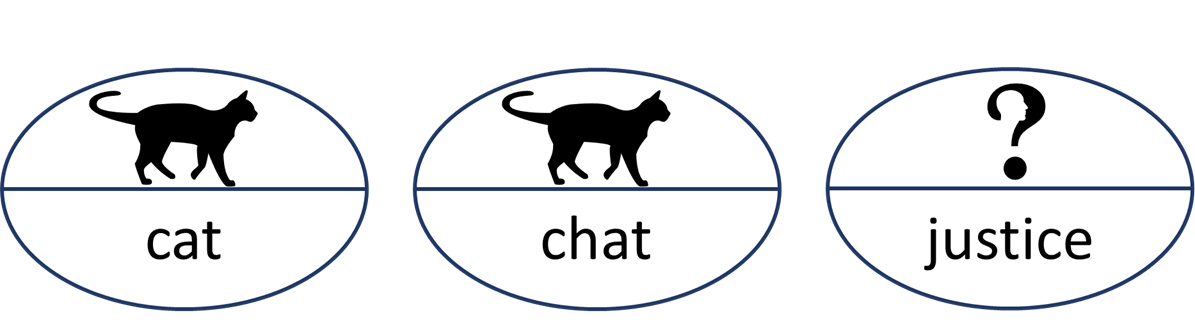
In my mind, leveraging Saussure’s ideas are useful to depict the differences in the concrete versus the abstract.
The famous painting depicted above illustrates explains the difference between a signifier and a referent. In this image, there is only the signifier. Magritte makes clear the distinction with the text, Ceci, n’est pas une pipe: This is not a pipe. It is merely a depiction of one. To be even more arcane, the image is a signifier to another signifier that in turn refers to the referent.
A sign is the device that encapsulates the concept. It may be visual—an icon (an illustration of photograph) or a written word or even Braille—or it can be spoken or signed, as with American Sign Language. These are all signs.
Notice when one considers a sign that a concrete cat (or in French, chat), it is pretty clear to what one is referring. Above the line, we see the signified, the idea conveyed by the sign. This doesn’t mean that everyone sees the silhouette depicted above, but it is a catlike thing, a feline animal, a mammal, normally with four legs and a tail. Perhaps you are thinking of a particular cat. But to someone with a grasp of the language in which you are communicating, when you say cat, there is little room for ambiguity. In fact, if you are trying to teach someone a different language, say, French, you could show them the cat with the chat signifier, and they would grasp your meaning almost instantaneously.
All language is arbitrary and socially constructed, so there is no connection between the words—say, the spelling or shape of a word—and its referent. The words cat and chat do not look like cats.
There are concrete things that cannot be so readily translated into an icon; for example, the wind. However, one could fairly quickly be able to articulate or gesticulate, as the case might be, the notion of wind. The same cannot be said for the abstract concept of justice.
As I’ve mentioned before, justice, especially one of the restorative or retributive varieties, is a euphemism for vengeance. The distinction is supposed to be found in the intent, but intent cannot be known; it can only be inferred. And, speaking of Foucault, justice can only be delivered from a power position.
But the notion of justice relies heavily on social construct; it has geo-spacial dependencies. What is considered to be just in ancient times may not be considered just now. What is considered just in one country might not be considered to be just in another. And this is more than a difference in instantiation. It is due to the arbitrary if not capricious articulation of a nebulous concept.
Returning to Foucault, (Christian apologist) Nancy Pearcey declares his stance paradoxical: “[when someone] states that it is impossible to attain objectivity, is that an objective statement? The theory undercuts its own claims.”
First, Pearcey merely asks a question about objectivity, but it doesn’t matter. The answer is: this may as well be an objective statement, but it’s just another language game. Wittgenstein (and Russell and Heidegger and Rorty…) was on the right path when he pointed out that the ambiguity inherent in language provide cover for all sorts of mischief. I’m only pretty sure that Derrida might yield paydirt as well. Besides, let’s pretend for a moment that there exists some objective truth, there is no reason (language game; except in accepting the broadest definition, reason is a capability elusive to many if not most humans) to expect that this truth is either accessible or verifiable anyway. The best one can do is to pose a more convincing rhetorical argument.
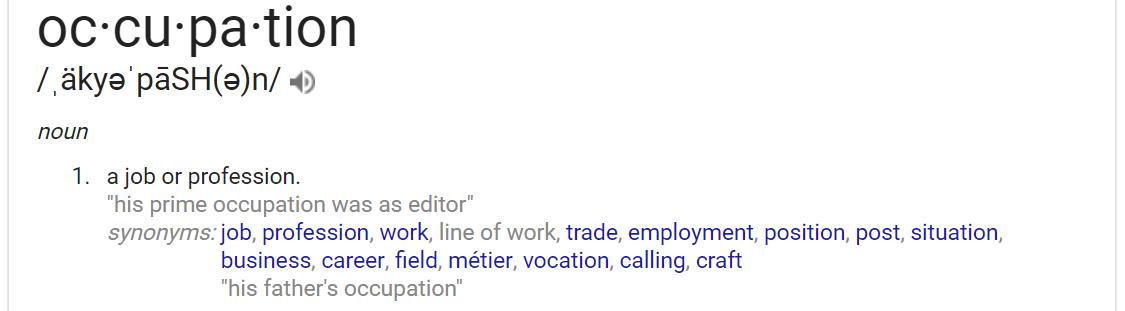
Reason /ˈrēzən/ (noun) the power of the mind to think, understand, and form judgments by a process of logic
A similar critique has been advanced by (another Christian apologist) Diana Taylor, and by Nancy Fraser who argues that “Foucault’s critique encompasses traditional moral systems, he denies himself recourse to concepts such as ‘freedom’ and ‘justice’, and therefore lacks the ability to generate positive alternatives.”
So whilst I’ve just managed to stream-of-consciousness my contention, I am not in a position to resolve anything. For now, I’ll settle for documenting my position as I continue to search for other supporters and formulate a more cogent response, a more robust rhetorical presentment.
If anyone can direct me to resources relevant to my position, let me know in the comments. I’ll appreciate it. If you don’t agree—which would be expected, as this is the accepted orthodoxy—feel free to comment as well.
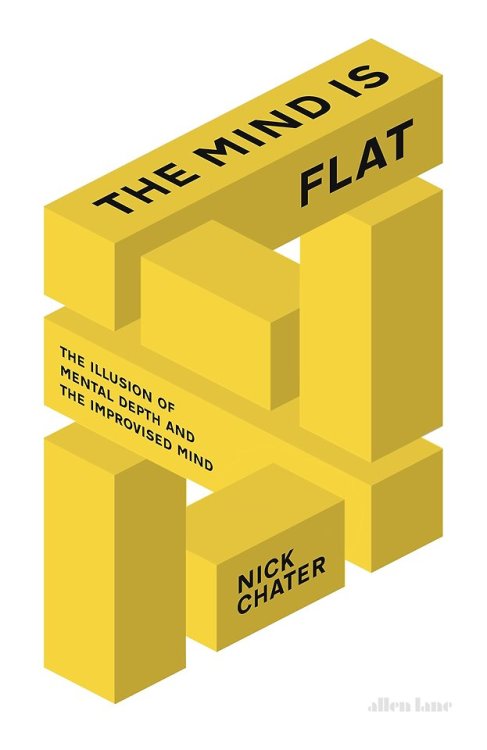
So, given the wide gap between the last post and this, it may be apparent that I’ve been otherwise occupied. I’ve been a bit distracted, but, among other things, I’ve just commenced reading The Mind Is Flat by Nick Chater.
Although this is more about the pseudoscience that is psychology, there is a bit of a philosophical, subjectivist undertone, and I find the political and jurisprudent implications interesting.
No amount of therapy, dream analysis, word association, experiment or brain-scanning can recover a person’s ‘true motives’, not because they are difficult to find, but because there is nothing to find. It is not hard to plumb our mental depths because they are so deep and so murky, but because there are no mental depths to plumb.
Of course, this perspective is right up my street: There is no there there, and this is where it becomes problematic: in the US anyway, much of law is based on the concept intent and motives—and the underlying belief that these can be sussed out. But in reality, as it were, it’s not much more than rhetoric obfuscated with smoke and mirrors.
Our ‘computational innards’ are not a churning sea of experiences, feelings, beliefs, desires, hopes and fears, whether conscious or unconscious. Our mind spins stories about how we work – driven by motives, beliefs, percepts, moral norms, religious precepts. And they are such compelling stories that we can imagine that they are true, or partially true, or surely at least along the right general lines.
From the perspective of evolution, humans are storytellers. More to the point, humans are storylisteners, and they can be are influenced by compelling narratives. These narratives range from a sense of identity to the yarn about history and progress. As Foucault might have noted, people in positions of power leverage these narratives and spin their own in order to maintain their advantage.
In practice, humans are mere parsing machines. Their brains may not work precisely like a computer, but practically, the brain is an interpreter and it generates ‘consciousness’ based on experiences and sense data. Input a new narrative and the brain will interpret it in context with other experiences—or as Chater puts it, ‘motives, beliefs, percepts, moral norms, religious precepts’.
Marketers, politicians, and other hucksters use this to their every advantage.
Well, enough typing for the moment. Back to reading…
I have no idea who wrote the headline for this piece—the title I borrow for this post—, but they didn’t read the article. I was wondering what educated person in the past 10 to 20 years still believes in the perfectly rational actor? The larger question is why educated people believe that humans are on balance more rational than not. It’s not particularly well-written, but, I am a sucker when it comes to articles about cognitive biases.
I have no idea who wrote the headline for this piece, but they didn’t read it. I was wondering what educated person in the past 10 to 20 years still believes in the perfectly rational actor? The larger question is why educated people believe that humans are on balance more rational than not. It’s not particularly well-written, but I am a sucker when it comes to articles about cognitive biases.
As with other concept nouns, rationality feels like it has weight, but it really doesn’t. If we so limit its definition, we can claim that the average person is rational on average, but that’s about it. Of course, almost everyone has ‘the quality of being endowed with the capacity for reason’, but that’s a bit too circular for my comfort.
Keynes understood the absence of rationality when he produced his macroeconomic opus and included a factor for animal spirits, yet adherents to classical and neo-classical economic theory continue to defend their models as good enough even in light of Nobel Laureate, Joseph Stiglitz, who showed that the models needed to follow chaos theory insomuch as a tiny almost imperceptible variance in an input could yield difference in orders of magnitude or even direction, but that’s a horse of a different colour.
DISCLAIMER: I suppose I should have saved this as a draft and finished it later, but I’ve been so otherwise occupied as of late, it will have likely ended up in the bin with the other half-commenced posts, so here it is in its raw stream of consciousness form.


![dunning-kruger-graph[1]](https://philosophics.blog/wp-content/uploads/2018/07/dunning-kruger-graph1.gif)












![745_600_10964maybelline-color-elixir-gloss-sohelee1[1]](https://philosophics.blog/wp-content/uploads/2018/07/745_600_10964maybelline-color-elixir-gloss-sohelee11.jpg)

![There_is_no_Spoon[1]](https://philosophics.blog/wp-content/uploads/2018/07/there_is_no_spoon1.jpg)
![1bb[1]](https://philosophics.blog/wp-content/uploads/2018/07/1bb1.jpg)


 Philosophics