<soapbox>
I’ve never been comfortable with the term ‘peers’, not since I first encountered it as a grade schooler in a civics or social studies course. It felt like nonsense at first utterance, but much energy is expended indoctrinating children and adolescents.
Thinking about the Frege–Geach problem has trebled my interest in ontological grammars. It’s also got me thinking about the ontology of peer groups. I’ve always been an eccentric, so I never felt I had any peers. Sure, I’ve had friends, colleagues, bandmates, and acquaintances I’ve genuinely liked and respected, but none were peers. Our connexions might best be described as ‘thin’. We connected through shared work, music, interests, and so on, but peer would have been stretching it.
So, what do I feel qualifies as a peer? And what is a standard definition? I suppose we should start with the latter.
OED: A person who is associated or matched with another; a companion, a fellow, a mate.
Fair enough. This definition works fine. The devil remains in the details. What does it mean to be associated or a match?
As a moral noncognitivist, I don’t think the concept arrives trailing clouds of metaphysical glory. But it doesn’t need to. The interesting question is grammatical: what ontological conditions would have to be shared for ‘peer’ to mean something thick rather than merely administrative?
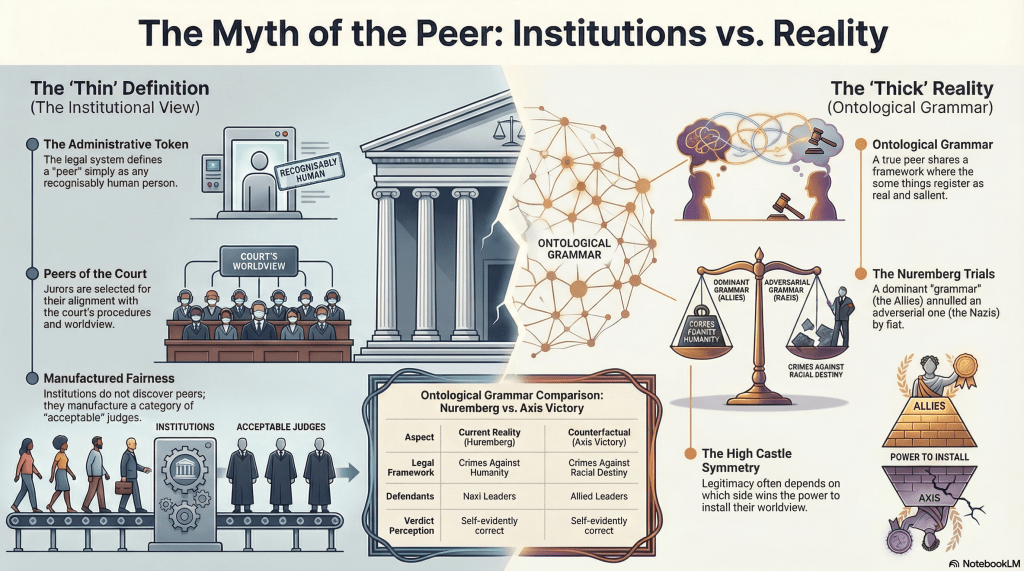
The legal system answers in the thinnest way possible. If you are recognisably human, that’s enough. Close enough for the government. Peer means person. Case closed.
When the system invokes ‘a jury of one’s peers’, it doesn’t care whether they are one’s peers in any thick or serious sense. It needs performative placeholders – tokens. Rather, it needs them to be peers of the court: those sufficiently aligned with its assumptions, procedures, and admissibility rules to reproduce its worldview in the form of judgement.
The court decides what counts as legible, what counts as relevant, what counts as rational, and what counts as legitimate. It does not discover peers. It manufactures a category of acceptable judges and then calls the result fairness. The deck is stacked before the first card is turned.
I like two examples, one historical and one fictional, to make my point.
Nuremberg
This case should be obvious. The peers here are precisely not their peers, but adversaries. The defendants were not tried by those who shared their grammar of legitimacy, history, necessity, authority, or even the relevant category boundaries. They were tried by agents operating within a rival grammar – one that had already classified the defendants’ framework not as a competing ontology, but as criminal pathology.
The Nazi grammar was effectively annulled. Not refuted, not outargued – annulled. And as with more typical civil and criminal courts, symmetry was never the goal. The institution ruled by fiat. I call this ontological imperialism in a yet unpublished manuscript. The dominant system merely declares the adversarial grammar invalid and inadmissible.
The standard legitimation story for Nuremberg is natural law: there exist moral facts so fundamental that they transcend positive law and sovereign authority. ‘Crimes against humanity’ was coined precisely to name offences no ontological framework could render legitimate. The phrase does the work – against humanity, not against a particular legal code or polity, but against the species as such. It presupposes exactly the universal semantic accessibility that the philosophy of language has shown to be unavailable.
Man in the High Castle
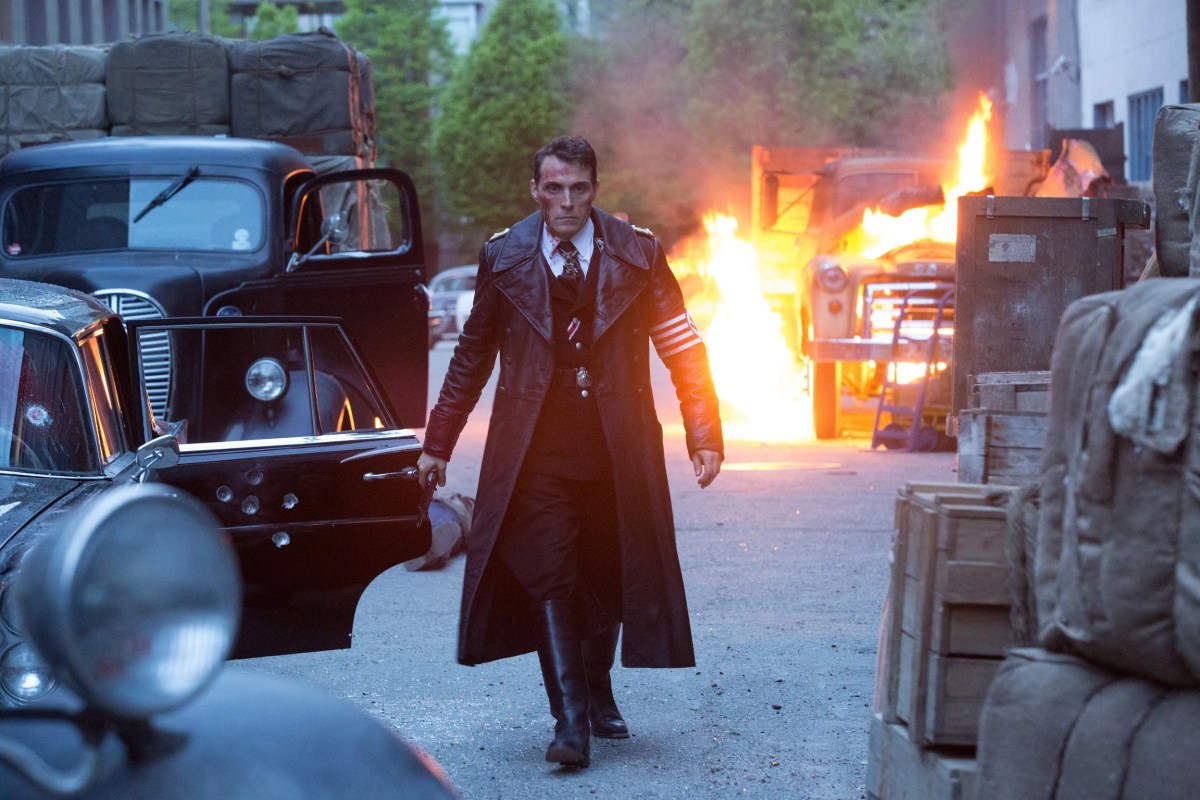
Now switch venues to a fictional universe. Philip K. Dick asks what would have happened had the Axis won the Second World War. The answer, structurally speaking, is: practically nothing — except that a different ontological grammar would now be dominant.
That is the value of the thought experiment. It doesn’t change the species, the cognitive architecture, or the capacity for deliberation. It changes the constitutive act – the moment at which a grammar gets installed as the world’s grammar. And everything downstream shifts with it. In Dick’s world, the inhabitants don’t experience their moral order as imposed or artificial. They navigate it as the background of intelligibility, the way things simply are. The I Ching functions for Tagomi the way human rights discourse functions for a postwar liberal – not as a choice, but as the grammar within which choices become possible.
The counterfactual is devastating because it is structurally symmetric. Had the Axis won, there would have been trials. Those trials would have applied retroactive categories – perhaps ‘crimes against racial destiny’ or ‘crimes against civilisational hygiene’. Allied leaders would have been the defendants. And the verdicts would have felt, to the inhabitants of that world, exactly as self-evidently correct as Nuremberg’s feel to us.
I don’t secretly wish the Axis had won. But the dialectic is worth consideration, and the discomfort it produces is itself the datum. Not evidence that the examination is wrong – evidence that the grammar is working.
So when modern institutions speak reverently of ‘a jury of one’s peers’, I hear not a triumph of fairness but a legitimating fiction. The phrase conceals the fact that institutions do not seek the defendant’s peers. They seek their own. They seek judges formed within the same order, obedient to the same grammar, and willing to mistake its categories for universal reason.
A peer, in any meaningful sense, would have to share enough ontological grammar with me that the same things register as real, salient, and intelligible in roughly the same way. By that standard, peers are rare. Institutions know this perfectly well. Which is why they do not look for them.
They appoint their own and call the matter settled.
</soapbox>
 Philosophics