I’ve been writing. In fact, I’ve been clarifying A Mediated Encounter Ontology of the World (MEOW) and expanding and extending it into a book with a broader remit. This might well be the cover, following the monograph layout for Philosophics Press.
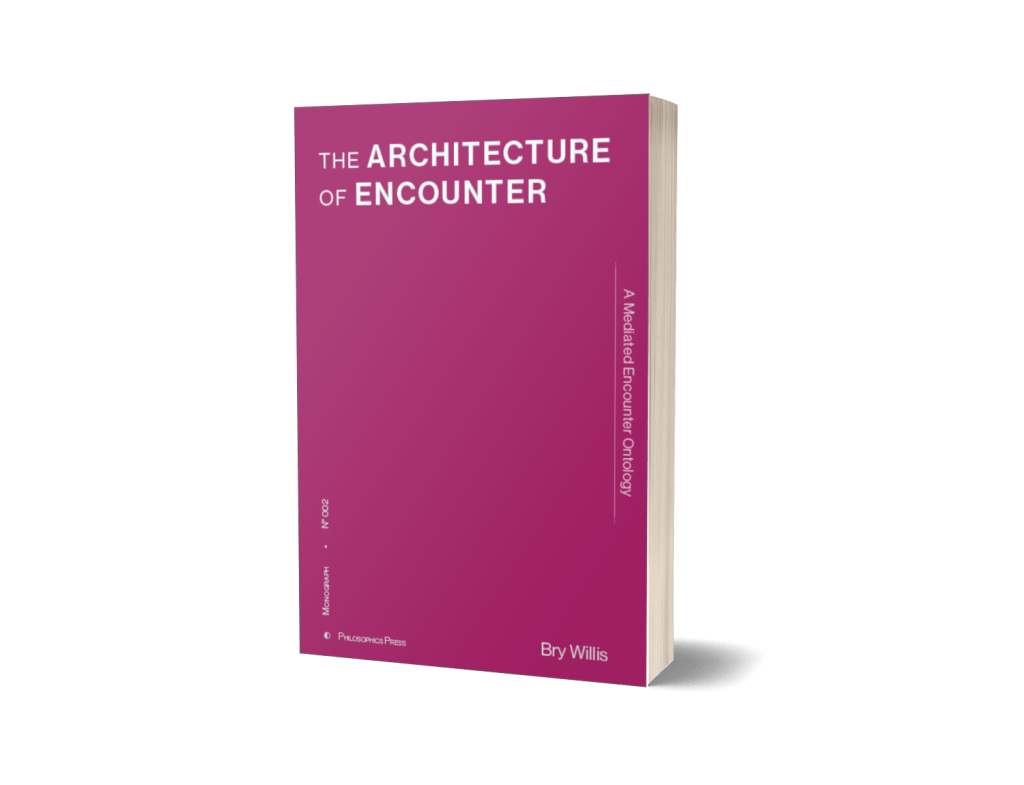
As shown, the working title is The Architecture of Encounter: A Mediate Encounter Ontology. I’ve swapped the slate cover for a magenta in this volume.
So what’s it all about?
I’m not going to summarise the book here, but I’ll share some tidbits. I’ve settled on these chapter names:
- The Mediated Encounter Ontology
- Ontology
- Subjecthood
- Logic
- Epistemology
- Perception and Affordances
- Language
- Social Ontology
- Realism
- Application
- The Normativity Frontier
- Conclusion
Chapter 1, The Mediated Encounter Ontology, is a summary and update of the original essay, which will be included in full as an appendix item for reference, but this update will become canonical.
Chapter 2, Ontology: Interaction, Constraint, and the Rejection of Substance, will describe what I mean by ontology and what my proposed ontology looks like.
Chapter 3, Subjecthood: Modal Differentiation Within the Field, will explain how the subject-object relationship changes, and what a subject is in the first place.
Chapter 4, Logic: Coherence Grammar Under Constraint, will explain what logic is and how it operates in this paradigm.
Chapter 5, Epistemology: Convergence, Error, and the Structure of Justification, will describe what knowledge looks like. IYKYK.
Chapter 6, Perception and Affordances: Encounter as Orientation, extends Gibson’s work to comport with MEOW 2.0 (or 1.1).
Chapter 7, Language: Synchronisation, Ontological Grammar, and Structural Limits, explains how language works and how it limits our perception. We’re not talking Sapir-Whorf here, but what respectable language philosopher wouldn’t reserve a chapter for language?
Chapter 8, Social Ontology: Second-Order Constraint Systems. MEOW has a lot to say about first-order constraints, but there are higher-order considerations. I discuss them here.
Chapter 9, Realism: Cross-Perspectival Convergence and the Invariant Anchor, talks about the real elephant in the room. Since MEOW challenges both realism and idealism, we need to talk about it.
Chapter 10, Application: The Apophatic Mind, is mostly an observation on artificial intelligence as it relates to the mind-consciousness debate, primarily scoped around LLMs and similar machine processes.
Chapter 11. The Normativity Frontier, doesn’t yet have a subtitle, but this is where I discuss issues like normative ethics and morality.
I probably don’t need to tell you how Conclusion chapters work.
I expect to have 3 appendices.
- Summary of commitments, which will summarise and distil key topics – so like a cheat sheet for reference – a bit more robust than a glossary.
- Bibliography of reference material. As this is not an essay, it won’t be chock-full of citations – only a few, where I feel they are necessary. Much of this work represents years of thinking, and in many cases, the attribution has been lost; I remember the contents and not necessarily the attribution. I will prompt AI to fill in some missing pieces, but that’s that. The bibliography attempts to capture the general flavour.
- The original MEOW essay. This is already freely available on several platforms, including Zenodo. Download it here if you haven’t already – or wait for the book.
The rest of the story
This book not only extends MEOW, but it also ties in concepts from A Language Insufficiency Hypothesis and other of my already published and yet unpublished work.
I expect to produce a decent amount of explanatory and support material, though to be fair, I tell myself that every time until I get distracted by the next project. I need a producer to manage these affairs.

 Philosophics