Lakoff, Wittgenstein, and the Quiet Collapse of Literal Language
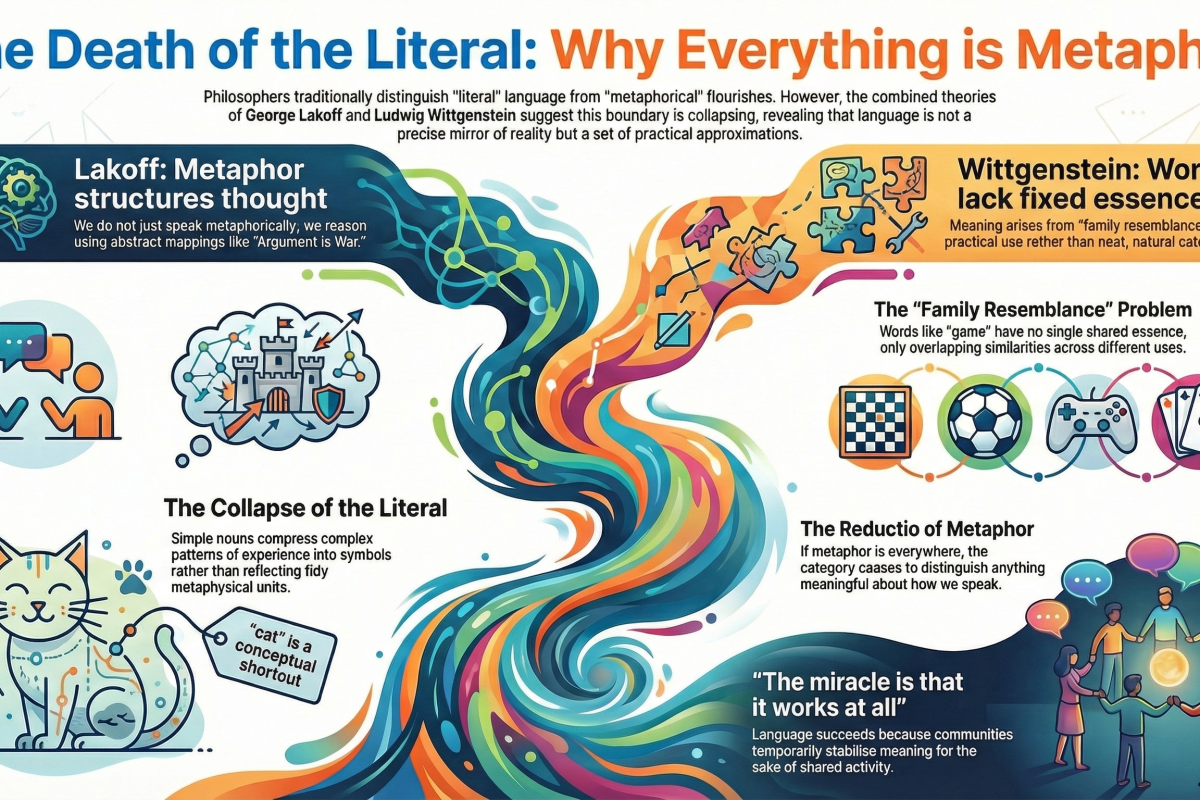
Philosophers have long comforted themselves with a tidy distinction: some language is literal, and some language is metaphorical. Literal language names things as they are; metaphor merely dresses thought in rhetorical clothing.
The trouble begins when one looks more closely at how language actually works.
Two very different thinkers – George Lakoff and Ludwig Wittgenstein – approach the problem from opposite directions. Yet taken together, their ideas produce a rather awkward conclusion: the category of metaphor may collapse under its own success.
Spotify Podcast TBD
Lakoff’s Problem: Metaphor All the Way Down
George Lakoff’s work on conceptual metaphor starts with a deceptively simple claim: metaphor is not merely a stylistic flourish. It is part of the structure of thought itself. We do not merely speak metaphorically. We think metaphorically.
Consider a few familiar examples:
- ARGUMENT IS WAR: We attack positions, defend claims, demolish arguments.
- TIME IS MONEY: We spend time, waste time, invest time.
- LOVE IS A JOURNEY: Relationships stall, partners move forward together, or reach dead ends.
Lakoff’s point is not that these are poetic expressions. Rather, these metaphors organise how we reason about abstract domains. They structure cognition itself. So far, so interesting.
But once one notices how pervasive such mappings are, a problem begins to appear. If abstract reasoning depends on metaphorical projection from embodied experience, then metaphor is not a special case of language. It is the normal case. Literal language starts to look suspiciously rare.
The miracle is not that language fails sometimes. The miracle is that it works at all.
Wittgenstein’s Problem: Words Without Essences
Wittgenstein arrives at a similar discomfort by a different route.
In the Philosophical Investigations, he dismantles the idea that words gain meaning by pointing to fixed essences. Instead, meaning arises from use within human practices.
His famous example is the word game. Board games, sports, children’s play, gambling, solitary puzzles. Try to identify the essence shared by all games and the category dissolves. What remains are overlapping similarities – what he calls family resemblances.
The word functions perfectly well in practice, yet no clean boundary defines its referent.
The implication is unsettling: even apparently straightforward nouns do not correspond to neat natural categories. They operate as practical shortcuts within forms of life.
Language works not because it mirrors the world precisely, but because communities stabilise usage long enough to get through the day.
The Awkward Intersection
Place Lakoff beside Wittgenstein and something odd happens. Lakoff shows that abstract reasoning depends on metaphorical structure. Wittgenstein shows that even ordinary categories lack fixed essences. The combined result is difficult to ignore: the supposedly literal core of language begins to evaporate.
Take a simple word like cat. It seems literal enough. Yet the world does not present us with tidy metaphysical units labelled CAT. What we encounter are patterns of behaviour, morphology, and recognition. The word compresses a complex set of experiences into a convenient symbol.
In practice, cat functions as a stand-in for a stabilised pattern within human life. It is a conceptual shortcut — a linguistic token that represents a distributed cluster of features. In other words, even the most ordinary noun already behaves suspiciously like a metaphor.
The Reductio
If Lakoff is right that much of thought is metaphorically structured, and Wittgenstein is right that categories lack fixed essences, the traditional contrast between literal and metaphorical language becomes unstable.
Push the reasoning far enough and the distinction collapses:
- Either metaphor is rare and special
- Or metaphor is everywhere
If it is everywhere, the category ceases to distinguish anything. It becomes like describing fish as “wet creatures.” Accurate, but not especially illuminating. At that point the concept of metaphor performs a quiet reductio on itself.
What Survives the Collapse
Fortunately, the collapse of the literal–metaphorical boundary does not render language useless. It merely changes how we understand it.
Words are not mirrors of reality. They are tools for coordinating experience. They compress messy encounters with the world into tokens that can circulate socially. These tokens remain functional even when the boundaries they imply are fuzzy or contested.
Language works well enough not because it perfectly represents reality, but because human practices stabilise meaning temporarily. Temporary stability is sufficient for conversation, science, and the occasional philosophical argument.
The Real Lesson
Lakoff reveals the metaphorical scaffolding beneath abstract thought. Wittgenstein shows that even ordinary categories rest on shifting ground. Together they suggest something rather humbling.
Language is not a system of precise mirrors reflecting the world. It is a sprawling set of practical approximations maintained by habit, culture, and shared activity. The miracle is not that language fails sometimes. The miracle is that it works at all.

 Philosophics
Descola provides us with an ontological grammar that explains why, in certain forms of thought (such as analogism), metaphor is not only natural, but fundamental (cf. Diderot).
LikeLike