
NB: I am travelling today, but I still wish to clarify how my ontologies and grammars operate, so I had a chat with, well, ChatGPT – from Bourdieu to Burgess – using an EPROM analogy.
I know that this analogy may appeal more to one with a technical background, but I hope it helps. If you don’t get the reference, just look it up
There is a persistent liberal fantasy that human beings update their beliefs the way laptops update operating systems. A patch is issued. A bug is identified. The system installs corrections.
This fantasy survives despite all available evidence.
What Bourdieu called habitus — durable dispositions structured by early social conditions — is not a folder of opinions. It is firmware. It is the background architecture that determines what even counts as legible input.
You can argue against a proposition.
You cannot argue against the grammar that determines whether that proposition parses.
This is where the EPROM analogy earns its keep.
EPROM — erasable programmable read-only memory — can, in theory, be rewritten. But not casually. It requires exposure to high-energy ultraviolet light. You do not “reason” an EPROM into new content. You blast it.
The durability is the point.
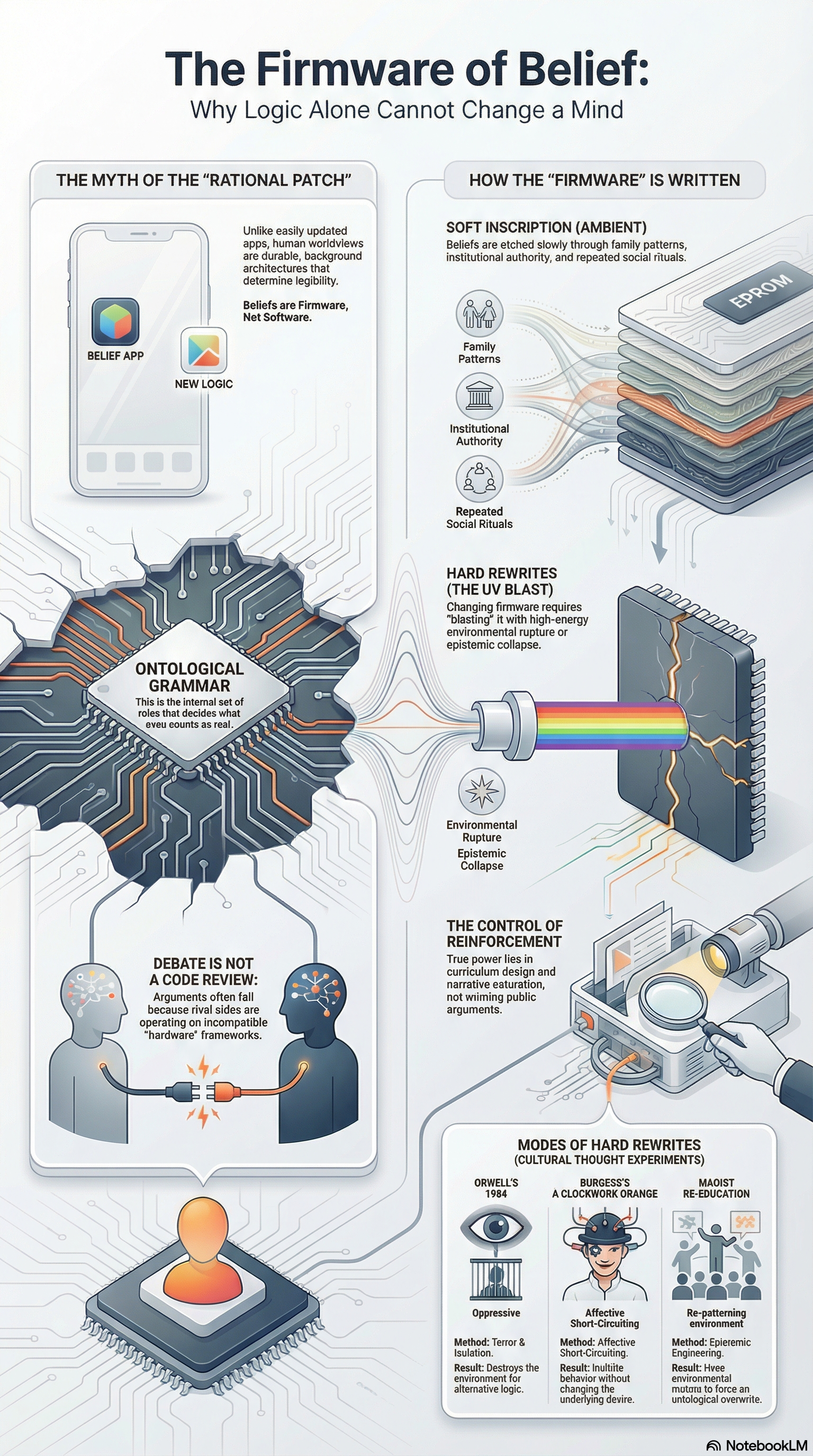
Soft Inscription: The Invisible UV
Most of the time, ontological grammar is inscribed slowly:
- Family speech patterns
- Institutional authority
- Ritual repetition
- Reward structures
- Peer reinforcement
No torture chambers required. No theatrical violence. Just ecological stability.
Over time, what is socially repeated becomes ontologically obvious. What is ontologically obvious becomes morally self-evident.
The result feels like reason.
It is not.
It is stabilised reinforcement architecture.
Hard Rewrites: Cultural Thought Experiments
Our culture understands this more clearly than our political theory does.
In 1984, by George Orwell, Winston is not persuaded. He is destabilised. Isolation, sleep deprivation, epistemic collapse, and finally pain. The Party does not win an argument. It destroys the environment that made alternative legibility possible.
Two plus two equals five is not stupidity. It is the final stage of ecological override.
In A Clockwork Orange, by Anthony Burgess, the Ludovico Technique does something subtler. Alex’s ontology is not rewritten. His affective circuits are short-circuited. He retains desire; he loses viable enactment.
Orwell shows firmware rewrite through terror.
Burgess shows behavioural inhibition without ontological conversion.
Both are caricatures — but useful ones. They compress what normally unfolds across decades into clinical spectacle.
Apologies in advance. Evidently, creating a post on a mobile isn’t very accommodating.

 Philosophics