
Two things, really – one, not particularly funny.
I tend to listen to audiobooks as I fall asleep. For short chapters, I set it to stop at the end of the chapter. For longer pieces, I might choose 15 or 30 minutes. If I’m still awake and hear it end, I’ll restart a timer or continue to try to sleep. If I fall asleep in the middle, when I resume listening, I’ll find the last spot I remember and continue from there. Often, I even roll back too far, but there’s no harm in re-listening. But this is the setup, not the story.
Having just finished Guns, Germs, and Steel by Jared Diamond, I started a new book – The Structure of Scientific Revolutions by Thomas Kuhn. It’s a classic work over half a century old, but I’ve yet to read it. What better time than now. I was tired. I cued the book and set a thirty-minute timer.
As I listen, I can’t help but think how comfortable I was with the material. It reminded me so much of Paul Feyerabend. I considered how much the two had in common on the philosophy of science. Thirty minutes passed, and I decided just to fall asleep, keeping in mind the notion and looking forward to hearing more.
As is a habit, when I awoke, I started another chapter or finished the one I had been listening to. What did I find? I had been listening to Against Method by Feyerabend. Mystery solved. Instead, I decided to listen to Kuhn’s opening chapter. Whilst the two are not hand in glove, they do share some insights. I won’t get into them now. Meantime, I recommend these books, each for its own reason.
And Now for Something Completely Different…
I’m still finishing my Language Insufficiency Hypothesis manuscript. I still need to review it at least a final time, but I paused to create charts, graphs, and annotations. This time, as I was documenting the central Language Effectiveness-Complexity Gradient (you had to have been there), I had an epiphany. I won’t delve into details, but how I thought of it conceptually and how it graphs are different. It won’t make sense without a lot of backstory, but it’s related to the way I critique and dis-integrate Gallie’s Essentially Contestable Concepts (ECCs).
In a nutshell, I contest ECCs, and then I explode them into three categories. I retain but redefine his core ECCs – I call them Contestables. As Gallie notes, these are value-laden and ideological concepts. I identified another category for boundary-resistant terms, which I named Fluidics. I name a third category Ambigents, as they share aspects of both – being ideological as well as boundary-resistant.
In conception, I viewed it as a Venn diagramme – a case where Ambigents are formed by the union of Contestables and Fluidics. In fact, that’s how I coined the term Ambigents at the start – think ambidextrous. I constructed a chart with this in mind. These fit between other conceptual complexity categories. This has been the configuration for about a month – until now.
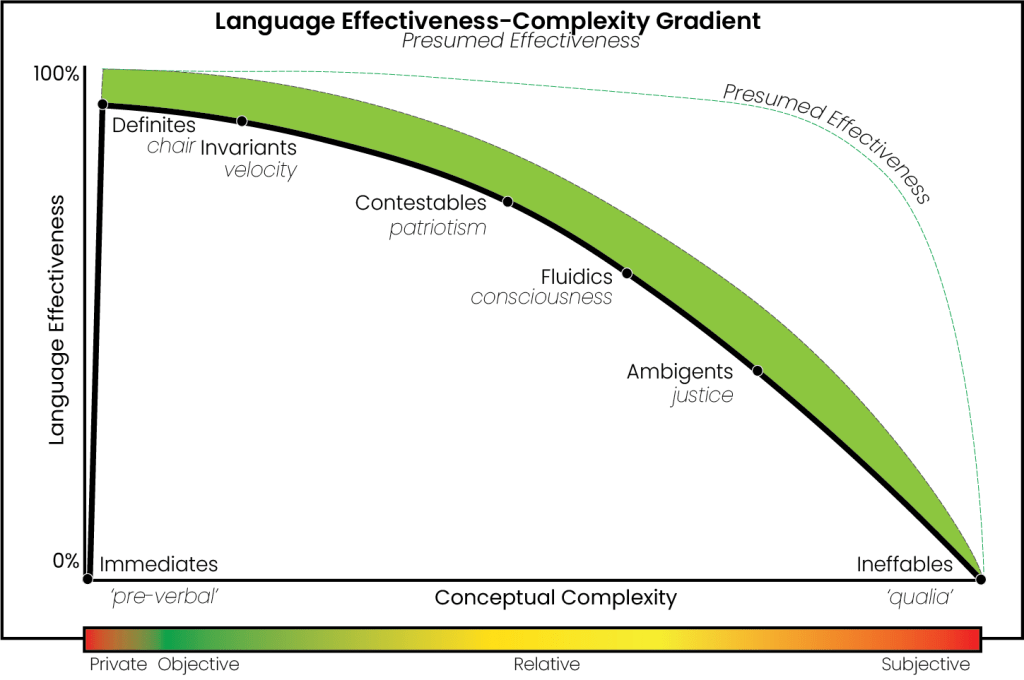
On the Complexity axis of a chart, it’s obvious that a combination of two complex concepts will be more complex than the constituent parts, not between them.
The good news is that I hadn’t created and placed all of the charts, so I didn’t waste that time. I did have to re-work the charts I had made, but this was trivial. Now, I need to revisit the manuscript and ensure any discussion involving orientation is amended. Meantime, crisis averted.
 Philosophics
One thought on “A Funny Thing Happened”