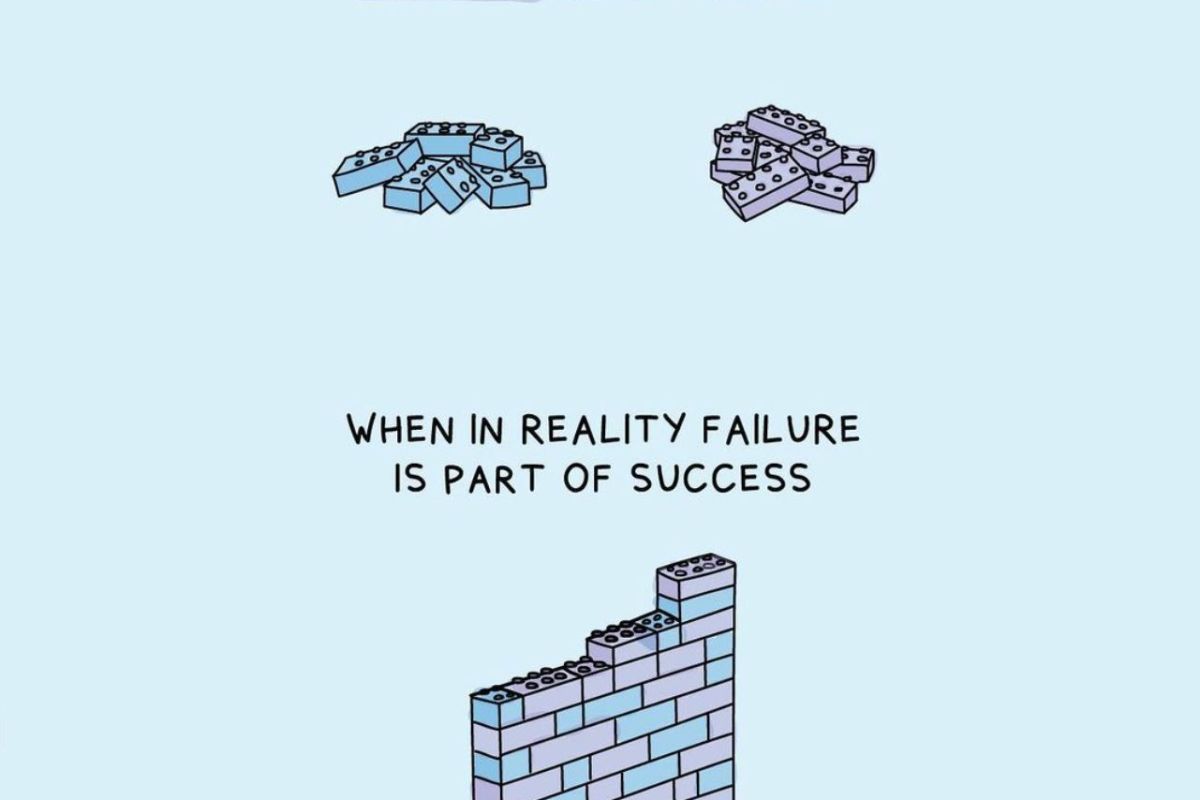
Ah, the motivational poster—a staple of uninspired office walls, gym locker rooms, and Instagram feeds run by people who think an out-of-context Oprah quote is the height of human wisdom. Today’s offender? That saccharine gem: “We think of failure and success as opposites when in reality, failure is part of success!” Often accompanied by a stock image of a brick wall, presumably suggesting that every stumble in life is just another brick in your empire of triumph.
Well, grab your trowel – Nah, mate. Not that towel, the clean one – and your bag of emotional cement because it’s time to demolish this wobbly metaphor.
Sometimes people don’t want to
hear the truth because they don’t
want their illusions destroyed.
–Friedrich Nietzsche
Failure: The Brick That Probably Cracked
First, let’s address the painfully teleological assumption underpinning this nonsense: that every failure is inherently on the path to success as if life is a kind of spiritual Lego set where you just keep snapping pieces together until you’ve built your little castle of achievement. But here’s the kicker: most failures don’t magically transform into success—they’re more like bricks that collapse mid-wall, leaving you with a pile of rubble and a bruised sense of optimism.
Sure, some lucky sods manage to slap together their botched efforts into something impressive. But for the rest of us, failure is often just the prelude to more failure. It’s like a bad Netflix series—just when you think the season finale will redeem it, the writers double down on the garbage plotlines, leaving you wondering why you’re still investing your time.
The Probability Problem: Your Failures Are Breeding
You see, failure doesn’t play by some karmic rulebook where every setback is a coded invitation to eventual glory. If anything, your failures are far more likely to multiply like feral rabbits. One last failure could become a success, sure—but it’s far more probable that your last success will fizzle into disaster or that your next failure will double down on the inadequacies of the last.
Motivational slogans conveniently ignore the very real likelihood that some walls are just destined to crumble. Because here’s the truth: failure isn’t part of success. Failure is part of life, like stubbed toes, traffic jams, and the realisation that you’ll never win an argument on Twitter. Sometimes, you fail and fail and fail, and the only thing you’re constructing is a monument to bad decisions.
Survivorship Bias: The Unseen Wall of Losers
Why do we love this “failure leads to success” myth? Because it’s the seductive love child of survivorship bias and wishful thinking. We adore stories about inventors who “failed a thousand times” before striking gold, or entrepreneurs who “risked it all” before making billions. What we don’t hear about are the countless others who failed a thousand times and… stayed broke.
For every Thomas Edison “learning 10,000 ways not to make a light bulb,” there are ten thousand Tom Eddies who never made it out of their basement workshop, whose life stories don’t get printed on posters because they’re not inspiring. They’re depressing. But that’s reality: success isn’t the inevitable outcome of perseverance. Sometimes it’s just a fluke.
The Brick Wall of Realism
So what’s the takeaway here? Should you just give up at the first sign of failure, retreating to your sofa with a pint of ice cream and a Netflix queue? Not necessarily. Failure isn’t inherently bad—it’s just not inherently useful, either. If you want to keep stacking those bricks, be my guest, but don’t let some pseudo-philosophical slogan trick you into thinking you’re constructing the Taj Mahal.
Instead, take a good, hard look at your pile of rubble. Maybe the real answer is to build something smaller. Or to stop stacking altogether. Sometimes, the smartest thing you can do with a failed wall is walk away from it and find a better blueprint. Don’t get mired in sunk-cost fallacies.
So next time someone smugly tells you that failure is just “part of success,” feel free to channel your inner Debbie Downer and remind them: success and failure aren’t opposites—they’re random roommates in the chaotic dorm of life. And sometimes, one of them keeps hogging the hot water.
 Philosophics