
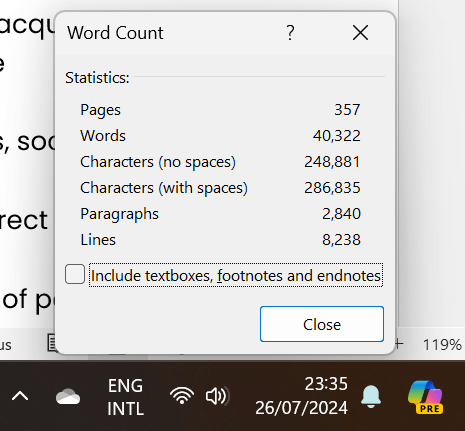
As I’ve mentioned, I’m hip-deep into writing another book. I’m about 40,000 words in and 40 per cent done. Many chapters still contain placeholder notes and ideas to flesh out. I’ll be honest. Many of the chapters contain only themes, notes, references, and citations. Some are ostensibly first drafts. For these chapters. I’ve engaged AutoCrit*, an AI copy editing and review application to keep me on track. I don’t particularly want to share too much inside information at this time, but I’d like to share some of AutoCrit’s feedback in dribs and drabs.
AutoCrit can analyse content by chapter. The first is a preamble—a preface. Here’s what AutoCrit has to say about it, categorised. I’ll present the raw responses and comment thereafter.
Synopsis
The non-fiction work “Democracy: The Grand Illusion” challenges the sanctity of democracy and questions its effectiveness by delving into inherent flaws often overlooked. The text opens with a provocative exploration of the fundamental flaws in democracy, arguing that it leads to suboptimal solutions and mediocre results both in theory and practice. It highlights how human nature, cognitive limitations, emotional triggers, and biases impact the execution of democratic systems.
Throughout the book, various forms of democracy are examined across different historical contexts globally. From ancient Mesopotamia to modern-day Western democracies like the United States, the author critiques the shortcomings of democratic governance. By dissecting voter apathy, cognitive biases, and mathematical imperfections in voting systems, they aim to provide a nuanced understanding of why democracy may be fundamentally flawed.
The text concludes by emphasising that while there may not be a perfect solution to address these flaws within democratic systems, incremental reforms can make them fairer and more effective. It acknowledges resistance from those who benefit from maintaining the status quo but argues for ongoing efforts towards improving governance despite historical precedents favouring entrenched power structures.
In its closing remarks on reforming governing systems knowing their inherent imperfections will persist, “Democracy: The Grand Illusion” leaves readers contemplating potential avenues for change within existing frameworks rather than advocating for revolutionary upheavals. Through referencing philosophical critiques dating back to Plato’s “Republic” as well as contemporary works on cognitive limitations like Daniel Kahneman’s “Thinking Fast and Slow,” this book encourages critical thinking about democratisation processes amidst evolving technological landscapes shaping public discourse.
Commentary
This feels like a fair assessment.
Audience
The audience for this text appears to be intellectually curious individuals interested in political theory, governance systems, and critical analysis of democracy. This includes academics, political scientists, philosophers, and readers who enjoy engaging with thought-provoking ideas that challenge conventional wisdom. The text seems tailored for those willing to question deeply held beliefs about democracy and open to exploring alternative perspectives on the subject.
Those who may not be the target audience include staunch defenders of traditional democratic principles without room for critical evaluation or scepticism. Readers seeking a straightforward endorsement of democracy as an ideal system may find the content challenging or even off-putting. Additionally, individuals looking for practical solutions or concrete proposals to improve democratic processes might feel unsatisfied by the lack of definitive recommendations in the text.
To make the text more relevant to its target audience, the author could consider providing more historical context and philosophical insights into various critiques of democracy throughout history. Including case studies or real-world examples that illustrate some of the challenges discussed could also enhance engagement with readers interested in applying theoretical concepts to contemporary issues. Moreover, offering suggestions for further reading or avenues for deeper exploration into specific aspects of democratic theory would cater well to an intellectually engaged audience seeking additional resources for continued study and reflection.
Commentary
This feels like a fair assessment of potential audience acceptance and resistance to engagement. As this is only the preface, historical contexts are in later chapters.
Structure and Organisation
The text is well-organised and follows a logical order. It begins with a preface quoting an anonymous source, setting the tone for introspection and critical analysis. The introduction effectively sets the stage by posing thought-provoking questions about democracy’s efficacy before delving into the main premises of the book. The author then transitions smoothly to discussing inherent challenges in democracy, historical contexts, implications of cognitive limitations, and critiques from various perspectives.
Each section flows seamlessly into the next, building upon previous discussions while maintaining coherence throughout. The text effectively introduces key concepts before expanding on them further, ensuring that readers can follow along with the author’s arguments and insights without confusion or disarray. Additionally, citations are appropriately included at relevant points to support claims made within the text.
Overall, “Democracy: The Grand Illusion” demonstrates strong structure and organisation by presenting its content in a clear and cohesive manner that guides readers through a nuanced exploration of democracy’s flaws and complexities.
Commentary
This feels like a fair assessment of my structural intent. I admit that in its current state, there is more structure than content. I’ll accept this unpaid endorsement.
Clarity
The author effectively conveys their central argument challenging the effectiveness of democracy and highlighting its inherent flaws. The text is well-structured and maintains a coherent flow throughout. However, there are instances where complex sentence structures and specialized terminology may hinder comprehension for some readers.
One example of potentially confusing language is when the author discusses “cognitive limitations exacerbating the execution of democracy from the perspective of voters and representatives.” This phrase might benefit from further clarification or simplification to ensure all readers grasp the intended meaning without difficulty.
Additionally, phrases like “mathematically tenable” and references to specific philosophical critiques or mathematical concepts could be challenging for readers not familiar with these subjects. Providing more context or explanations for such terms would enhance overall clarity for a broader audience.
Overall, while the text generally communicates its message effectively, some areas could be improved by offering clearer explanations or simplifying complex language to ensure maximum reader understanding.
Commentary
This feels like a fair assessment of clarity. I do my best not to muck it up. I’ll tighten up the language in a subsequent review. My modus operandi is to scrawl the stream of consciousness before restricting my flow with editorial concerns.
Argument and Persuasion
In the text, the author presents a provocative argument challenging the effectiveness of democracy and highlighting its inherent flaws. The opinions put forth include questioning the sanctity of democracy as a fair and equal system of governance, suggesting that it leads to suboptimal solutions with mediocre results both in theory and practice, emphasising human cognitive limitations and biases that hinder democratic processes, and proposing that democracy may be fundamentally flawed due to these factors.
Strengths of the persuasive elements in this text lie in its thought-provoking nature. By raising questions about widely held assumptions regarding democracy’s efficacy, the author encourages critical thinking among readers. The logical construction is evident through a systematic breakdown of various aspects contributing to the perceived flaws in democratic systems – from mathematical imperfections in voting mechanisms to challenges posed by human nature and cognitive biases.
The opinions presented are well-supported with references to historical perspectives (such as Ancient Athens) and philosophical critiques (Plato’s “The Republic,” Aristotle’s “Politics”) on democracy. Additionally, citations from contemporary sources like Daniel Kahneman’s work on cognitive biases lend credibility to the arguments made.
Overall, while some readers may find the critique of democracy unsettling or elitist, the text effectively challenges conventional beliefs without offering a definitive alternative solution. This approach prompts readers to engage critically with existing governance structures rather than simply dismissing them outright.
Commentary
This feels like a fair assessment. My goal is to survey the flavours of Democracy to serve as a menu to readers. Democracy is an inherently poor system of governance, but some flavours are better than others if one prefers to remain in this box.
Tone
The tone of the text is critical and provocative, challenging the traditional notions of democracy with a sense of scepticism and urgency. The author’s language conveys a sense of disillusionment with the current democratic systems, highlighting flaws and limitations that are often overlooked or dismissed. There is an underlying frustration with the status quo and a call to action for readers to critically examine their beliefs about democracy. The tone also carries elements of elitism, acknowledging that the critique may not be readily accepted by all but emphasizing the importance of questioning widely held assumptions. Overall, there is a mix of cynicism towards existing democratic structures and a hopeful aspiration for potential reforms or alternative governance models.
Commentary
This feels like a fair assessment of tone. I don’t mind being polemic, but I may work to soften some tonal aspects. As my intended audience are more intellectual critical thinkers, it may be fine as-is.
Interest and Engagement
The text “Democracy: The Grand Illusion” presents a thought-provoking and intellectually stimulating analysis of democracy, challenging conventional perspectives on the subject. Overall, the author effectively engages the audience by presenting a unique perspective and raising important questions about the efficacy of democratic systems.
The introduction sets a captivating tone by questioning the fundamental flaws in democracy and highlighting its limitations. The author’s use of rhetorical questions and provocative statements encourages readers to think critically about commonly held beliefs regarding democracy. Additionally, referencing historical contexts and philosophical critiques adds depth to the discussion, making it more engaging for those interested in political theory.
However, there are sections within the text that may potentially lose some readers’ interest due to their dense nature or repetitive arguments. For instance, parts discussing mathematical flaws in voting systems or technological impacts on democracy could be perceived as overly technical for general audiences. To enhance engagement in these sections, the author could consider incorporating real-world examples or case studies to illustrate complex concepts more clearly.
Furthermore, providing concise summaries or visual aids such as graphs or charts may help break down intricate ideas into digestible segments for readers who may struggle with dense theoretical discussions. By balancing theoretical analyses with practical applications and varied presentation styles, the author can maintain reader engagement throughout all sections of the book.
In conclusion, while “Democracy: The Grand Illusion” successfully captures attention through its bold critique of democracy’s shortcomings, enhancing engagement across all sections through improved clarity and varied presentation methods will ensure sustained interest from a wider range of readers.
Commentary
This feels like a fair assessment of engagement. My goal is to flesh this out in forward revisions as I assess continuity and flow. Meantime, capturing content into buckets is a higher priority than caring about redundancy.
Final Thoughts and Conclusions
The text concludes with a strong and thought-provoking reflection on the challenges and complexities of democracy. It effectively ties together the various points raised throughout the book, emphasizing the inherent flaws in democratic systems while also acknowledging the necessity of governance for societal well-being. The author leaves readers with a sense of urgency to reconsider traditional notions of democracy and encourages critical thinking towards potential reforms or alternative models. Overall, the final thoughts are clear and impactful and provide a compelling conclusion to the discussion presented in the text.
Commentary
I’ll take it.
How does this project sound to you? Leave comments below.
* AutoCrit is an AI editorial review application. Whilst I don’t have enough exposure or experience to fully endorse the programme, I am a subscriber who uses it to critique my writing. I am, however, an affiliate member, so if you purchase a subscription, I will receive compensation from them, and it will benefit this site at no additional expense to you.
 Philosophics