Section 6: Can This Be True?
The Nature of Truth in Fictions
In exploring the concept that nations, economies, money, legal systems, and even sports are fictions, we confront a fundamental question: can this be true? The answer hinges on our understanding of truth and reality. If we define truth as correspondence to an objective, external reality, then fictions, by their nature, are not “true” in a literal sense. However, if we recognize that truth can also be a construct shaped by human perception and social agreements, then fictions hold a different kind of truth.
Fictions are true in the sense that they have real effects on our lives. They shape our behaviours, influence our decisions, and structure our societies. The value of money, the authority of laws, and the significance of national identities are all real because we collectively believe and act as if they are. This shared belief and action give fictions their power and their truth.
Philosophical Perspectives
Philosophers have long grappled with the nature of truth and reality. The concept of social constructs aligns with the ideas of thinkers like Michel Foucault, who argued that knowledge and power are intertwined, and that what we accept as truth is often a product of social and historical processes. Similarly, Jean Baudrillard’s concept of hyperreality suggests that in the postmodern world, the line between reality and simulation becomes blurred, and fictions can become more real than reality itself.
These perspectives challenge the notion of an objective, immutable truth, suggesting instead that truth is often contingent, context-dependent, and constructed through human interactions. In this light, the fictions that structure our world are as true as any other aspect of our lived experience.
Empirical Evidence
Empirical evidence supports the idea that fictions have real effects. For instance, studies in economics and sociology demonstrate how beliefs and narratives shape market behaviours and social norms. The placebo effect in medicine, where patients experience real improvements in health due to their belief in a treatment, exemplifies the power of belief in creating tangible outcomes.
Historical examples further illustrate this point. The Treaty of Westphalia in 1648, which established the modern system of nation-states, was a legal and diplomatic construct that reshaped political boundaries and identities. The creation of fiat currencies, which derive their value from collective trust rather than intrinsic worth, has revolutionized global economies.
Practical Implications
Recognizing the constructed nature of our social realities has practical implications. It empowers us to critically examine and potentially reshape the fictions we live by. This critical awareness fosters adaptability and innovation, allowing us to address contemporary challenges more effectively.
For example, understanding that economic systems are human-made constructs can inspire alternative models that prioritize sustainability and equity. Similarly, recognizing the fictional nature of national identities can promote more inclusive and cosmopolitan forms of belonging.
Ethical Considerations
While fictions can be powerful tools for organizing society, they also carry ethical considerations. The manipulation of fictions for political or economic gain can lead to exploitation and injustice. It is crucial to approach the construction and perpetuation of fictions with a sense of responsibility and a commitment to the common good.
Transparency, inclusivity, and critical engagement are key to ensuring that the fictions we create serve the interests of all members of society. This requires ongoing dialogue and reflection to align our social constructs with our evolving values and aspirations.
Conclusion
The notion that we live in a world of fictions is both profound and practical. It challenges us to rethink our assumptions about truth and reality, and to recognize the power of collective belief and social constructs in shaping our lives. By embracing this perspective, we gain the ability to question, reform, and innovate the fictions that structure our world, fostering a more just and dynamic society.
In acknowledging the constructed nature of our social realities, we affirm the human capacity for imagination and creativity. This recognition opens up possibilities for envisioning and creating new fictions that better reflect our values and aspirations, guiding us toward a more equitable and sustainable future.
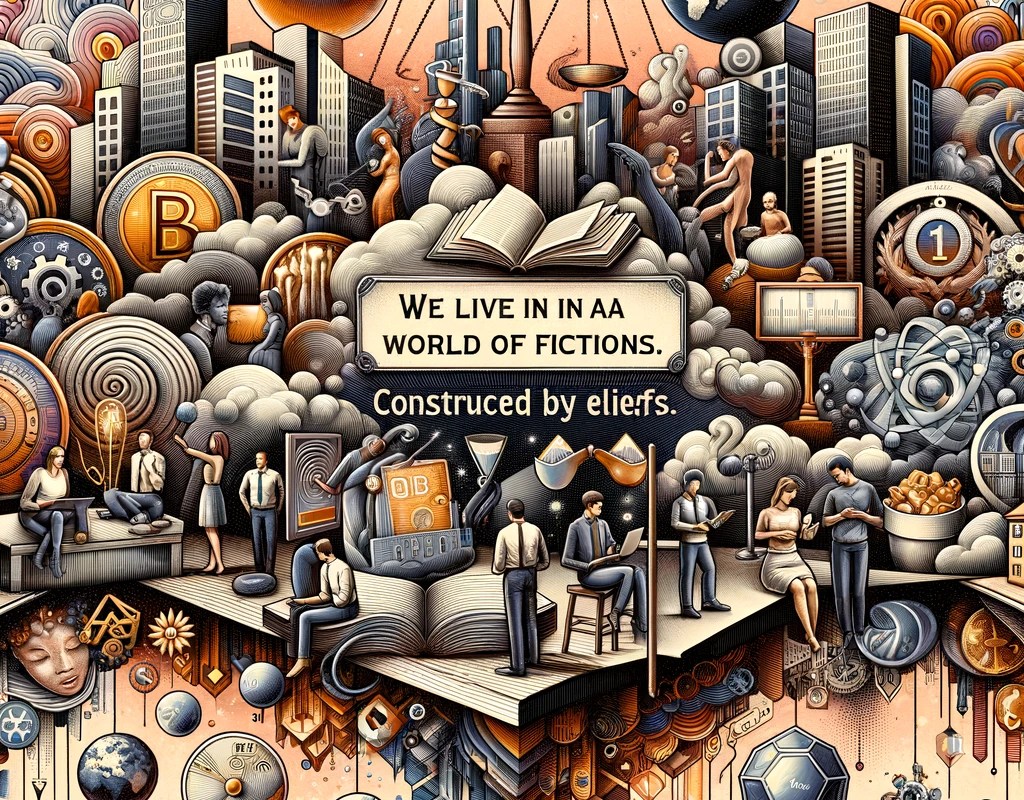
PS: Apologies for the AI typo in the thumbnail image. I fixed it once, and it went missing. Perhaps. I’ll mend it later.
References
- Graeber, David. Debt: The First 5,000 Years (2011).
- Foucault, Michel. Discipline and Punish: The Birth of the Prison (1975).
- Baudrillard, Jean. Simulacra and Simulation (1981).
- Anderson, Benedict. Imagined Communities: Reflections on the Origin and Spread of Nationalism (1983).
- Giddens, Anthony. The Consequences of Modernity (1990).
- Beck, Ulrich. Cosmopolitan Vision (2006).
 Philosophics
One thought on “Fiction Nation: Can This Be True?”