Index and table of contents
Intro
Creativity is the eighth chapter of Iain McGilchrist’s The Matter with Things.
In the last chapters, the topics were about different intelligences. As we’ll see, intelligence is one of the factors for creativity, but there are more. Let’s crack on.
Content
Creativity is an elusive phenomenon that cannot only not be summoned at will, the very act of trying inhibits it. Unlike left-hemisphere-oriented intelligence, there are no simple tests for creativity because of their very nature. Assessing the left-hemisphere is relatively simple because it is systematic and any tests have definite known solutions—whether calculating some figure, solving a puzzle, choosing analogies, or recounting some trivia. There is no such test for creating something not yet created, but there are some proxies that most people categorically fail.
Psychologist, Colin Martindale, had this to say about the personal characteristics of creativity
“Creativity is a rare trait. This is presumably because it requires the simultaneous presence of a number of traits (e.g., intelligence, perseverance, unconventionality, the ability to think in a particular manner). None of these traits is especially rare. What is quite uncommon is to find them all present in the same person.”
— Colin Martindale
Whereas the left hemisphere is analytical, the right hemisphere (hence creativity) is a Gestalt. When given a difficult time-boxed challenge, the left hemisphere dominant individual who does not arrive at the expected response on time will commit to and defend an incorrect response (think escalating commitment), and the right hemisphere dominant individual will simply not commit to a response under the thought that there were still options to be explored.
Effectively, creativity can be broken down into three phases: preparation, incubation, and illumination.
In essence, for the creative individual, the best we can do is to leave well enough alone. Anything but space and permission will kill the creative impulse.
Preparation is simply the accumulation of a particular domain of knowledge. For an artist, it will be to understand, perhaps, colour, shape, texture, form, shadow, media, or so forth; for a musician, it might be to understand melody, harmony, tempo, timbre, dynamics, and so on; for a mathematician, it might be basic arithmetic, theories, proofs, and on and on. It’s also important to note that accumulated information in multiple domains also forms a foundation leveraged by many polymaths.
Incubation is simply waiting for something to grow in the prepared garden. Incubation is an unconscious activity and cannot be controlled or accessed by the conscious mind. In fact, conscious effort and introspection will serve only to impede cultivation. Digging up planted seeds to see how they are growing will only hinder the process.
Illumination is the final phase. Again, this is unwilled. Prepared and incubated flowers bloom. Of course, this is an imperfect metaphor because the ground must already have been fertile at the start. Tossing seeds on fallow ground still yields no blooms no matter how carefully attended.
In essence, for the creative individual, the best we can do is to leave well enough alone. Anything but space and permission will kill the creative impulse.
McGilchrist discusses generative, permissive, and translational requirements.
“The key element in generation seems to be the ability to think of many diverse ideas quickly, demanding breadth, flexibility and analogical thinking – seeing likeness within apparent dissimilarity.” This can be summed up as divergent thinking. This is the openness afforded by the right hemisphere as opposed to the convergent behaviour of the left. As it happens, this is where artificial intelligence falls flat as it is predicated on convergent activity.
The right hemisphere Gestalten surveys the environment and notes otherwise unperceived parallels. It is not a systematic approach. In the words of Oscar Wilde, “Education is an admirable thing. But it is well to remember from time to time that nothing that is worth knowing can be taught.”
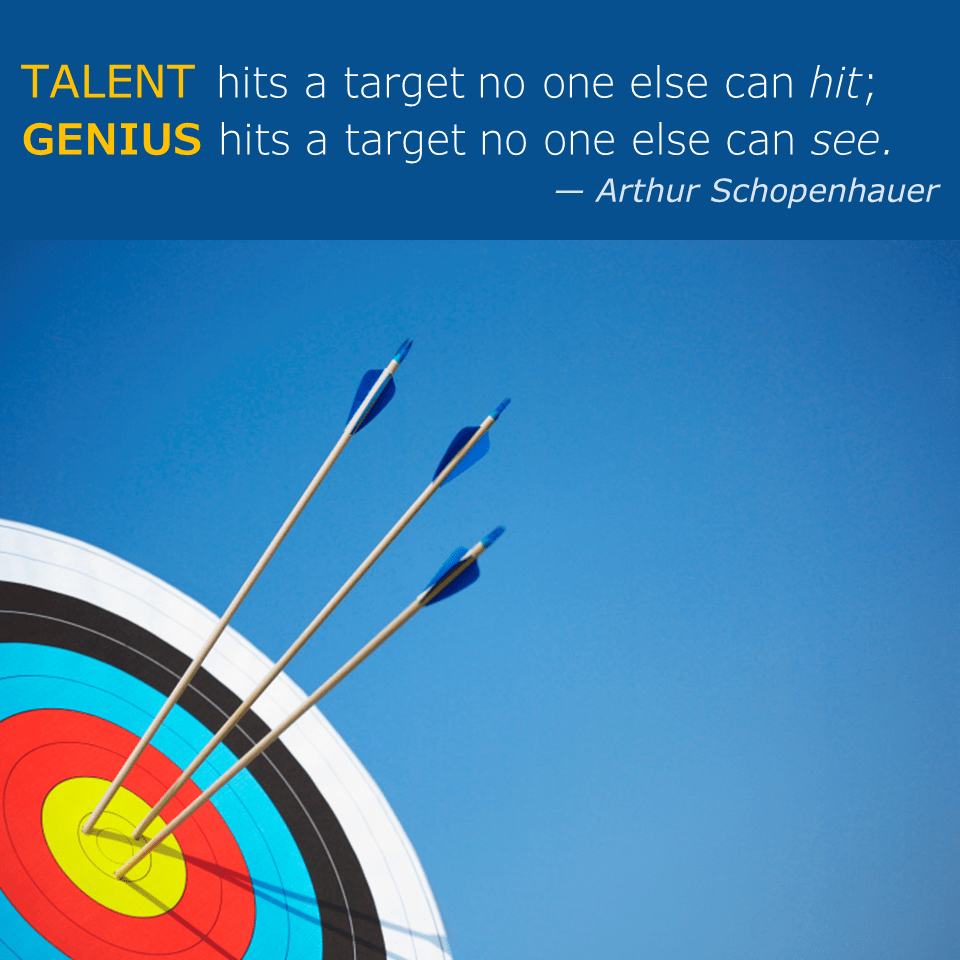
“Talent hits a target no-one else can hit;
Arthur Schopenhauer
genius hits a target no-one else can see”.
Schopenhauer sums it up nicely, “Talent hits a target no-one else can hit; genius hits a target no-one else can see”.
Citing Isaac Asimov writing about Darwin’s insight, he notes that before Darwin, many people had read Malthus and studied species, but they lacked the creative spark that Darwin had.
Steve Jobs noted that
“Creativity is just connecting things. When you ask creative people how they did something, they feel a little guilty because they didn’t really do it, they just saw something. It seemed obvious to them after a while. That’s because they were able to connect experiences they’ve had and synthesize new things … A lot of people in our industry haven’t had very diverse experiences. So, they don’t have enough dots to connect, and they end up with very linear solutions without a broad perspective on the problem. The broader one’s understanding of the human experience, the better design we will have.”
— Steve Jobs
This is a failing of the business world and of specialisation more generally. McGilchrist writes, “Linear approaches and analytic thinking, characteristic of the left hemisphere, are fine in the right context, and may at a subsequent phase take part in creativity by narrowing things down and eliminating some of them, but on their own will not achieve creativity”.
There is a direct link between intelligence and creativity. Ego crushes creativity.
There is a direct link between intelligence and creativity. Ego crushes creativity.
He again cites Asimov:
“My feeling is that as far as creativity is concerned, isolation is required. The creative person is, in any case, continually working at it. His mind is shuffling his information at all times, even when he is not conscious of it …The presence of others can only inhibit this process, since creation is embarrassing.”
— Isaac Asimov
Some people excel at maths, but many are systematic and procedural left-hemisphere types; they apply logic and reason—insert tab A into slot B. The famous mathematicians understand the procedures, but their ideas come from intuition rather than reason. The left hemisphere doesn’t recognise this as a viable vector, and therein lies the rub. “Math is not about following directions; it’s about making new directions,” writes mathematician Paul Lockhart.
This is why we hear so many accounts of aha moments, something coming to one person in a dream or Isaac Newton’s falling apple anecdote.
“These thoughts did not come in any verbal formulation. I very rarely think in words at all.
Albert Einstein
A thought comes, and I may try to express it in words afterward”
Einstein told Max Wertheimer, founder of Gestalt psychology, “These thoughts did not come in any verbal formulation. I very rarely think in words at all. A thought comes, and I may try to express it in words afterward”. Words are a left-hemisphere phenomenon.
Many accomplished musicians hear a piece whole. All they need to do is to compose it to staff paper or perform it. We hear this regularly: “I was driving from here to there and it just came to me. All I needed to do is to remember it long enough to get it down.”
I found McGilchrist’s inclusion of hemispheric damage quite interesting. He provides many examples of artists, composers, and poets, but I’ll only summarise them. For musicians and Artists with right hemisphere damage, those who even retained the urge to create did so at a lower quality level. However, those with left hemisphere damage operated at the same level and oftentimes at a higher level, without the inhibition and censorship of the left hemisphere.
It’s important to note that most people rely on both hemispheres. When I write left hemisphere dominant, I mean to say that either the right hemisphere simply underperforms or that the left hemisphere does not cede control back to the right hemisphere. Generally speaking, both hemispheres experience the world, and a strong right hemisphere will act as air traffic controller, or perhaps have the right of first refusal, but this is a loose metaphor because sometimes the left hemisphere just fields an experience and takes its best guess how to handle it even if it should have been fielded by the right hemisphere and even if the left hemisphere provides the wrong answer. The left hemisphere is the hemisphere of the ego and identity, so it is somewhat relentless and defensive even when it is wrong.
As a side note, I trust that political identity and escalating commitment are left-hemisphere activities and why modern Western politics feel so intractable.
After a strong argument for right hemisphere dominance and divergent thinking being hallmarks of creativity, he offers some counter-evidence and counters some of it.
A paper by Arne Dietrich and Riam Kanso co-authored a book citing instances of convergent thought processes that led to something innovative or creative. At the onset, McGilchrist calls them out for conflating problem-solving with creativity. In the end, the left hemisphere does play a role. He calls this the translational phase. Essentially, this is Mozart having heard his symphony and needing to put his thoughts to paper. Or the poet.
He goes off on a bit of a tangent noting how words pale concepts, and divergence and convergence are no exception. This fits in with my own insufficiency of language theory, but McGilchrist and I have different rationales for our arguments, so I’ll not side-track this summary.
He cites some statistics correlating creativity with mental health disorders and incidences of suicide. This will set the reader up perfectly for the next chapter about schizophrenia and autism.
Perspective
In summary, creativity has got me riled up more than in the previous chapters. This is partially due to how it comports with my own observations. I have always felt that humans are not very creative or innovative despite protests to the contrary. In fact, I’ve often commented when I’ve heard people say something like “artificial intelligence will never create the next…” Fill in the blank: Mozart, Picasso, Michelangelo, Nabokov, Wordsworth. Or Einstein. Of course, neither will a human be the next of these.
All these people are right cerebral hemisphere dominant. AI operates systematically, in the manner of the left hemisphere. None of these people built up systematically. Instead, their ideas were wholly formed, and their creations were reductive rather than additive. Famously, Michelangelo was to have said, “The sculpture is already complete within the marble block before I start my work. It is already there. I just have to chisel away the superfluous material.” He sees the solution first and then builds towards it.
In my professional life, I have been a strategist as a management consultant as well as a business analyst. In each case, I could quickly assess a situation and then spend weeks or months defending my intuition with words, diagrams, and numbers.
As a business analyst, I would offer a recommendation, and this would need to come with an estimate to deliver the recommendation. This figure would come to me in a matter of minutes. Then, per protocol, I would need to enter micro-level details into a pricing model so it could calculate from the ground up. First, this was time-consuming. Second, this would be circulated for review where different people would (almost invariably) reduce the number of hours estimated, typically due to pressure to reduce the cost. Ultimately, a number would be output and tendered to the client or the person footing the bill. Again (almost invariably), the number initially intuited was more accurate and reflective of what was ultimately invoiced. Unfortunately, business is a left-hemisphere endeavour, and that will be its Achilles’ heel and denouement.
This wraps up the chapter on Creativity. The next chapter is “what schizophrenia and autism can tell us”, and is the end of part one of The Matter with Things.
What are your thoughts and experiences with creativity now that you’ve heard McGilchrist’s take?
Leave comments below.
 Philosophics
2 thoughts on “The Matter with Things: Chapter Eight Summary: Creativity”