As I’ve been engaging in the works of Iain McGilchrist, several concepts remain unresolved in my head. One was unresolved even before I engaged with his work, but he touches on the topic with a strong opinion. In fact, I wrote about it recently.

As a refresher, let’s re-establish that the right brain is the open experiential hemisphere and the left brain is the closed re-presentative hemisphere. Where the right diverges, the left converges. Where the right composes, the left decomposes.
The difference can be seen in the way the left brain views a person. Ostensibly, it not only sees a person as body parts—face, hands, torso, and whatever—, but it also sees these things as discrete slices of time. The right brain doesn’t see the parts. It only recognises the whole. Yes, it can discern you from me, but this is by a Gestalt heuristic that doesn’t ‘care’ about the details, per se. It just knows. Call it intuition.
When we experience something anew, the right hemisphere takes it in and signals the left hemisphere to categorise it and name it. This may be utilised by the right hemisphere at a later time.
From a practical perspective, on a day-to-day basis, it makes it more convenient to view these holistic concepts rather than elements. The challenge I am facing is that I know these to be constructions. McGilchrist seems to claim that we perceive them as they are and only then deconstruct them.
Regarding the image below, the right brain sees the S-shape and the left brain sees the 4s. I am oversimplifying, but the notion gets us where we need to be.
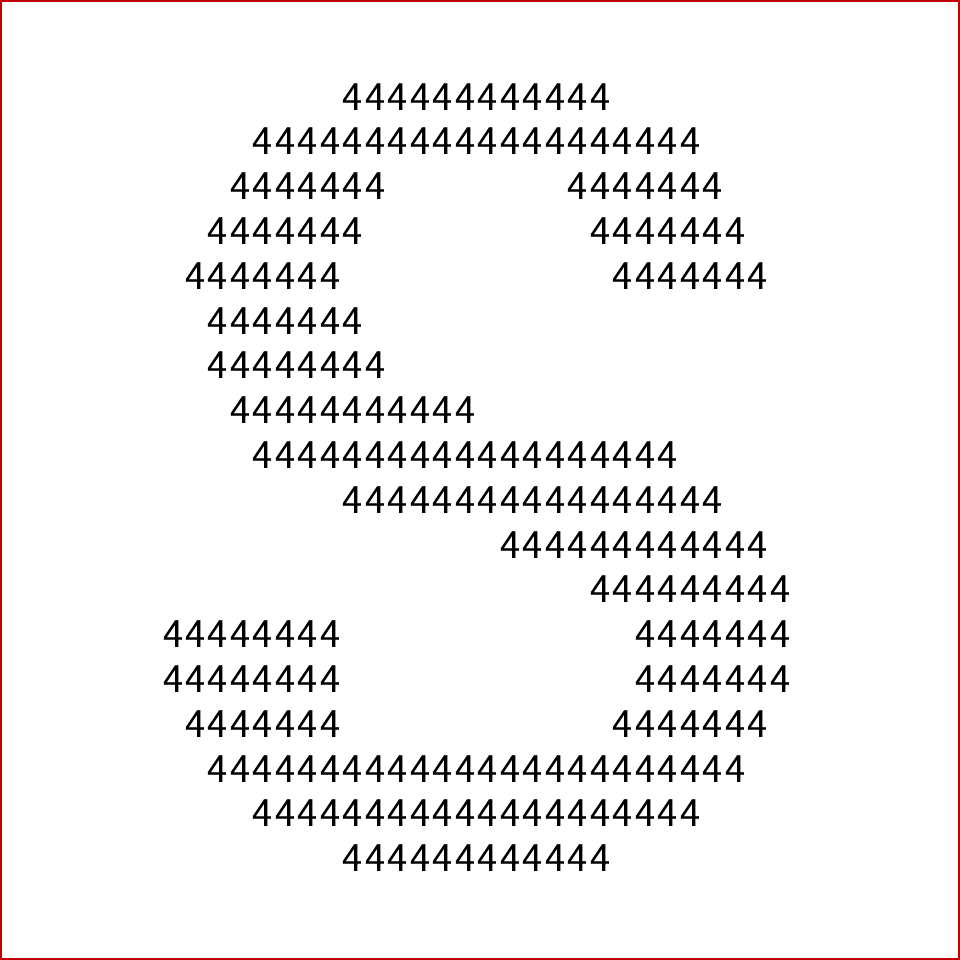
Schizophrenics will first see the 4s. If you registered the 4s first, don’t worry. There are other reasons why a person might see the 4s before the S, but as I said I am simplifying for discussion.
McGilchrist’s claim is that the S-ness is more important than the 4-ness, generally speaking. Even further, he asserts that the S is more real whilst the 4 is only part of the construction—that the elemental nature is less real. As always, I leave room for my own misunderstanding, but I think I’ve got it—precisely what the left hemisphere would say in its defence.
My contention is that the self, like the S, is a construct. We may perceive the S holistically, but without the notion of S, it’s just a shape. In fact, I could have rendered the 4s as gibberish, and Gestalt-driven apophenia would still have an opinion. We only have to look to the stars to note that we can render any number of constellations. Only there is no Archer or Taurus or Scorpion; there is no Little Dipper or Ursa Minor. These are wholly fabricated. My favourite is what has been named Orion in the West is The Giant in Arabic. Other examples connect stars identified in one culture’s constellation and configure it with different stars to create another constellation, obviously given a relevant name by and for the culture.
So why should I accept that the fabrication of the self or an identity is somehow real? How is this not apophenia? More importantly, why should I accept it as true or real or more real?
I feel that the point here may be more about balance. I am not a fan of the facile Greek notion of moderation, though this and the middle path seem to attract many eyes.

The hemisphere dominance scale above represents the spectrum of possibilities of seeing the S or the 4s. It doesn’t account for blindness, the inability to see it, nor attention, having not noticed it. Each of these may have its own cognitive reason.
There are two key elements aside from if these are perceived. One is the relative speed of recognition; the other is the order in which they are perceived. One may be able to add proximity. I often use Pointillism analogies, and I feel it is appropriate here.
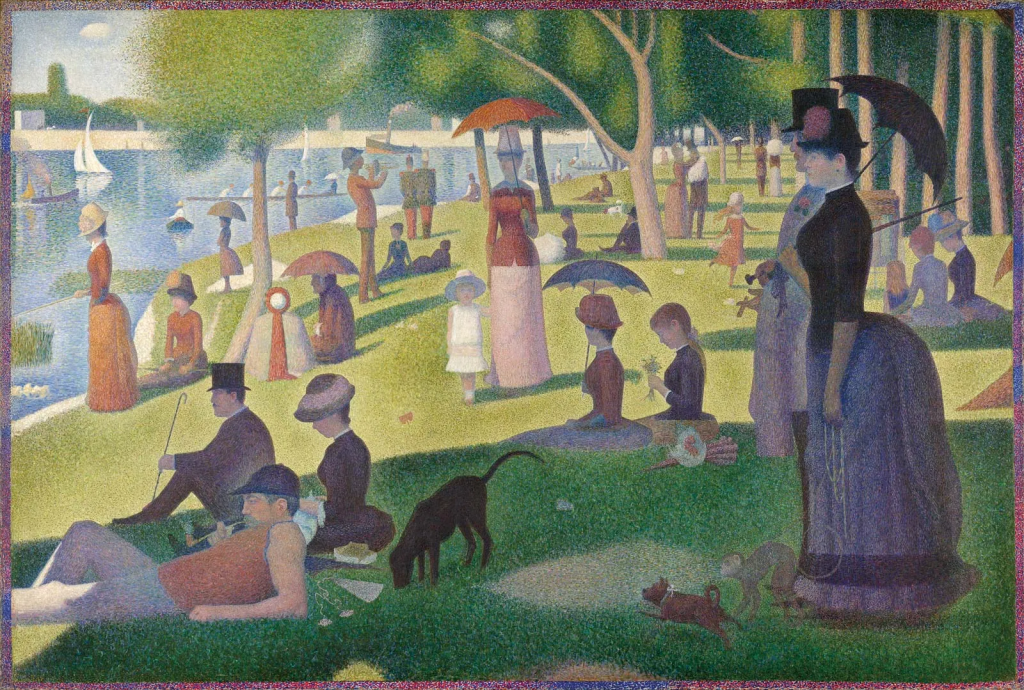
From a distance, Saurat renders the whole, but from a foot away, it’s pretty much colours and dots. Perhaps showing my age, but when I was younger and went to a cinema, I had the occasional bad fortune of having to sit in the front row. Although being hypervigilant to detail was not a problem, seeing the entire picture was. I recall tracking an object travelling left to right by turning my head. Of course, if anything else was supposed to come to my attention, it would have likely been missed.
In the end, we should see that, as with the Saurat, this whole is the sum of its parts, but in the world, we can and perhaps should see the forest before the trees.
 Philosophics
Reblogged this on Neuroscience and Philosophy.
LikeLike