Index and table of contents
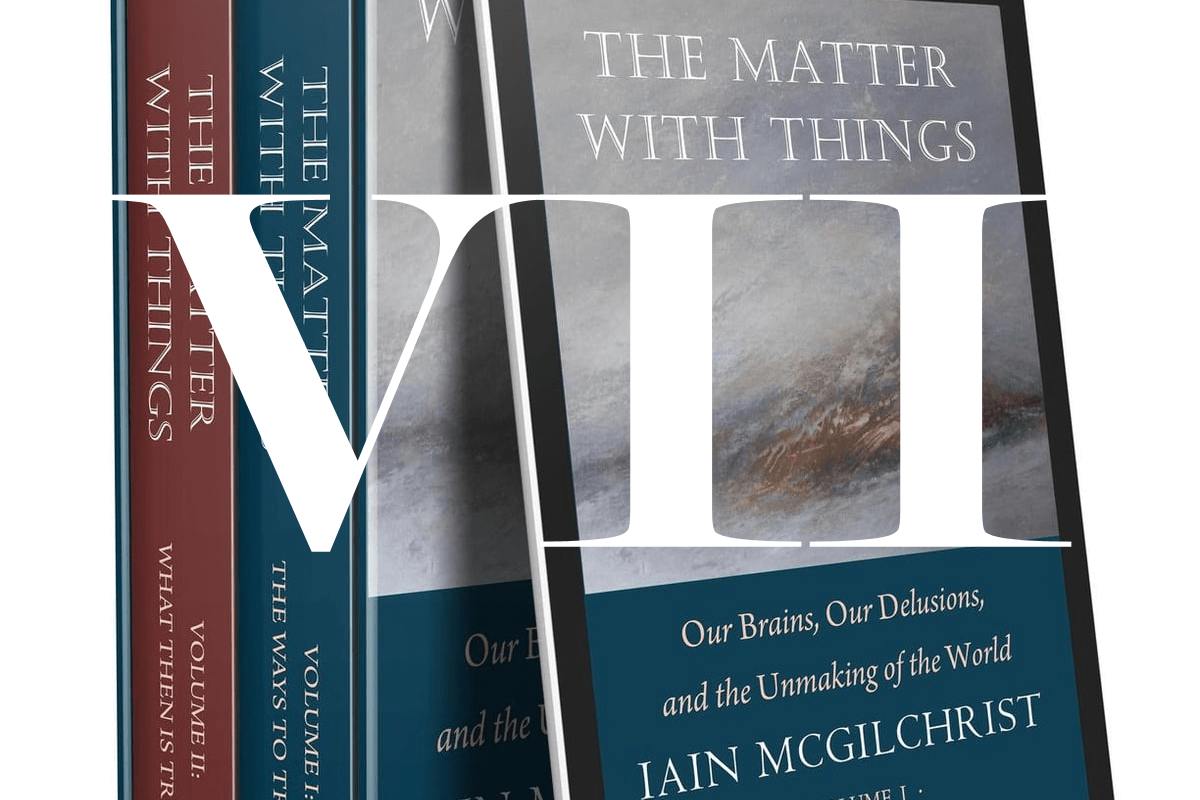
Following Emotional and Social Intelligence and the rest, Chapter 7 of The Matter with Things is Cognitive Intelligence.
In the last chapter, we learned that Emotional and Social Intelligence are the provinces of the right hemisphere. In this chapter, we discover more of the same. Whilst the left hemisphere has its duties and functions, it’s primarily a delegate. Let’s jump right in.
Under the old pseudoscientific mode of thinking, the left hemisphere was the logical side whilst the right hemisphere was creative. It turns out that this is not correct. At its core, intelligence is about understanding. Keep in mind that there are multiple kinds of intelligence—not referring to multiple intelligence theory, per se. Besides the emotional and social sort discussed at length in the last chapter, there is a sort of rote intelligence. This is where the left hemisphere excels. The left hemisphere is symbolic and algorithmic. It has facilitated the making of computers and other instruments that allow us to extend our intelligence, but these are not sources of intelligence. In a conceit to his previous book, The Master and His Emissary, McGilchrist notes that the left brain is effectively the emissary, the junior partner in the relationship, and not really even a partner as the right hemisphere seems to call all the shots when it’s intact.
He tells a story about a geneticist who declared to a biologist that the notion of intelligence was quite meaningless. The biologist retorted that he (the geneticist) was unintelligent, and the two never spoke again. Clearly, the notion is that whilst it may be ill-defined, it nonetheless contains meaning.
I share the working definition of intelligence that he shared, taken from the journal Intelligence and cited in the Wall Street Journal in 1994.
Intelligence is a very general mental capacity which, among other things, involves the ability to reason, plan, solve problems, think abstractly, comprehend complex ideas, learn quickly and learn from experience. It is not merely book learning, a narrow academic skill, or test taking smarts. Rather, it reflects a broader and deeper capability for comprehending our surroundings – ‘catching on’, ‘making sense’ of things, or ‘figuring out’ what to do.
As noted, there are several flavours of intelligence, even if they are attempted to be captured as G, general intelligence. This can be separated into crystallised intelligence (Gc) and fluid intelligence (Gf). Crystallised intelligence is more culturally bound than fluid intelligence and is more the domain of the left hemisphere. Generally, this is what IQ tests aim to measure.
Two criticisms of IQ tests are the cultural bias and the rote nature of the tests. As it happens, trends show that IQ is generally on the rise despite a feeling that people are getting dimmer. This may be because this rise represents the shift toward left hemisphere thinking, an alarming topic he’ll cover more in future chapters. We’re witnessing a trade-off between creative thinkers for intelligent rote automatons—the type of people more easily supplanted by computers and automation. Even as IQs are apparently increasing, undergraduate professors are complaining in higher numbers about how unprepared their incoming students are. I can add my experience anecdotally to this list. I recall chatting with a physics professor who complained that he had to devote some 20 per cent of his class time to teach students the same prerequisite maths, which meant that he had to cut this from his intended time to teach physics.
As a student, one of my physics teachers said he wouldn’t demerit much for maths errors because this was, after all, a physics course. Again, this was a reaction to many students not being prepared. They just had different approaches to handling the deficits. And don’t get me started on grade inflation.
The right hemisphere is the realm of fluid intelligence and is activated more in gifted persons. This affords creative problem-solving.
The right hemisphere is the realm of fluid intelligence and is activated more in gifted persons. This affords creative problem-solving.
Let me editorialise here in place. Sometimes we hear that this or that person is good at maths, but it turns out that this is not a simple declaration. A person who studies geometry, trigonometry, and calculus and can perform the functions may simply perform all of this rote activity in the left hemisphere. Because someone can do maths a few levels above us may feel like this person is good at maths, but this may not make this person actually good at maths.
A few years ago, I read the introduction to a book whose title I’ve long forgotten. In this introduction, the author had excelled at left hemisphere maths and got his bachelor’s and master’s degrees in mathematics. Whilst pondering whether to pursue a PhD, in a moment of self-reflection, he decided not to. He was an A student and the pride of his family, but he had to work hard at maths. Then he considered some of the other classmates who seemed to perform the tasks effortlessly. He could do maths, but they could think maths.
This reminds me of the story of a young Carl Gauss whilst he was still in elementary school. Don’t worry. I’ll get back to the summary presently. Gauss’ teacher was hoping to keep the students occupied, so he assigned them the task of summing the numbers 1 through 100.
Eight-year-old Gauss considered the problem. He noticed a pattern and worked out the answer in his head after a few seconds—5050. Gauss excelled at maths naturally. He noticed that pairing each ascending integer from 0 to 100 created values of 100; 1 and 99; 2 and 98, 3 and 97 … 49 and 51. There are 50 such groupings with a product of 5,000 and 50 left over, so 5,050. Easy Peezy.
And now we return to regularly scheduled programming.
Another interesting characteristic of the hemispheres is that the left hemisphere operates serially whilst the right hemisphere operates in parallel, metaphorically speaking, of course. The right hemisphere is the Gestalt operator, which is a problem as McGilchrist sees it given the leftward shift in the sciences, losing the woods for the trees. Moreover, as we are forced into the constraints of business and bureaucracies, we are forced into a left hemisphere perspective, which may create a vicious epigenetic cycle or a downward spiral.
Perspective
In summary, the right hemisphere not only contributes to the majority of emotional and social intelligence as discussed in the last chapter, but it is also the workhorse of cognitive power.
Before ending, I want to share one more elucidation. I was reading elsewhere about critical thinking, and an example given was an emergency room nurse triaging patients—prioritising the treatment of patients. I wholly disagree. This is algorithmic thinking, not critical thinking. It could easily be done by a computer. In fact, in the late 1980s, I was working with so-called expert systems, which were the AI hype of the day in wave 3.0. We are now in wave 4.0 and it is still hype. Only nowadays it’s deep learning, machine learning, visual recognition, edge computing, and robotic process automation. The only difference is that technology has driven costs down, so they are more accessible to more people and can be run on more powerful computers. For the uninitiated, there is no intelligence in artificial intelligence. So, it’s less artificial and more non-existent.
Yet again, I am left wondering what this left hemisphere is good for. It seems to do less than 20 per cent of the work and does half of that poorly. Not exactly someone you’d pick for your team. Of course, I wouldn’t want to sacrifice my left hemisphere, but still.
That about wraps up the chapter on Cognitive Intelligence. Next up is chapter eight on Creativity. If you think this will focus more on the right hemisphere, I’ll bet you’re right. I hope you’ll join me.
What are your thoughts on intelligence and the hemispheres’ split duties? Did anything surprise you? Was there anything of particular interest?
Leave comments below.
 Philosophics
2 thoughts on “The Matter with Things: Chapter Seven Summary: Cognitive Intelligence”