A toddler lives with me. She’s been on the brink of verbal language for the past few months, and I am sharing some observations.

Juicy Shoes

Two objects that play a large part of her verbal life are juice and shoes. As I hear her employ these words, they are virtually indistinguishable. I may actually misperceive her, and she could be uttering the same morphemes. I captioned how I perceive these images with IPA references.
In English (in IPA), juice is spelt / d͡ʒˈuːs / and shoes is / ˈʃuːz /. She simplifies ‘juice’ by not voicing the leading alveolar plosive ‘d’ and by shortening the diphthong to a monopthong vowel. For ‘shoe’, she similarly shortens the vowel sound and annunciates a voiceless rather than voiced alveolar fricative.
Awhr
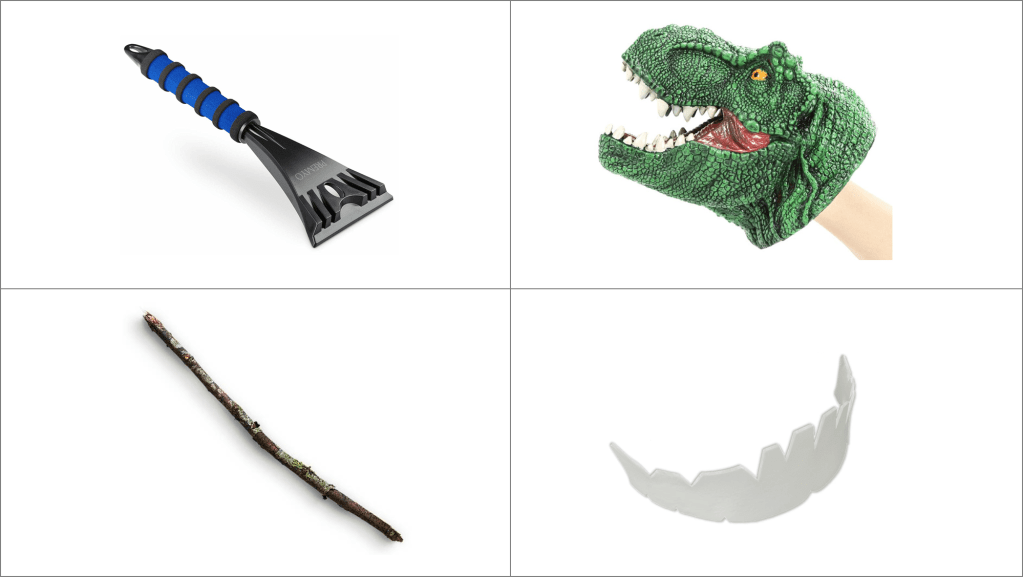
Can you guess the common thread the above objects share?
Spoiler Alert: They are each signified by the same signifier— Awhr, which I believe may be transliterated as Rawr. Bear with me.
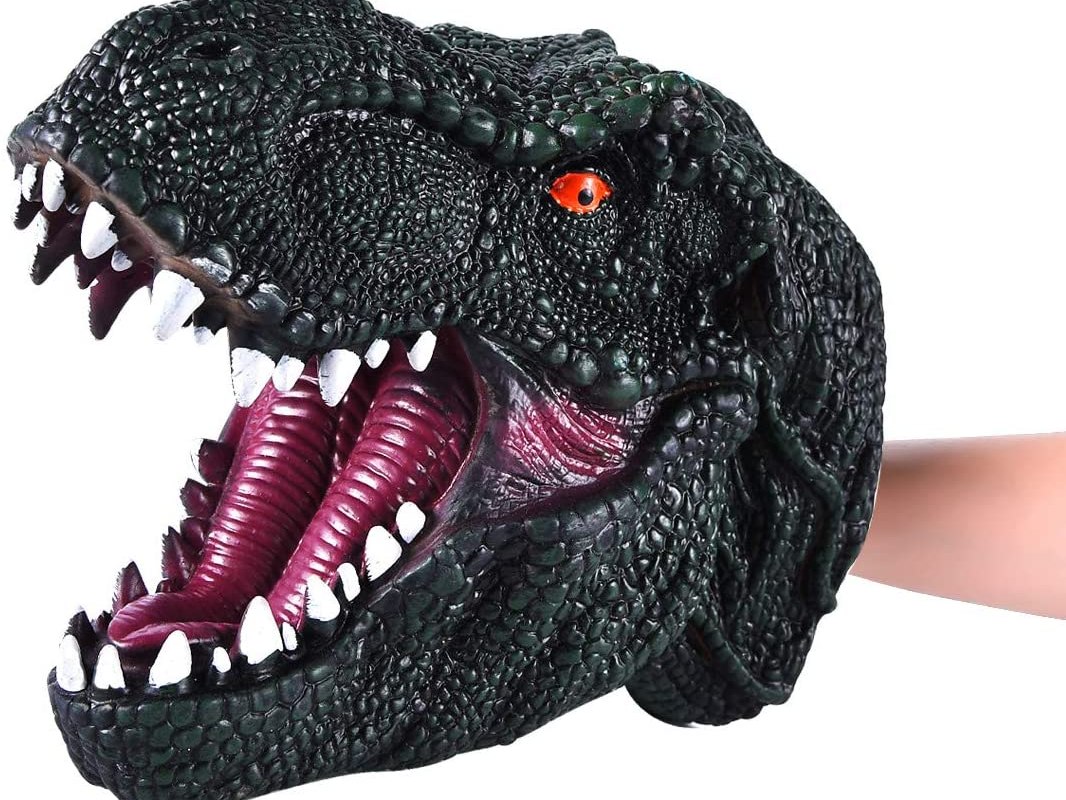
She loves dinosaurs. Seeing one, she reflexively roars onomatopoeically, awhr. I know. You are thinking to yourself, that’s a no brainer. Dinosaurs roar. At least in the modern-day mythos. I don’t speak dinosaur, and perhaps dinos had regional dialects or species nuances. She’s just a toddler, so ‘awhr‘ is representative of all dinos.
But, you are thinking, these other things not only don’t roar, but they’re also inanimate. Sure, you tell yourself, the dinosaur is a puppet, but you can envisage the connexion. That’s a toy dinosaur, but these other things are an ice scraper, a stick, and who knows what that last thing is? It’s a hat shaper. It was an insert to a cap—like a baseball cap or trucker cap. It was removed for the cap to be wearable, and the insert is one of her favourite toys. All of these rank high on her list of preferred toys.
As far as I can tell, she envisages the cap insert as teeth—resembling, perhaps, the teeth of a dinosaur—hence ferocity, hence a roar. I believe the roar-stick connexion has an aetiology that involves the ice scraper, so I’ll share that origin story.
Whilst shopping for an ice scraper in Winter, we were in the automotive aisle. As she was interested in the variety of air fresheners, I parked her trolley and surveyed the aisle looking for scrapers. Finding one—and for reasons unknown to me; perhaps the ‘teeth’ on the back of it—, I represented it as a claw and produced my own roar. The impression was made. It’s been months, and whenever she interacts with it, she roars as if it were a dinosaur.
By extension, I believe, the stick is a simulacrum. We’ve travelled from the signified to the first-level signifier (puppet) to a second-level signifier (scraper) to a third-level signifier (stick). Absent the causal narrative, one would be hard-pressed to suss out why a child might be representing a stick with a roar. And now you know.
But wait. There’s more. I was so busy geeking out, that I almost forgot the story that prompted this post in the first place. We were driving somewhere. She sits in a car seat that, by design restricts her movement, and sometimes her playthings go out of reach, where ‘sometimes’ means ‘almost invariably’.
As we were heading wherever, I heard the cue, awhr. A quick glance in the mirror caught the dinosaur puppet. I reached back and handed it to her. Crisis averted. She played with the puppet for a bit, and that leads to a brief diversion from the narrative. Her roars have two noted contexts. The first is playing, awhr. She finds herself amused to be a dino ventriloquist, and she bursts out laughing if you acknowledge her playing. The second is serious business, awhr. Laughter is not the expected reaction. Anything less than feigned terror will get you the look. This is no play dino. This is a dino incarnate. But I digress.
A minute or so later, awhr. This roar is neither play nor serious. She wanted something else. A quick survey of available candidates, and I sussed out the cap stretcher cum teeth. Crisis averted. But only for a minute. After satisfactorily animating the stretcher, another roar. Another glance back. No good candidates. But there was a stick. What do I have to lose?
Awhr. Yep. This is what she had in mind. She animated the stick for another few minutes. And that brings this chapter to an end.
Moar
Though her vocabulary is so far quite constrained, she does have a few more available words. More was pretty early on her list, almost invariably accompanied with a gesture—thrusting an empty juice cup or just generically declaring that she wanted more of whatever it was that she’d just had. Nice general-purpose word, for sure.
Thank You
Thank you was another early entry. She pronounces it like the German, danke, but with a cut schwa sound at the end and perhaps more: / ˈtaŋk ə /. Schwa is already a short unstressed vowel, and I don’t know how to represent it shorter. In musical notation, I might have opted for a staccato-pianississimo combo in an attempt to capture the dynamics. Alas…
Hello, Goodbye
Other phatic and still enthusiastic utterances are hi and bye with attendant waving gestures.
Enfin
She does have words for dad and mum, respectively da and ma or maman, comme en français, and she employs nods and headshakes to communicate yes and no. And she uses sulking body posture to convey disappointment. Finally, she says ow to any number of things to indicate frustration.
I’m sure she’ll be adding many more words relatively soon and quickly.
 Philosophics
Language acquisition is the greatest! Just wait till she starts coming up with narrative … also delightful.
LikeLike