
Despite its propensity for divisiveness, the Internet still offers a promise of communication exchange. I use Philosophics as a lectern or pulpit to articulate my ideas and solicit feedback. As often as not, it’s just a memorandum repository and sounding board. I also operate on other fora, whether Reddit, Quora, Facebook, or some other blogs.
A recent post on Wittgenstein‘s talking lion generated some discussion. On one Facebook thread, a virtual colleague used this post as a springboard to consider speech as reflected by Pragmatists—particularly Peirce, whose name I reverse the e and the i as often as not. I before e…
Although I have some familiarity with Pragmatists—namely, Peirce and James—, I’ve not read their work directly and intently, so I don’t pretend to be an expert and any points I suss up may have already been answered. But that’s never stopped me before.
As my colleague—let’s name him John—presents—and I quote:
Peirce was a logican but in terms of linguistic representation, he held that our representations of Universals always allow for further determination. In other words since our representations of Universals denote unexamined cases we don’t ever represent them concretely in all of their possible instantations. For example, when we say an apple is red, we do not know every object that will ever have in the past and possible will the future exemplify redness. So in other words any representationation of a Universal that we make is a kind of an uncashed check, that awaits further determination. Peirce goes on to consider such a cashing in as the Final Opinion of all who investigate. This Final Opinion can be taken two ways. First, it can be taken as metaphor for the infinite possibilities of cognitive representations. Second, it can refer to those representations that we have positited with a likelihood of denoting real Universals, that also turn out to be true in spite of their reference to unexamined cases. The first position has the problem that inquiry may be ended before the Final Opinion has been reached: The End of the World possibility. Peirce however has the second option. The idea is that some settled cognitive representations of real things have a high likelihood of denoting real Universals. In fact Peirce claims that we may have already reached the final opinion on many subjects. An example here can be what is called Settled Science. The idea is that some of the classifications of the Sciences likely denote the real properties and relations that an object has. Examples of this are the Periodic Table, and DNA sequences. We sometimes also get things right with our common sense representations of Universals, but these opinions of what counts as being real are more tenuous.
— John
John, Peirce, and I are all in accord that representations of Universals always allow for further determination. I don’t generally believe in universals, but that point is irrelevant or at least obviated by the further determination aspect.
We likely are also all in accord with the red apple example. So far, so good. Then this happens…

John, Peirce, and I are all heading down the same path, but when it comes to abstract expressions, I need to take the slip road because I don’t feel Pragmatism captures this use case satisfactorily.
REWIND: For those unfamiliar with me or who haven’t read a lot of this blog, I am Nihilist with a fondness for Existentialism (to a point) and Zen Buddhism (as an ethical framework). Despite this, I operate somewhat as a Pragmatist, if only to navigate this world whilst I occupy space upon it.

In the objective world, Peirce is right* to consider that we may not be able to ever capture all that it is to be a lion or to capture every nuance of disparate lions, but speech affords us a way to categorise things in this world. It even allows us to categorise non-things but to a lesser degree of success.
Regarding danger, language is probably superfluous to expression or gesticulation. Animals without what we would qualify as language can indicate threats with screeches and screams. Some animals can even signal between threats from on high or down low. Variation in alarm calls of a vast number of different species are known to contain information on the type of threat, predator size, distance, location, or the type and urgency of a flight response.

(original sin by Jan Brueghel de Oude and Peter Paul Rubens)
This type of speech has facilitated humans to evolve to the point this blog exists. It’s a communication vehicle wherein one can convey to another, ‘Run, lion’ or ‘Yummy apples’ or ‘soft kitten’ or ‘hard rock’. For two speakers of a shared language, It’s generally pretty good. Even where there is disagreement on meaning, it shouldn’t take long to reach some consensus position. This is the happy path.
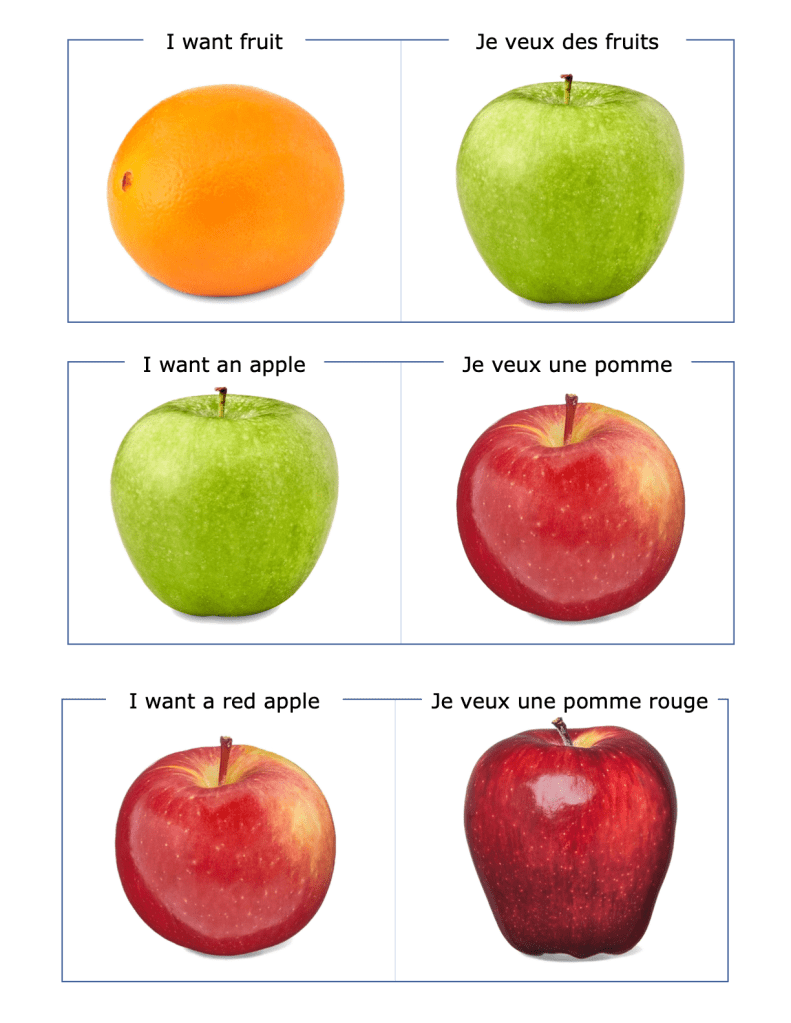
Two people can quickly navigate this possible dialogue—perhaps Adam and Eve. In response to Adam’s, ‘I want fruit’, Eve’s response result is already limited by the category of fruit. But Adam had something else in mind, so he tells Eve, ‘I want an apple’. He doesn’t want just any fruit, he’d like an apple. However, apples are subcategorised—among other attributes—by colour. Adam wants a red apple. Eve error-corrects, and she offers a Fuji apple or a Red Delicious. By now, Adam indicates that he wants that apple—a particular apple. In fact, he could have wanted that particular apple from the start—the one in the cupboard behind the tin of beans. In any case, it shouldn’t take many steps or iterations or exchanges to reach agreement. For her part, Eve opts for a pomegranate.
So far, so good. Where this all breaks down is for abstract concepts—the words I consider to be weasel words. Not only do these words have ambiguous meanings at one moment in time, but their meanings morph over time. This is particularly problematic when, for example, politicians often hide behind equivocation when they push for fairness, freedom, justice, truth or whatever other chimaerical words we’ve fabricated.
The problem is that unlike a physical apple that we can rather triangulate and interpolate into a position, abstract concepts offer no such vantage. The insufficiency of language prevents us from assessing the other’s nuanced perspective.
Perhaps the biggest problem is that of connotation. Connotation is not unique to abstract concepts. An apple can have symbolic and metaphoric meaning outside of its fruitness—semantic ambiguity. We’ve got the Big Apple, apples of one’s eye, the Biblical allegory, William Tell, Snow White, apple pies, les pommes de terres, et ainsi de suite. But this determination by context in the concrete is not available to the abstract.

Consider the perspectival image above. In the spatiotemporal world, one can illustrate the difference—as this does—, or one can change their point of view. This results in an ‘Aha! I see where you are coming from’ resolution. In the abstract world, on the other hand, is simply not possible.
A challenge for abstract concepts is that there is a recursion of connotations. So when one talks of justice, even if one can agree on which flavour of justice, one then needs to come to accord on equality and then on fairness. There’s simply too much to unpack. One might attempt to employ a philosophic approach and coin new terms, but ultimately—in order to facilitate communication—these terms much be defined by existing terms. And though this might succeed in getting us closer, any reader of Heidegger—or even Derrida—will demonstrate the inherent challenge. What happens, in the end, is that these authors are labelled as obtuse and difficult.
Just to sort of wrap it up without actually wrapping it up—but at least to put a finer point on it—, we likely are familiar with the freedom to versus freedom from debate. We’ve got perspectives of the inherent goodness or badness of humans. We’ve got sacred and secular perspectives. Since perspective colours interpretation and peoples’ perspectives are multifaceted, we can never—in my opinion—resolve these concepts, so we will continue to miscommunicate and adopt our own interpretations, forever disappointed of the outcome and left wondering why others just don’t understand these things the way we ourselves do.
EDIT: A problem with writing from a stream of consciousness and not an outline is that sometimes my mental model gets distracted and I forget to include an intended piece. Although minor, I want to include that even in the world of objects, things get classified and reclassified. For example, biological taxonomies are altered as new information becomes available. With the advent of better DNA knowledge, some entities have even changed species. The two examples that come top of mind are (1) that there are three species of what we call electric eels, and (2) some have petitioned chimpanzees to be considered as Homo troglodytes — troglodytes being cave-dwellers. Chimps and bonobos were considered to be the same species until about 1928.
Commencing around 2003, given advances in knowledge of genetics and genomic mapping some have argued that chimps are misclassified. Let’s rewind for a few moments. Orangutans, gorillas, and chimpanzees used to be considered to be part of a homogeneous family Pongidae, which is distinguished from the Hominidae family, where humans are classified. The genus subclassification of the so-called great apes is Pongo (orangutan), Gorilla (gorilla), and Pan (chimps). As every schoolchild is taught at some point, Humans are classified as the genus Homo—as in Homo sapiens or more precisely Homo sapiens sapiens.
It turns out, however, that chimpanzees are more closely related to humans than they are to other great apes. As recently as 2017, this is. an ongoing debate. One major detractor for inclusion is hubris. Humans want to feel they are more unique—more special. On the other hand, some have argued that we might be more conscientious of chimps if we felt they were genetically closer to us—more of an us than a them. Damn, dirty apes. For now, chimps officially remain Pan troglodytes rather than Homo troglodytes.
Keep in mind that science—at least taxonomies—are a matter of consensus opinion. In fact, there is an academy that governs taxonomical changes, so what is classified one way at time-X may be classified another way at time-Y. Moreover, taxonomic systems are a way of dimensionalising a domain. But the one chosen might not correctly segment its contents. In practice, this is where much of the gender debate comes it. For some, gender expression is seen as an extension of biological sex, which has been traditionally seen as binary with some exception for some 2-ish per cent for non-binary inclusion. For others, these are two entirely different maps. Even if they accept some fundamental binary sex definition, there is no reason to retain that same categorisation for socially constructed gender identity. Although this may seem complicated to some, it is still not as intractable as abstract concepts—though one might have a valid argument to consider gender as abstract expression.
Regarding different taxonomical systems, a commonly known problem is that biologically, tomatoes are fruits, botanically they are berries, but by nutritionists they are vegetables. Evidently, tomatoes are vegetables under US law—not surprisingly on commercial grounds. Don’t get me started on the Reagan administration to declare that tomato catsup was also a vegetable in an attempt to make school lunch programmes cheaper whilst maintaining US Department of Agriculture (USDA) nutrition guidelines for children.
A parting shot is a statement uttered by the sentient elephant man, who may have been misclassified.

* Right means in accord with my beliefs.
 Philosophics